Skip to main content
Woody music internship melds mentorship with classroom experience
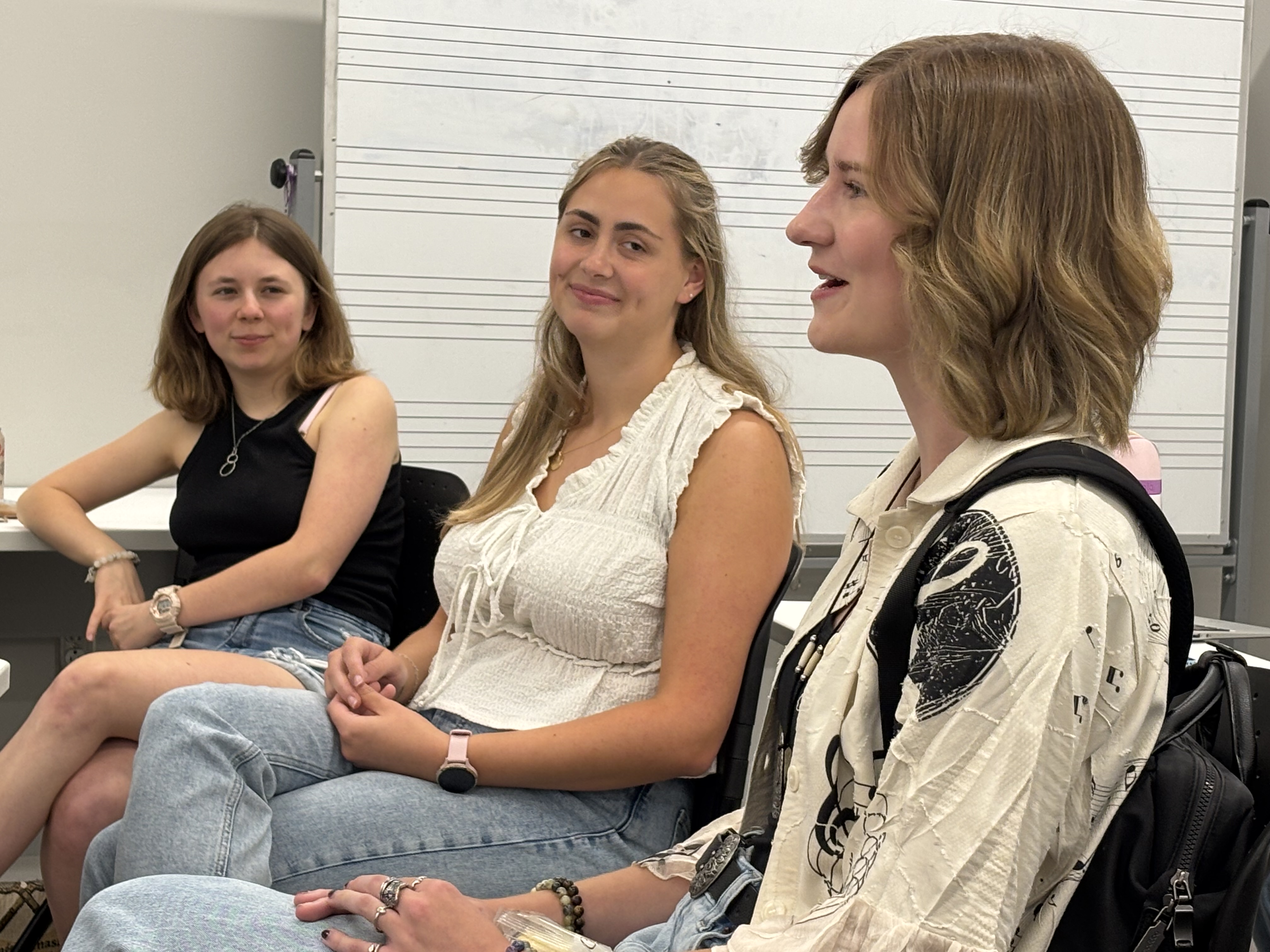 Through an innovative partnership between Williamsburg-James City County Public Schools and the Early Childhood Music School (ECMS), an unprecedented five William & Mary undergraduates will gain invaluable teaching experience during the 2026-27 academic year through Elliot’s Song, an outreach program that collaborates with Bright Beginnings and Head Start to bring free music education to local preschoolers.
Administered by the Charles Center for Undergraduate Research, the Woody Internship in Early Childhood Music Education uses music to teach key developmental skills, from fine and large motor skills to impulse control and focus skills.
ECMS Director Anthony Williams says he has been impressed to see how music is used to prepare young learners for school and for life.
“Whether it's impulse control with waiting their turn for some of the activities we're doing, or even just focused listening for some of the listening exercises,” he explains, “how music is getting used even at an early age for day-to-day life skills that will help these children their whole lives.”
Woody music interns are key to the program’s impact on the preschoolers’ lives. “To just have someone there for them, someone who is there to see them, you’re adding more people that show up for these kids in their life, and whether they fully understand it, I think they get that someone is there to help them. And that goes a long way,” says Williams.
The lessons instill a love for music and movement that transcends classrooms. Often, children carry songs and dances to the playground — like one little girl who sang the “walk-and-stop” song, a red-light-green-light type of lesson about impulse control, at recess and was joined by a group of her friends. “It was awesome to see that fun and enjoyment flowing over into other times,” said Williams.
The Woody Internship in Early Childhood Music Education was founded in 2019 after Dr. Carol Clayman Woody ‘71 and Mr. Robert Woody reached out to William & Mary and Professor Jamie Barlett in the Music Department to see how they could help. Williams and ECMS across the street was the perfect partner.
(The Woodys also sponsor a Charles Center museum internship program for 10 William & Mary students each summer, as well as an internship for students in the university’s Gender, Sexuality & Women’s Studies program—among the first of its kind.)
Students selected for the Woody Internship in Early Childhood Music Education receive training in the childhood music education curriculum Musikgarten, a $1000 stipend per semester to cover transportation fees, close mentorship by ECMS staff, and weekly opportunities to work in and eventually lead classrooms of preschoolers in music activities.
Tamara Carver, ECMS assistant director, serves as a mentor to interns and oversees implementation of the Elliot’s Song program.
“Being able to have the interns come and join, it’s definitely made the program, our whole outreach program, better,” Carver said. “We’re able to reach more children. I’m just so grateful to have the interns, and they have been really committed to trying their best.”
Interns have come from a variety of disciplines. Natasha Haines ‘27, a music and environmental advocacy double major will return in 2026-27 for her third year as a Woody music intern. Joining Haines in the largest ever intern cohort are psychology major Grace Harvey ‘27, prospective linguistics and music double major Jack Laird ‘29, psychology and music double major Emma Shellman ‘27, and music and English double major Rachel Tivenan ‘27.
Williams says the interdisciplinary backgrounds of W&M students is valuable in the classroom. “Students who pursue multiple disciplines provide a lot more perspective than those who are siloed and offer just one way to do things or one way to think about them.”
Williams spoke to the unique opportunity afforded by the internship, which requires students to prepare weekly presentations and draft education curriculum to lead their classes. “It’s just a whole different setting than what they do in a college classroom — probably what they’ve done their whole lives,” Williams said.
Two of last year’s interns — Haines and Caroline Pence ‘26 — reached the point where they taught their classes entirely by themselves, preparing their own lesson plans and leading the lessons. Carver provided constructive feedback and tips.
Carver says she enjoys how each intern develops their own teaching style and rapport with their students. Though all interns use the same curriculum, “We all have our own special way of bringing the curriculum to life, if you will,” she said.
Another intern in last year’s group, Sarah Schulte ‘26, started her music education career working with ECMS at a different program, teaching piano lessons to 6-year-olds at the United Methodist Church. She was impressed by ECMS’s curriculum and approach to childhood music education.
“The amount of music theory that these kids were getting at such a young age, while also just incorporating that in games and having fun was something that was really inspiring,” Schulte said.
Last spring Schulte worked with two-to-four year olds at nearby J. Blaine Blayton Elementary School and loved the experience.
Teaching preschoolers, instead of 6-year-olds, has changed some of her approaches. Whereas “older kids” are under their own pressure to do well, for two to three-year olds, “this is just another game. And so it’s very imaginative, very playful.”
“Everything from a three-year-old comes from a place of love,” Schulte noted. “They have no concept of hatred in their hearts. They’re literally just curious.”
“These kids wouldn’t get this kind of education in other ways,” Schulte said. “Often, arts are the first to be cut from a school’s programming. And we forget that there’s a whole other side of our brain that needs to develop, when it comes to creativity, when it comes to imagination. No matter what you do in life, you’re going to need those skills. So being able to instill those skills very, very young, and for them to have positive memories associated with music, is really, really rewarding.”
“People don’t realize how beneficial music is for kids — especially kids who are high risk,” said Caroline Pence, who was an intern two years in a row.
Working two years with many of the same students, Pence says she’s witnessed firsthand dramatic changes. Kids who start off not wanting to participate often end the year at the front of the class — confident, engaged, and singing loudly.
“Those social-emotional learning skills, music can really help with that,” says the sociology and music double major. “So it’s definitely supporting their growth, and supporting their confidence, and their overall capacity to learn and interact with others, which is really, really good.”
Pence says she’s learned a lot from having to lead her own classes. “Going into the classrooms by myself and teaching is teaching me a whole lot more about being adaptable and being able to adjust things as kids are struggling,” she said. “But it’s also kind of freeing to make my own lesson plans — I get to pick what I like, and I also get to assess, ‘what is this class really going to benefit from? Are they going to benefit from a song that’s going to help them with their fine motor skills? Or with rhythm?’”
Pence says she also learned a great deal from Carver’s mentorship. “It’s really great to have an expert telling us what we could be doing better, because how else are we going to learn? Being alone in the room teaching, there’s nobody there who can tell you what you’re doing well.”