Skip to main content
The art of neuroscience: Caroline Cha ‘26 takes Barr Prize in Public Speaking
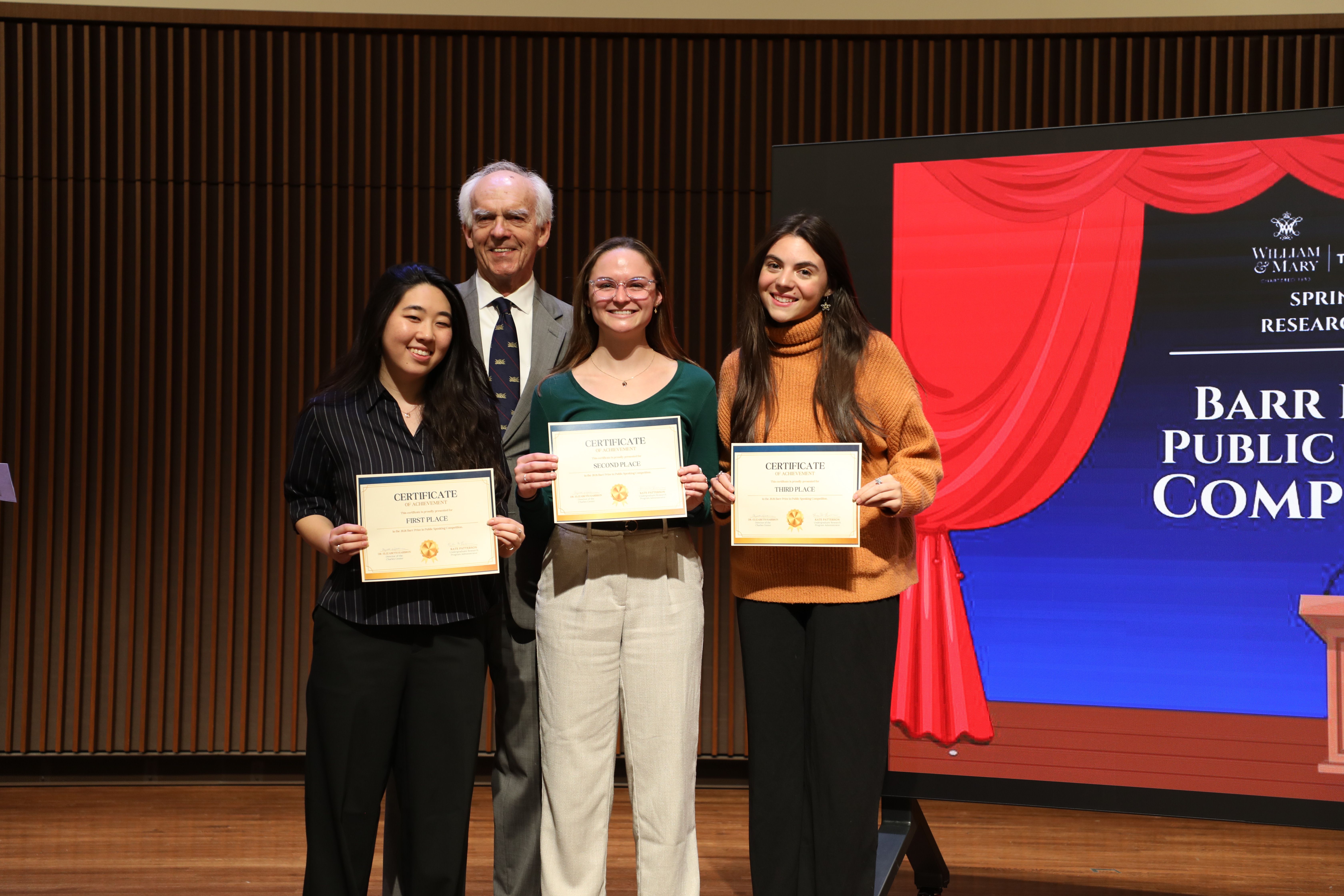 Art and neuroscience major Caroline Cha ‘26 secured the 2026 Barr Prize in Public Speaking April 3 with a pithy, compelling distillation of her honors thesis exploring how creativity works in the brain.
When we speak of combining arts and sciences, Cha said, people usually imagine visualizing scientific concepts through art. “I’m trying to do something a little bit more integrative,” she explained. “I think that the process of painting, or creating something, is something that we can explore scientifically.”
Cha’s honors research examined brainwave activity during the “creative process,” illuminating meanings and inner workings of creativity.
During the event, which took place during the Charles Center’s 2026 Spring Honors Research Symposium, five finalists competed for the $1,000 prize before an audience of 75 and a panel of faculty judges in William & Mary's Comey Recital Hall.
Cha garnered first place, while physics major Julia Rodrigues ‘26 was awarded the $500 second-place prize, and Hannah Ashburn ‘26, an international relations and French & Francophone studies major, took third place. They were among 23 honors students who elected to become Barr Fellows in Public Speaking last spring by taking a 1-credit course taught by Len Neighbors, associate professor of speech.
Stanley “Butch” Barr ‘62, a legal professional and instructor of speech at the university, provided the vision and support for the fellowship, administered through the Charles Center for Undergraduate Research. 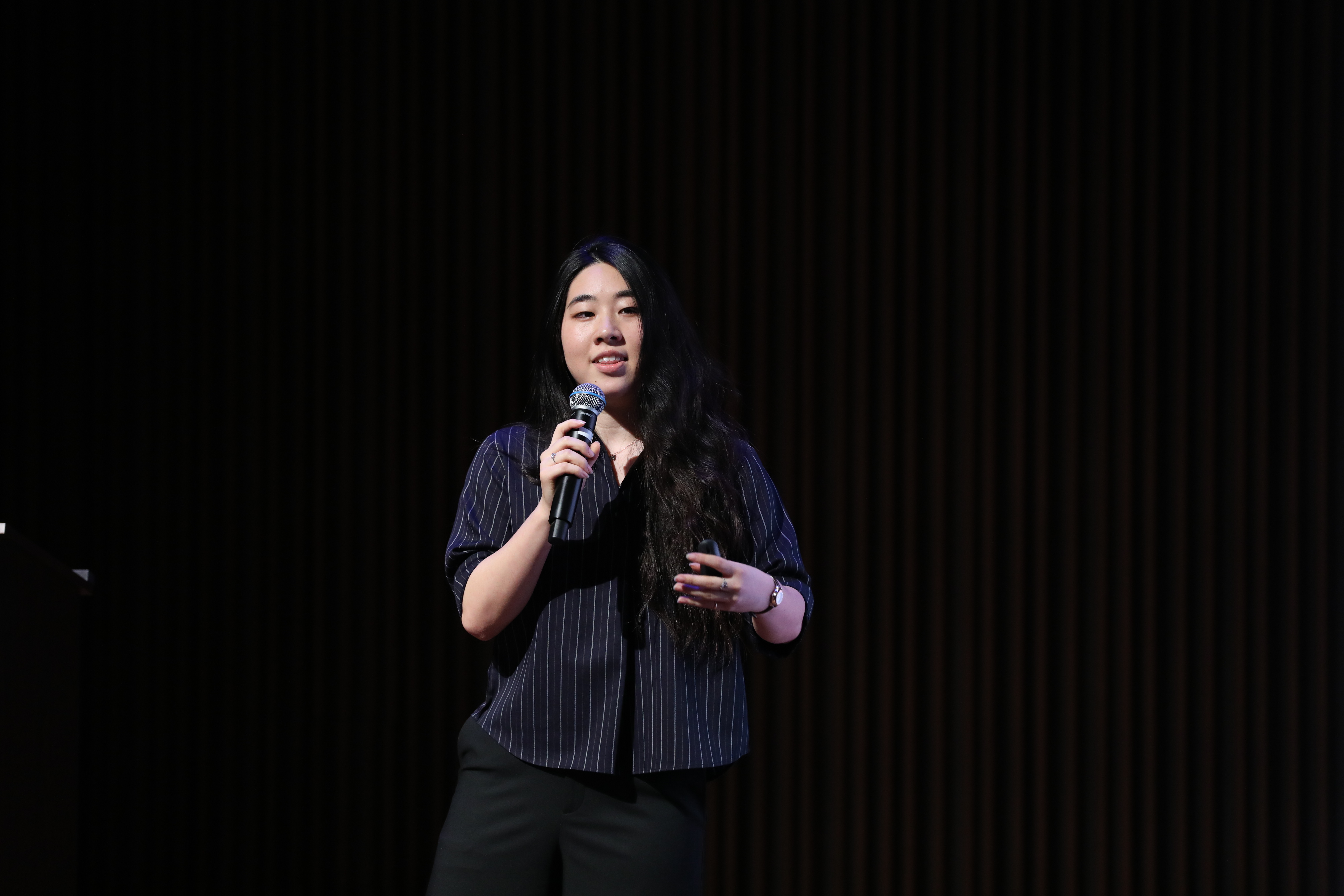 Cha explained that the basis of artistic creativity “is being able to take a bunch of symbolic components and being able to unify it into a whole.” She says she’s looking for the brain’s neurological basis for that process. “I’m looking at specific brain waves.”
The crossover of neuroscience and art is part of a larger trend, as the growing field of neuroaesthetics — the scientific study of the brain’s reactions to creating and contemplating art and aesthetic experience — is steadily finding its footing in the scientific community. The value of neuroaesthetics is often recognized in art therapy, or studies analyzing the cognitive benefits to engaging in art.
Cha says that’s just one application. Her investigation of the creative process was also philosophical and steeped in present-day concerns.
“I think at an age where A.I. is “creative,” and it can retrieve recombined information super fast, it kind of makes me wonder: ‘what’s unique about human creativity?’ What is it that makes us unique when it comes to art?” She doesn’t have the answers, but she says the creative process, “that fact that we need to revise, and elaborate, and edit so much when we’re creating,” as “the human aspect, in some ways.”
The newness of Cha’s field has meant forging this research from scratch. Even defining “the creative process” as a research parameter was difficult — “our definition is just too broad,” she says. 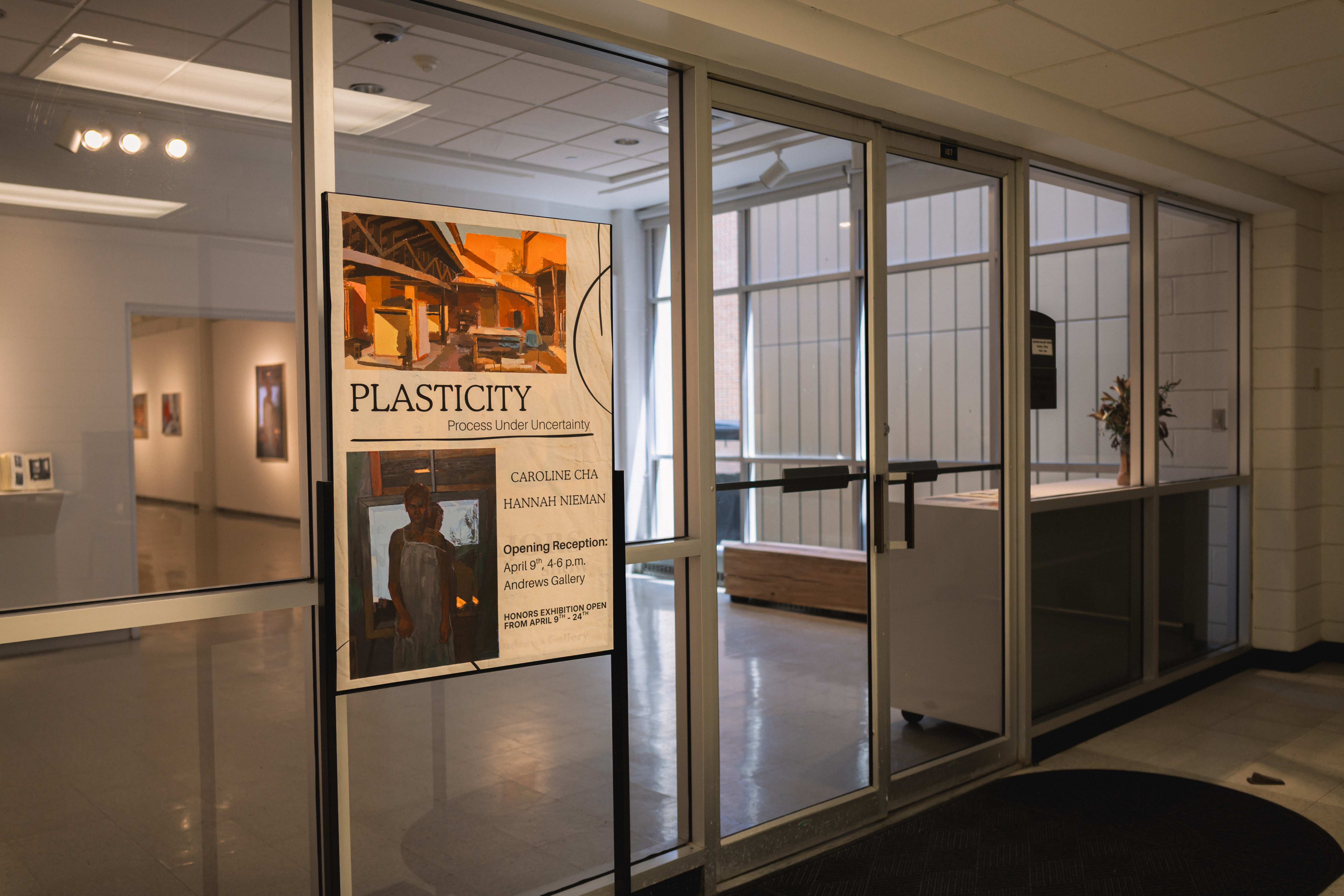 “I do feel like I'm sort of in uncharted territory in some ways,” Cha admitted. But, she added, it’s been exciting to work at the forefront of a field. “I think this whole experimental design has been a lot of original work, and I think that's been pretty exciting to do as an undergrad. And this experiment was completely my idea, which is also awesome. It's really cool.”
Innovation has also meant a steep learning curve, and some unique difficulties — including a late start to data collection and a completely new lab location after a portion of the Integrated Science Center flooded last September.
“I think it was definitely a challenge because I had never done neuroimaging before and I never really knew how to code before,” said Cha. “I didn't know how to troubleshoot this kind of technology. I think I learned a lot on how to be resilient and how to, you know, ask for help.”
In addition to her neuroscience research, Cha completed a senior art thesis — an exhibition of her work, alongside that of senior Hannah Neiman, in the Andrews Gallery. Her paintings in the exhibition interrogated how we perceive space. Her tilted perspectives, with lines careening at odd angles off the canvas, are actually accurate portrayals of how the human eye interprets a straight line when tracing the edge of a ceiling or wall.
Cha said that she was not trying to “depict science through art, or depict art through science,” but rather reflect on the “shared principles between the two.”
In fact, she maintains that her disciplines are not so different. Perception, for example, and gestalt, are large overlaps between the brain and art.
“The way the brain makes a visual perception is very similar to the way that an artist has to take the 3D world and make it into a painting,” says Cha. “We’re always lifting the world into a form that can be understood as a visual perception, or as a painting. There’s a sense of transduction.”
As to gestalt, Cha explains that in the creative process “there’s this idea that you’re orchestrating parts in order to unify something so that it’s greater than it was before.”
She says this reflects how the brain, composed of just parts — cells, and neurons — “somehow unifies and it’s orchestrated in a way that we have this sense of consciousness, and lived experience.”
Paintings are the same: “it’s just a bunch of colors, and splotches of marks, but somehow it unifies into this illusory space. So you see the parallels in the process,” she said.
The next steps for the graduating senior, include a research position at the National Institutes of Health (NIH), and someday, a Ph.D. in neuroscience.
At the NIH, Cha hopes to do more neuroimaging, studying strokes and developmental disorders. “And then I'll apply to PhD programs and keep doing this. I want to keep writing. I want to keep up my art practice as well. So, yeah, that's the dream.”