Skip to main content
W&M research teams wow General Assembly, spark dialogue
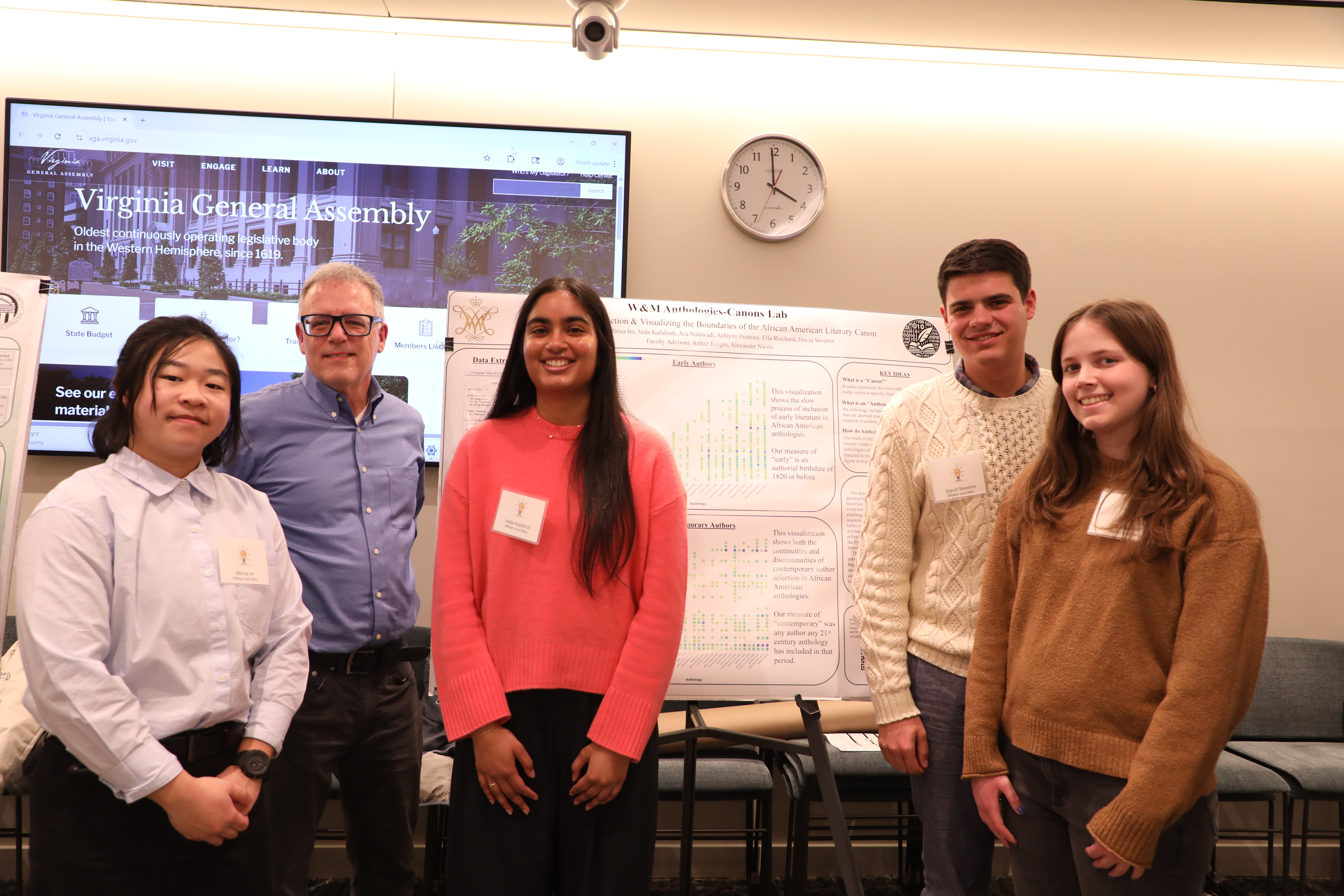 Six William & Mary undergraduates braved icy roads Jan. 29 to represent the university at the second annual Network for Undergraduate Research in Virginia (NURVa) showcase at the State Capitol in Richmond.
The students presented their projects to several dozen members of the General Assembly, scholars, and members of the public.
Mirina Im ’26, Veda Kalidindi ’26, Ella Rischard ’26, and David Severns ’28 worked within the Anthologies-Canons Lab overseen by mentor Arthur Knight, associate professor and chair of English, to bring data science into dialogue with the African American literary canon, assessing its construction and its impact.
Im, who majors in computer science with an art & art history minor, shared the ambitious goals of their project, which seeks “to compile and ultimately analyze a comprehensive database of works in American Anthologies throughout history – particularly with a focus on African American literature.”
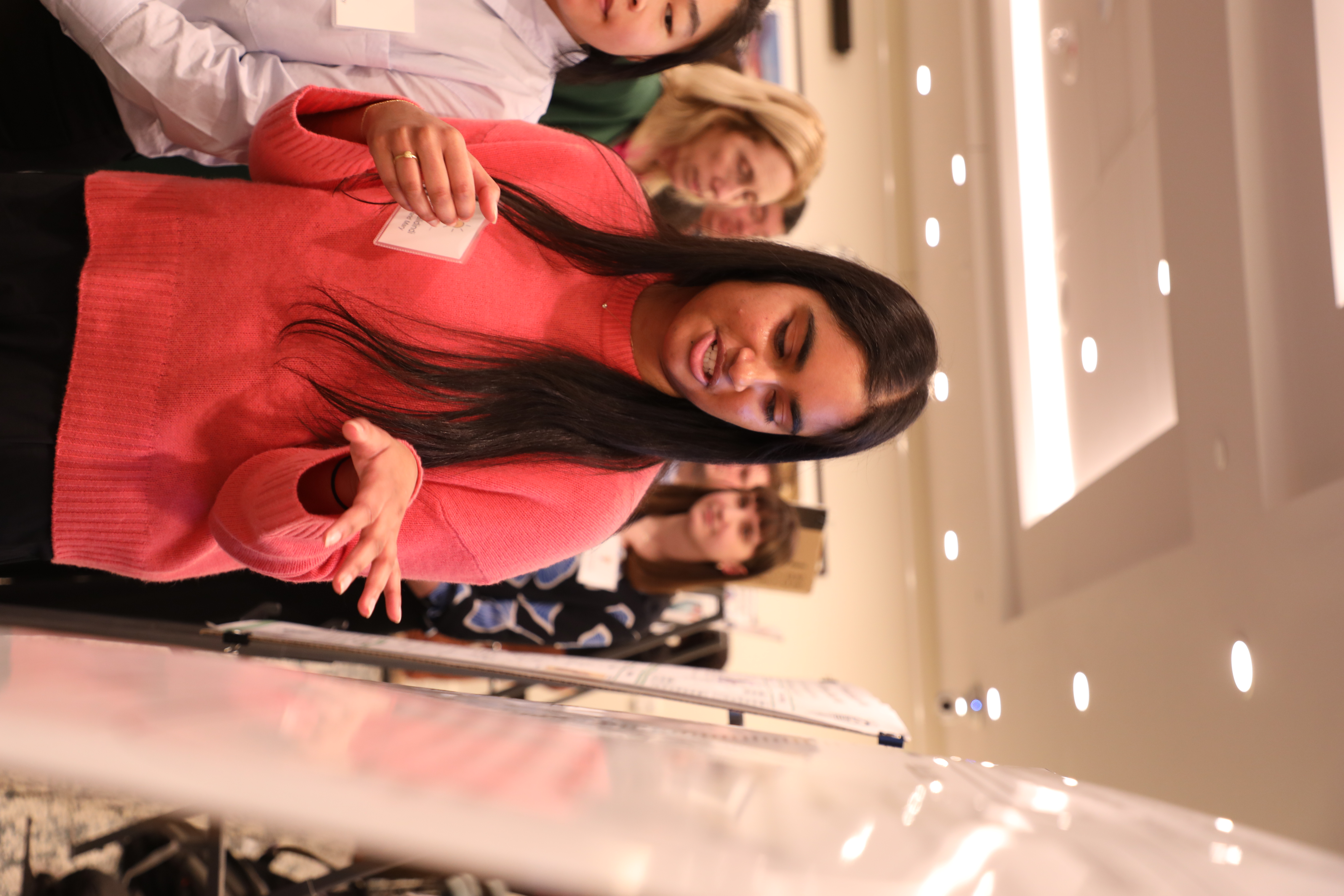 Personal passion may have brought David Severns ’28, an English and economics double major, to the lab, but his interest in universal questions sustains his research.
“I am – as anyone who’s studying English probably is – fascinated with the canon and who gets to create it,” Severns said. “You know, it determines so much of what kids are taught in schools and what we, as adults, read and what is recommended to us.”
Severns was drawn in by the project’s qualitative and quantitative approaches to identifying key patterns in the canon – signaling when and how authors have been suppressed, which have been disproportionately represented, and how anthologies interact across the literary world.
The team assessed African American literature by working from “the intersection of technology and the humanities,” Im said.
They are also experimenting with Python and AI in their analyses of large language models (LLMs), seeing where such approaches could fit into their methodological framework.
“How could we take a scan of a table of contents, and translate that into a database entry? We started our data entry processes around the time that AI was gaining traction, so it naturally became a part of the conversation of how we might expedite data entry, always with human oversight,” Im said.
She added, “We had to find ways to break down complicated steps into simpler steps, since the LLM seemed to respond much better to singular steps. There was a lot of experimentation with prompts, and with where in our process that we would involve AI.”
For this literary research team, the NURVa conference was an opportunity to highlight the interdisciplinary nature of their work. They enjoyed bringing their cross-discipline inquiries into the public conversation.
“It just brings me so much joy when something like computer science and data science, seemingly unrelated fields of study, are brought together to bolster something like English in our collective understanding of literature,” Severns said. “That’s not something that often lends understanding to literature, but when it does, it is so effective.”
Im agreed. “Ultimately, I hope attendees were coming away from our presentation with a greater appreciation for how AI and technology can support humanities research, as well as a deeper awareness of how literary canons are formed and understood,” she said.
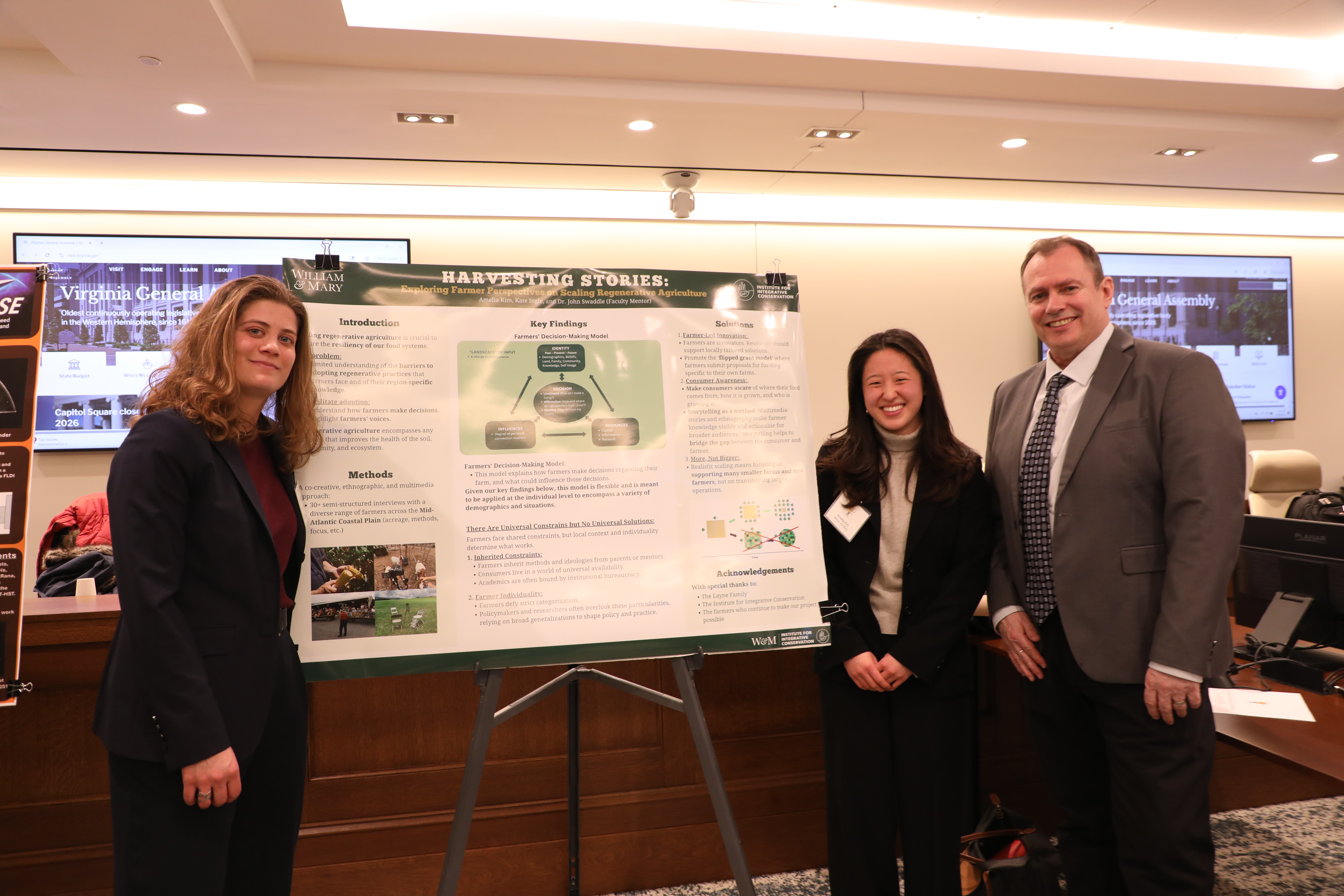 Kate Ingle ’27, an integrative conservation and anthropology double major, and Amelia Kim ’27, an integrative conservation and art history/built environment studies double major, comprised the second research team at the Capitol, further illuminating cross-discipline approaches to research methodology.
Under the guidance of John Swaddle, faculty director of the Institute for Integrative Conservation (IIC) and professor of biology, Ingle and Kim investigated scalable regenerative agriculture by adopting an “ethnographic take on the farmer’s side of these issues,” according to Ingle.
While their work attempts to tackle large questions, their research rests on the fundamentals of an honest conversation: sitting down with “all kinds of farmers – conventional, regenerative, big, small,” to ask them “what they think about the state of agriculture today, what their visions are, what they want to see happen on their farms,” Ingle said. “The conversations go wherever they want to guide them.”
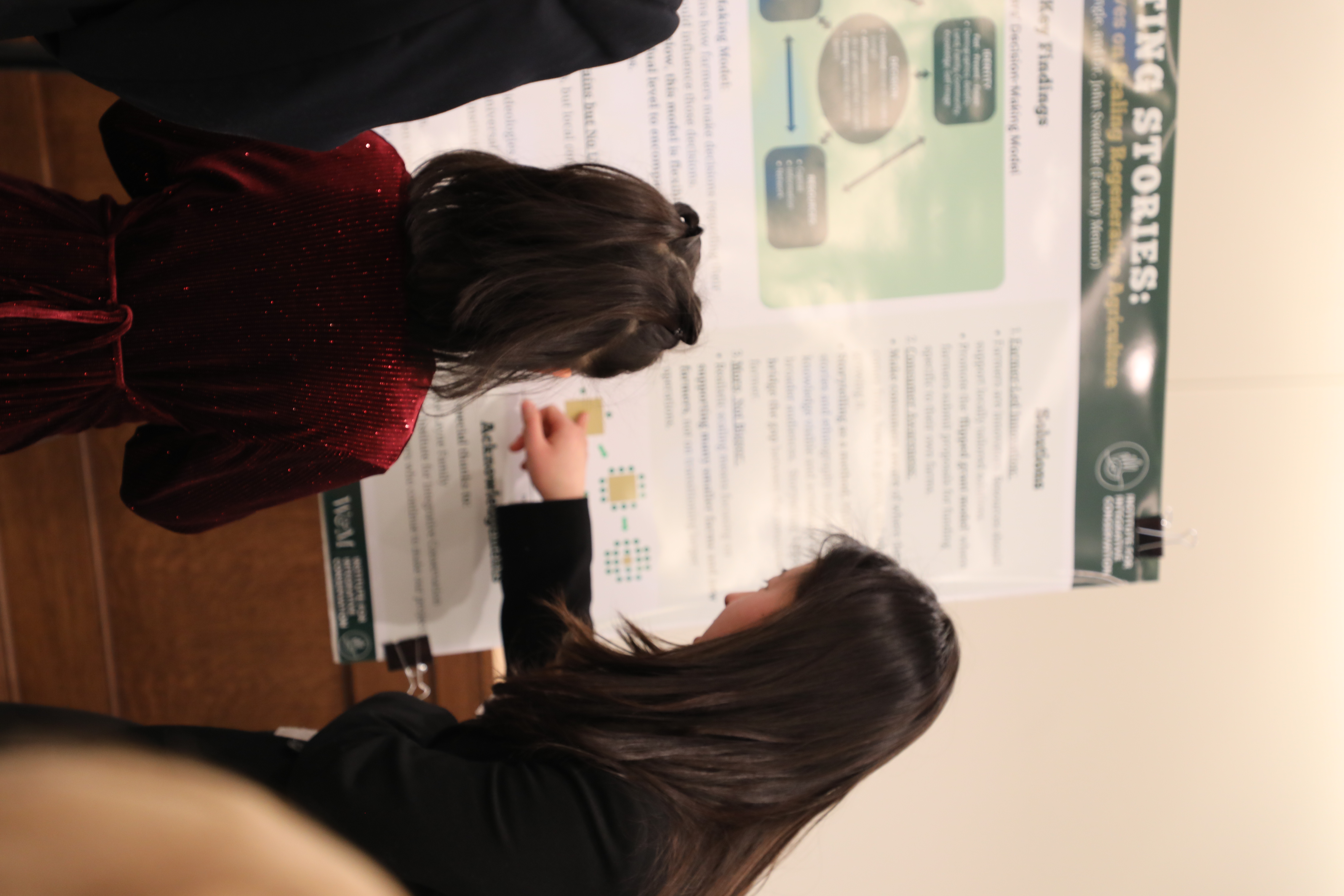 As part of the IIC’s Conservation Research Program, Kim and Ingle were excited to explore interdisciplinary approaches to conservation in agriculture.
By speaking with farmers across the mid-Atlantic coastal plain region, their project addressed the urgency of the issue.
“It’s not just the farmers,” Kim said. “But it is the communities living around them. It is the ecosystems around the land that they farm on, so agriculture really does impact everybody and the type of agriculture we’re doing now just isn’t sustainable. So, I think this work is really important for everyone, really.”
This farmer-centered approach has driven their project, allowing Ingle and Kim to propose a bottom-up solution modeled after the American Farmland Trust’s Flip Grant, where farmers can receive support based on their expertise on local landscapes.
Presenting to legislators, esteemed faculty from other universities, and even Lieutenant Governor Ghazala Hashmi, Ingle and Kim took the opportunity to “elevate the voices of the farmers,” and “connect their stories to decision makers, to consumers, to anybody in the top-down side of things,” Kim said.
“I was teaching our work to this six-year-old and then also to delegates representing Virginia,” Kim said. “So, it was really interesting and it was an awesome opportunity to be able to share our work with just whoever was coming by.”
Sharing their discoveries across generations and disciplines, the research team has cherished the opportunity to support “this group of people that feeds America,” Ingle said, as they join farmers in their efforts to expand the reach of regenerative agriculture and sow the fruits of the future.
This year's teams followed in the footsteps of W&M undergraduates who attended last year's inaugural NURVa showcase at the Virginia State Capitol.