Skip to main content
Sharpe Community Scholars program earns national recognition
 The National Residence Hall Honorary (NRHH) has recognized William & Mary’s Sharpe Community Scholars program as its “Organization (non-Greek) of the Month” for November and December of 2024.
In its award letter, the NRHH stated that “there is no group more deserving of recognition that has truly provided a level of opportunity and learning from collaborators who truly care about the ability to positively contribute to something greater than themselves.”
The honor recognizes “leaders on campus who go above and beyond in making this school a home for students,” according to the NRHH. In celebration, the William & Mary chapter of the NRHH hosted a dinner for the current cohort of Sharpe Scholars in their current campus home, Spotswood Hall.
Of Sharpe, a nominee shared with the Council: “[Sharpe] does a great job with connecting people to the community, [and] its students consistently engage in research and opportunities that seek to make the communities they serve a better place.”
For nearly 25 years, Sharpe has explored and innovated programming in its living-learning community, a best practice in higher education that continues to gain traction at campuses across the country.
Dr. Monica Griffin has directed the Sharpe Community Scholars program since 2004.
“For Sharpe Scholars, learning has never just happened within the classroom,” Griffin said. “As the program’s name suggests, Sharpe Scholars frequently find themselves outside of academic buildings and in the communities around them. But before they dispatch across Williamsburg and beyond, Sharpe Scholars must learn from one another in the most local of communities: their own residence hall.”
Living-learning is a practice which seeks to integrate academic teaching, learning and research exploration with residence-based programming. In a living-learning community like Sharpe, students live together in the same residence hall, take community- and research-focused courses, and participate in year-round programming together.
Sharpe’s mission is to “to support the development of select students through the integration of academic studies, research and community engagement.” Sharpe’s living-learning goals, practices, and programming thus align with this focus on community-based research and engagement.
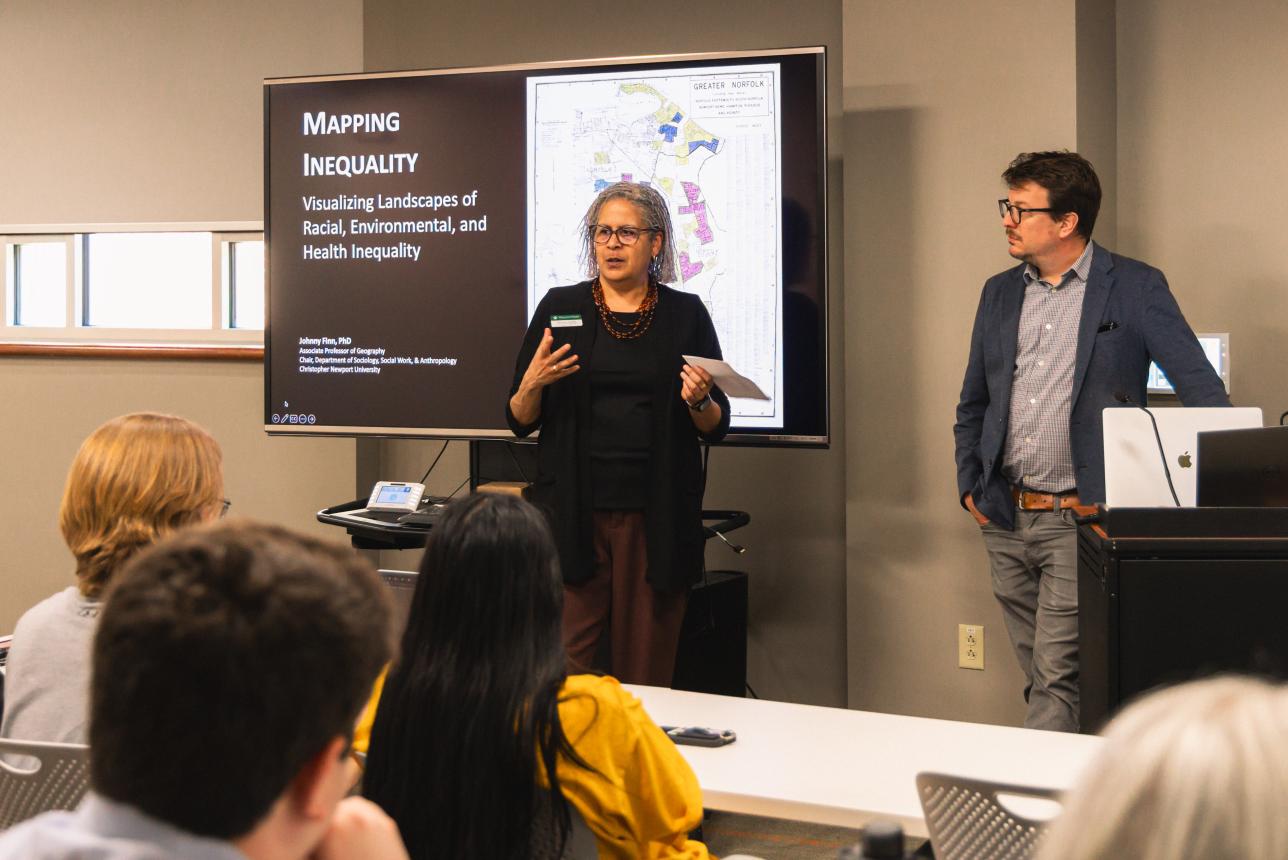
According to Griffin, the residence hall serves as a kind of “home base” for community experiences, as well as a site for Sharpe-affiliated professors to speak informally and directly to the program’s students.
The residence hall facilitates program-wide reading groups and film series coordinated by Sharpe staff. It also serves as a meeting place before and after community excursions to prepare for and reflect on their experiences.
Sharpe Fellows, who were once first-year Sharpe Scholars, serve as peer mentors and program leaders in the living-learning program. Fellows regularly meet with a small group of scholars to further explore classroom discussion, reflect on recent experiences, and mentor students through their first year in Sharpe and at William & Mary.
In Spotswood Hall, the longtime home for the Sharpe Scholars program, fellows coordinate their mentorship and programming in the Collaboratory, a shared, designated space for Sharpe Scholars that is a visual and spatial extension of the strong civic and community-centered identity evolving in each student, according to Griffin.
The Fall 2025 semester will mark Sharpe’s 25th anniversary and some big changes in the Sharpe Program. The most significant is the program’s relocation to Cedar Hall – a new residence hall specially designed with living-learning in mind (located at the corner of Jamestown Road and Landrum Drive between Lemon and Hardy halls).
“More than ever before, Sharpe will be able to integrate faculty, staff, students, and community partners into the student residential experience of learning, making community-based research and engagement opportunities all the more accessible on central campus, with meetings and classroom spaces in Cedar,” Griffin said.
Maxwell Tippl-Cloe, Sharpe’s program coordinator, said that “Sharpe’s capacity for bringing together faculty, students and community, inside and outside of the classroom, for the many purposes of learning and engaging research gets better with each year.”
When the lights of classrooms, labs, and programs have dimmed for the evening, Sharpe Scholars continue to craft their understandings of community with each other outside of the expectations of professors, grades, and major requirements.
Tipple-Cloe said, “Reflections on research projects and interests, meditations on identity and belonging, civil debates across the ideological spectrum, and formations of lifelong academic and personal relationships all occur among Sharpe Scholars in their first-year, campus home. This free-form, community-situated learning and peer-to-peer mentoring is at the heart of living-learning as an academic practice.”