Skip to main content

Journalism masterclass investigates AI and misinformation
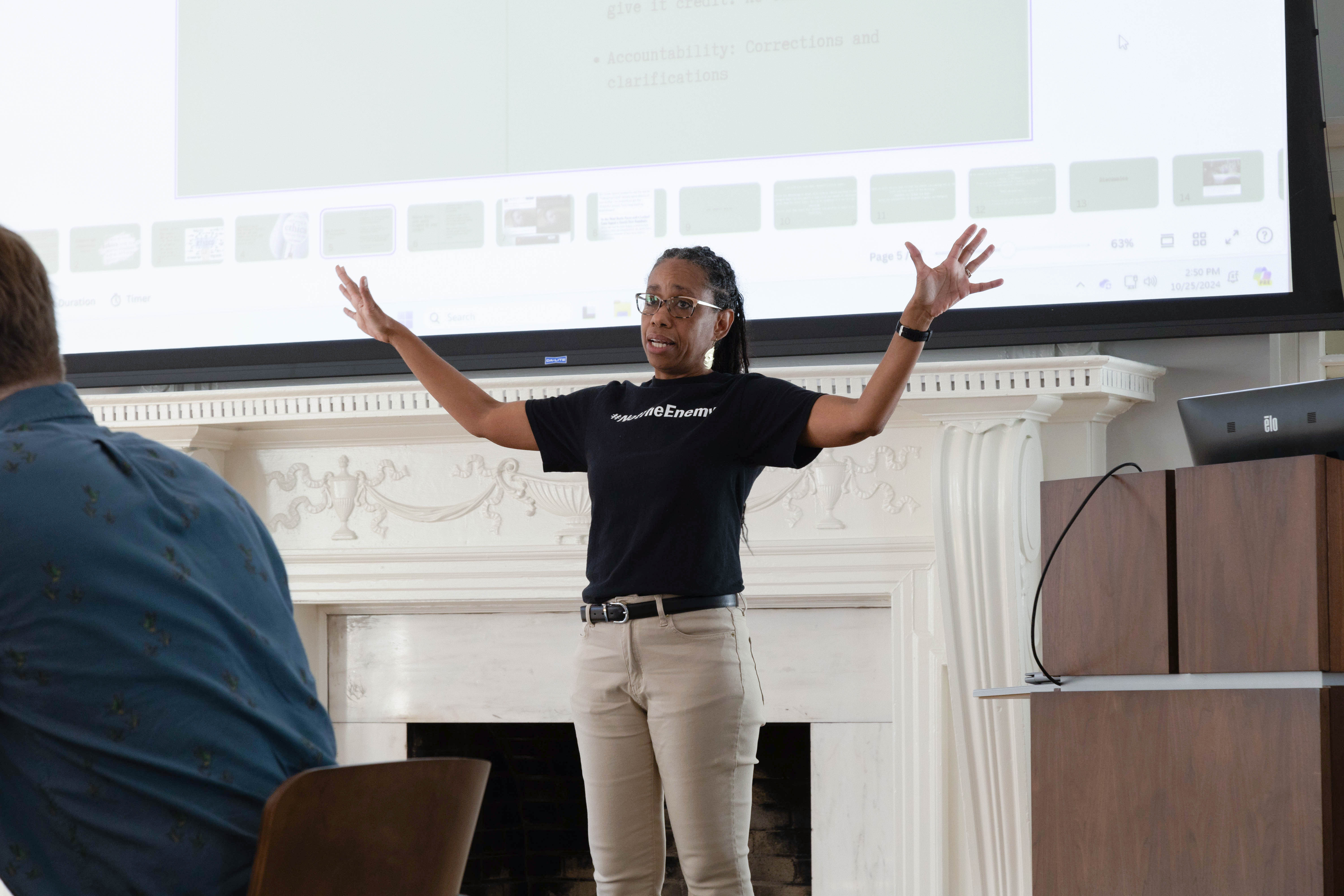 In a timely discussion following the recent presidential election, Denise Watson, features editor of The Virginian-Pilot and Daily Press newspapers, led a Nov. 15 journalism masterclass on artificial intelligence (AI) and media misinformation, the third session in a series of six workshops offered by the Charles Center this academic year.
Watson welcomed students to the warmly lit Grimsley Boardroom by emphasizing that she was among her peers.
“This is our newsroom.” Watson said. “We are journalists. While we're here, ask questions, be curious, be brave, because that's what journalists do.”
To Watson, this curiosity, and the ability to “call things out where we see it,” is crucial to a functioning democracy. Watson explained the impact of misinformation and disinformation, especially in the political landscape of today.
One of the essential skills Watson hopes to cultivate in journalists is media literacy, a topic that often addresses questions such as: why should we care? Why should we take this seriously?
Watson highlighted the results of a report from the Brookings Institute. “This is why we should care,” she said. “Polling data showed that false claims affected how people saw the candidates, their views on issues including the economy, immigration and crime, and the way the news media covered the campaign.”
As a journalist, this was a sign that the problem of false information in the news was going to grow worse, Watson illustrated. This meant, “that we need to be more cognizant of what to look for.”
Sharing the valuable lessons she learned in the field, Watson explained the use of the Washington Post’s fact checker’s “Pinocchio test” as an industry standard for flagging misinformation, pointing to real examples of news headlines to highlight the key patterns that revealed certain information was inaccurate or manipulated to appear a certain way.
Common red flags to look out for included the use of phrases like “the media won’t report this” and, “make this go viral,” Watson explained.
Watson mentioned that building media literacy skills is especially critical in an era oversaturated with false information and AI-generated images. The popular generative AI tools, such as ChatGPT, Google Gemini, and others, are not reliably factual tools, nor are they objective.
“These tools are subject to the biases of the people who program them,” Watson said. “They are going to pull in copyrighted, misleading or biased information, and we've already seen that.”
Projecting AI-generated images that had heavily circulated online, Watson demonstrated the use of AI to promote certain narratives about candidates, issues, and groups of people. Though not all AI is bad -- Watson explained instances where journalists found AI helpful in transcribing interviews -- it is important to learn how to separate what is true from what has been fabricated or AI-generated.
Key to building critical responses to AI and misinformation in the news is understanding how people respond. Watson asked the room, “why do people keep spreading it? If everyone knows, why is it still an issue?”
To find the answer to these questions, Watson challenged the students in the room to ask both themselves and others three key questions: In the last 6 months, have you come across any sort of mis/disinformation? How do you engage with it? Do you feel consumers have an obligation to discredit misinformation?
A rich discussion was born out of the responses to these questions, as Watson and students discussed the use of AI by figures in popular culture, the ethics of using AI in films and artwork, and the recent departure of The Guardian from X (formerly Twitter).
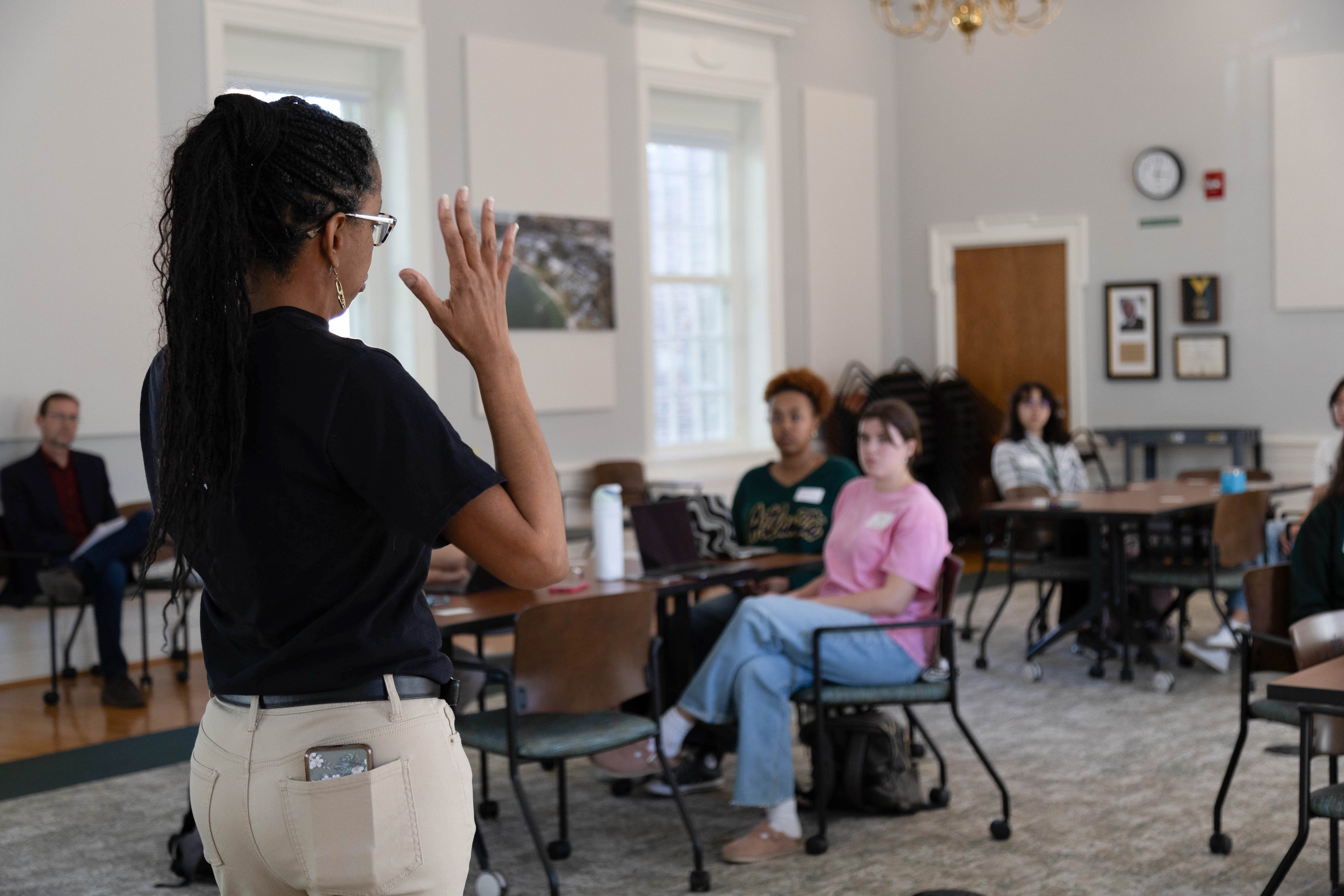
As Watson asked the students if news sources could ethically maintain accounts on online platforms where the use of AI and misinformation has distorted interaction with legitimate media sources. Dativa Eyembe ’26, a junior majoring in Africana studies, offered her thoughts. “Wherever the people are, the press needs to be,” Eyembe said.
Eyembe, one of the students who had the chance to ask passersby about their interactions with AI in media, said the group’s discussion and the chance to gather “perceptual data” from students outside was critical. It gave her the chance to see the perspectives of people she “wouldn’t have previously thought to ask about something that is emerging in a really strong way.”
Inspired to attend the masterclass series by a desire to contribute to the canon of African diasporic literature, Eyembe is excited to start her journey as a reporter by working on an oral history project for the William & Mary Scholars Undergraduate Research Experience (WMSURE).
Anja Keil, a PhD candidate studying American studies with a focus on migration and queer theory, expressed her appreciation for the exposure to interviewing and the rich discussions that the masterclasses gave her.
“It’s exposure that I needed,” Keil said. “It’s so easy to say, ‘I really want to become a journalist,’ ‘I want to work in journalism,’ but then you never have practical experience. So I really enjoy the workshops being so hands-on.”
Keil recalled the workshop’s discussion of the media’s reliability, saying it was these kinds of discussions that founded her aspirations for journalism.
“The reason for me to become a journalist is that I would like to take part in re-establishing trust in the media, because I feel like nowadays the public opinion is that you cannot trust the press, that you cannot trust the media,” Keil said. Mirroring Watson’s own sentiments, Keil emphasized the importance of journalism in present times.
“Journalists are the watchdogs of democracy, and they have to be transparent and reliable. They have to take accountability,” Keil said. “They have to report objectively.”
It’s not too late to sign up for the Charles Center journalism masterclass series, which continues this spring with “Writing for News” Jan. 31, “Tone and Style: Writing for a popular audience” Feb. 21, and “Visual Journalism” March 21--all to be held 2-4pm in Blow 201 (the Grimsley Board Room). Click here to learn more.