 Skip to main content

Sunken Garden
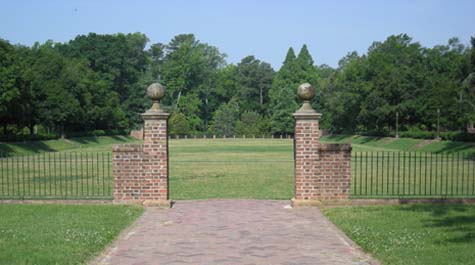
The Sunken Garden
View from Wren Building down the Sunken Garden toward Crim Dell.
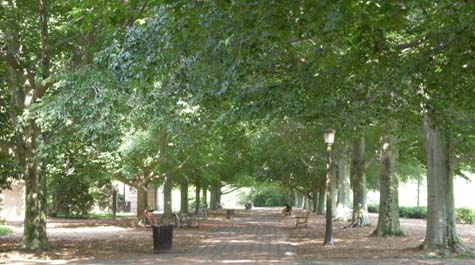
Fagus grandifolia
Rows of American Beech trees flank both sides of the Sunken Garden.
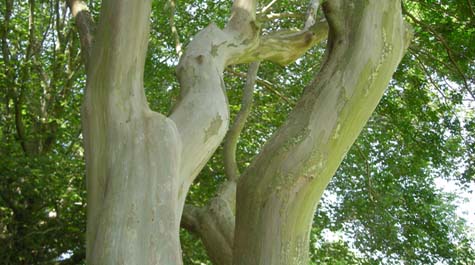
Lagerstroemia indica
An attractive feature of the Crape Myrtle is its mottled, peeling bark.

Buxus sempervirens
The sides of the Sunken Garden are lined with Common Boxwood.
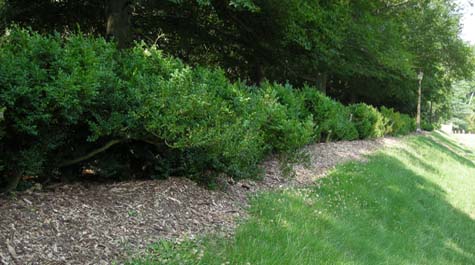
Buxus sempervirens
The Boxwood were pruned and refreshed in 2007.
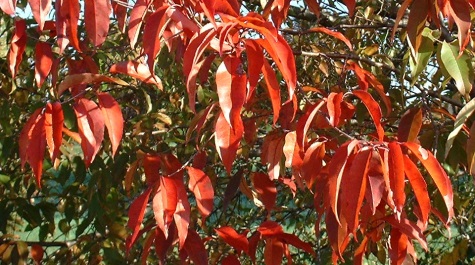
Nyssa sylvatica
Black gum at its peak fall splendor.
Steven J. Baskauf http://bioimages.vanderbilt.edu/
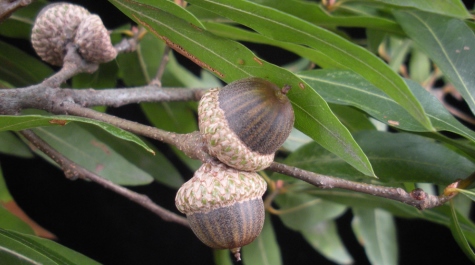
Quercus phellos
Willow oak leaves and acorns
Bruce K. Kirchoff http://www.uncg.edu/~kirchoff
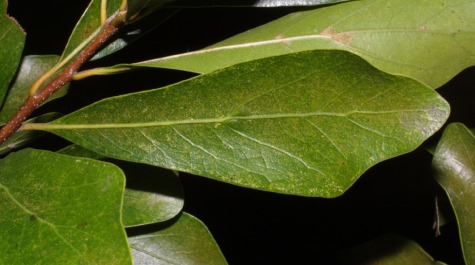
Quercus nigra
Note the shallow lobes on the water oak leaf apex compared to the lack of lobes on the willow oak leaf
Steven J. Baskauf http://bioimages.vanderbilt.edu/
Design and History
Extending west from the Wren Building, the Sunken Garden offers a peaceful space for relaxation and recreation. Its design draws inspiration from eighteenth-century English landscape gardens, guiding the eye toward Crim Dell to fulfill Thomas Jefferson’s vision that “the College shall forever look upon the country.”
- Origins: Initial design created in the early 1920s by College Architect Charles M. Robinson.
- Construction: Carried out between 1935 and 1936 by the Civilian Conservation Corps (CCC) under the supervision of landscape architect Charles Gillette.
Botanical Highlights
The Sunken Garden is home to several of the oldest and most notable trees on campus.
Key Specimens:
- Willow Oak (Quercus phellos): Located to the south of the Wren Building steps.
- Water Oak (Quercus nigra): Located to the north of the Wren Building steps.
- Black Gum (Nyssa sylvatica): Prize for its vibrant fall color and support of local wildlife.
Landscape Borders
The garden is framed by a harmonious selection of hedges and trees, including:
- Common boxwood (Buxus sempervirens) hedges.
- American beech (Fagus grandifolia).
- Crape myrtle (Lagerstroemia indica).