 Skip to main content

Integrated Science Center
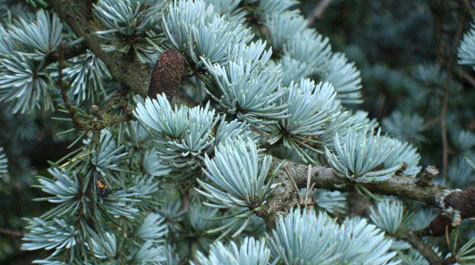
Cedrus atlantica glauca
Blue Atlantic Cedar.
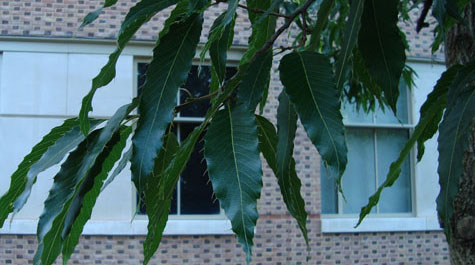
Quercus acutissima
Leaves of the Sawtooth Oak, which is native to eastern Asia.
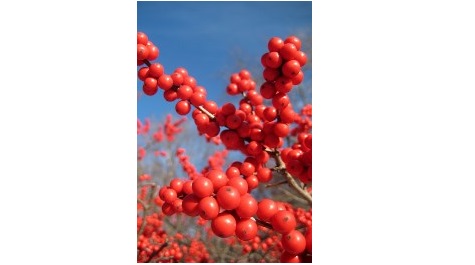
NYC - Bronx - New York Botanical Garden – Winterberries
by {{https://www.flickr.com/photos/wallyg/,Wally Gobetz}}, {{https://creativecommons.org/licenses/by-nc-nd/2.0/,(CC BY-NC-ND 2.0)}}
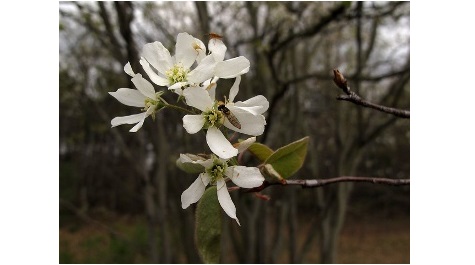
Downy Serviceberry
by {{https://www.flickr.com/photos/per_verdonk/,PerVerdonk}}, {{https://creativecommons.org/licenses/by-nc/2.0/,(CC BY-NC 2.0)}}
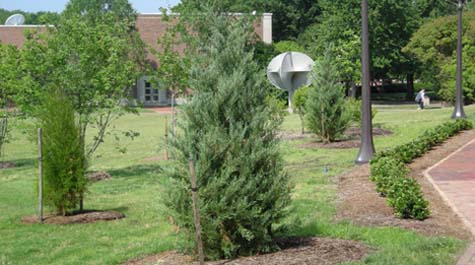
Integrated Science Center
New landscaping planted outside ISC2 (formerly Rogers Hall) after the renovation was completed in 2009. In the background is the sculpture "Oliver" by Robert M. Engman, who was Artist-in-Residence in 1979.
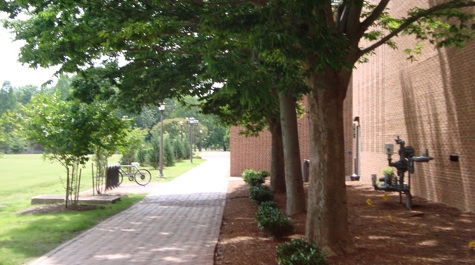
Zelkova serrata
Several mature Zelkova trees along ISC2, formerly Rogers Hall.
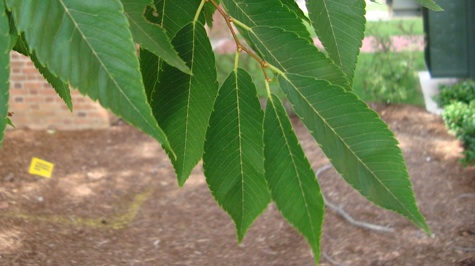
Zelkova serrata
Closeup showing the Zelkova's serrated leaves.
A Collaborative Environment
The Integrated Science Center (ISC) spans 162,000 GSF and houses the departments of biology, chemistry, psychology, and applied science. While much of the surrounding vegetation is newly planted to match the facility's modern design, several mature trees were preserved to maintain the landscape's character and continuity.
The Cedar Collection (South Side)
Approaching the building's south side from the west, you will find a diverse group of "cedars" against the west facade. Interestingly, "cedar" is a common name used for many scientifically unrelated trees:
- Japanese Cedar (Cryptomeria japonica)
- Blue Atlas Cedar (Cedrus atlantica)
- Deodar Cedar (Cedrus deodara)
- Sawtooth Oak (Quercus acutissima): A non-cedar specimen providing structural contrast.
Native Berries and Winter Interest
The ISC landscape prioritizes native species that support local wildlife:
- Downy Serviceberry (Amelanchier arborea): A native tree with early white blossoms and edible dark berries that attract birds.
- Winterberry Holly (Ilex verticillata): These native hollies lose their leaves in fall to reveal bright red berries.
- Note: Both male and female bushes are planted here to ensure successful fruit production.
Resilient Species and Modern Features
- Japanese Zelkova (Zelkova serrata): A mature member of the elm family prized for its resistance to Dutch elm disease.
- The Outdoor Classroom: Near Chandler Hall, look for the curved seating wall with an integrated chalkboard. This area is bordered by newly planted Bald Cypresses (Taxodium distichum), which are remarkably tolerant of the drier soils in this area.