 Skip to main content

Student Research in Kenya Explores How Maasai Communities Balance Livelihoods and Conservation
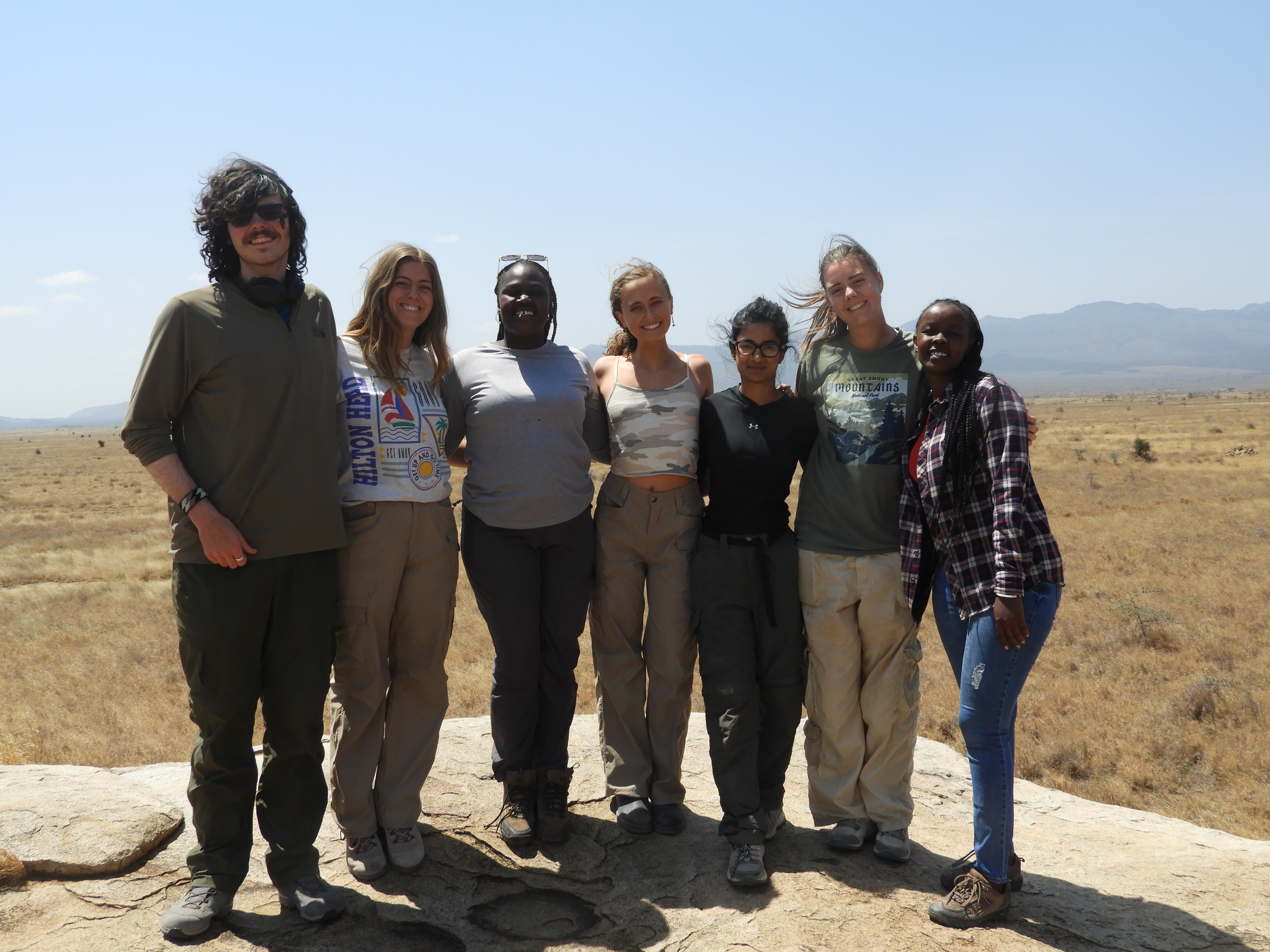 Research often takes students to unexpected places — into local communities, across districts, and sometimes around the world.
For a group of William & Mary students, their research led them to southern Kenya to explore one of today’s most pressing conservation challenges: balancing local livelihoods with the conservation of wildlife and ecosystems amid environmental change.
Supported by the Institute for Integrative Conservation (IIC), a team of students and faculty partnered with non-governmental organizations South Rift Association of Land Owners (SORALO) and Amboseli Ecosystem Trust (AET) to study best practices for integrating community livelihoods with conservation efforts.
Emma Hugo ’26, a biology major with an innovation and entrepreneurship minor, Skyler Hartgerink ’27, a history and environmental policy double major and Sharpe Community Scholar, and Sharanya Dutt ’28, a data science major, leapt at the chance last summer to gain research experience and become part of a global classroom.
Hugo’s participation was made possible by a Charles Center Summer Research Grant.
They spent six weeks in Kenya’s South Rift region, working closely with Maasai communities and collaborating with Kenyan researchers Ketito Killeen, Mercy Titeu Kimeshua, and Veronica Simaloi Ketente to ensure their research reflected the context and values of Maasai culture.
The Maasai, whose pastoralist livelihoods are deeply tied to the land and wildlife, offer important lessons on how local communities and conservation organizations can work together to sustain both human and ecological systems.
The year-long project aims to understand how sustainable livelihood initiatives are structured and how they support pastoralist communities, their livestock, and local wildlife in the face of frequent droughts, shifting rangeland patterns, and changes in land tenure.
The students focused on livelihood initiatives commonly supported by NGOs in Kenya, including beadwork, beekeeping, and grass seed banks. Hugo explained, “We examined what’s working, what’s not working, the challenges, the successes — then compared and contrasted across the landscapes.”
These activities are more than economic opportunities; they are strategies for conserving ecosystems while enhancing community well-being.
For partner organizations working closely with communities, supporting livelihoods is essential to successful conservation. As Jackson Mwato, Executive Director of Amboseli Ecosystem Trust, explained, “Almost 90% of conservation work is about people and not animals as one may expect. Therefore, if you want to address the challenges affecting wildlife you must involve people, and the intervention you are doing must, in one way or another, affect their lives positively. That is why AET supports community livelihood projects. The student project helps make recommendations to better implement livelihood programs in the future in a way that creates a more desirable impact for the environment and for people.”
Some key findings highlight that context matters — no single solution fits all communities. Effective projects involve communities in every step, from identification to implementation. Initiatives that connect to clear and consistent markets perform best, and those that directly contribute to environmental restoration balance livelihoods and conservation effectively.
Entrepreneurial thinking played an important role in helping students approach the complexity of the work. As William & Mary Assistant Provost for Entrepreneurship Graham Henshaw explains, “Entrepreneurial thinking is about approaching complex problems with curiosity, collaboration, and a willingness to adapt as you learn. Conservation work rarely follows a straight line, so that mindset helps teams move from ideas to practical, community-informed solutions.”
In addition to research, W&M students gained firsthand experience on a multicultural and interdisciplinary team, observing how conservation work is conducted on the ground. “We learned about conservation, built our skills as future leaders, and discovered more about ourselves through these experiences,” Hugo said.
Guidance from advisors, including Henshaw, IIC Director of Innovation and Entrepreneurship in Conservation Troy Wiipongwii, IIC Director of Research Erica Garroutte, and mentors at the partner organizations, helped the students navigate interviews and connect with local communities, Hartgerink said.
Reflecting on the collaboration among students, faculty, and partners in Kenya, Henshaw emphasized the value of shared learning. “The strongest outcomes come when students, faculty, and community partners are learning together,” he said. “Entrepreneurial thinking helps create that shared problem-solving environment, where research supports real-world decision-making and communities remain at the center.”
The students also had the opportunity to work closely with AET and SORALO, learning from their expertise on how to incorporate community livelihoods into conservation initiatives. At the same time, the Maasai communities provided invaluable guidance, sharing local knowledge, cultural insights, and practical perspectives on sustaining both people and ecosystems. Together, these experiences highlighted the importance of bridging disciplines, sectors, and communities to inform innovative and effective conservation solutions.
The students gained valuable experience in the conservation field. Hartgerink reflected on adapting to the dynamic rhythm of field research: “There it is very much, go where the day takes you. We didn’t know in advance what our interviews would be; sometimes we’d find out in the morning and have to shift plans. We learned to take advantage of every opportunity and just go with the flow.”
By the end of the trip, the students formed strong bonds not just with Kenyan partners but with the broader communities.
Hugo shared, “We had such a special connection with everyone we met. They were always there to support us — teaching us so much. We shared meals, cooked together, and watched the stars at night.”
Hartgerink emphasized a central lesson from the experience: the success of conservation initiatives depends not only on environmental goals but also on understanding and supporting the communities that live alongside nature. “We met so many amazing people. Their insights, culture, and daily realities showed us how crucial it is to balance human livelihoods with conservation,” she said.
For Henshaw, the impact of the experience reaches far beyond the fieldwork itself. “What’s powerful about this project is that the learning extends well beyond one place,” he said. “Students are developing skills in listening, adapting, and working across disciplines — capabilities that translate to conservation and community challenges anywhere in the world.”
This research was done last year as part of the IIC's year-long Conservation Research Program that matches William & Mary students and faculty with external partners to complete applied research needed to solve pressing environmental challenges. A new team of William & Mary students in the 2026 Program is prepared to start their work this summer all over the world, including two teams of students returning to Kenya to continue collaborative research.