 Skip to main content
American Studies Ph.D. student receives prestigious fellowship for art history research
Exploring the U.S. oil industry‘s entanglement with landscape art, American Studies Ph.D. candidate Morgan Brittain’s research is inspired by his upbringing in Iowa.
“The dissertation is informed by my lived experience. Iowa is an incredibly transformed landscape because of its heavy adaptation for agricultural purposes and is exceptionally petrochemically intensive also because of its use in agriculture,” Brittain said.
Brittain was recently awarded the 2026 Henry Luce Foundation and the American Council of Learned Societies (ACLS) Dissertation Fellowship in American Art. The program issues a $43,500 grant, which provides for a year of writing and research-based travel. This prestigious award is only granted to seven scholars for their doctoral research on visual art in the U.S.
“The grant provides for my living expenses for the year, but it also comes with a research fund, and that's going to allow me to visit archives that I might not have been able to otherwise and through those experiences, enrich the dissertation even more,” Brittain said.
Brittain’s work explores how landscape art has been shaped through three pivotal moments in U.S. oil industry history: the discovery of oil for commercial purposes in 1859, the first trans-regional pipeline in 1943, and the No Dakota Access Pipeline movement of 2016. Brittain’s research asserts that artwork around these landmark moments provide a unique lens through which to understand ongoing environmental issues associated with oil production.
As Brittain finished coursework and began dissertation research, his focus turned to the visuality of pipelines. Just 50 feet outside his apartment window in Williamsburg hidden beneath the surface of a manicured lawn, there was a petroleum products pipeline. “Between this and my time in Iowa, I was really thinking about these structures and where else oil industry violences might be lurking.”
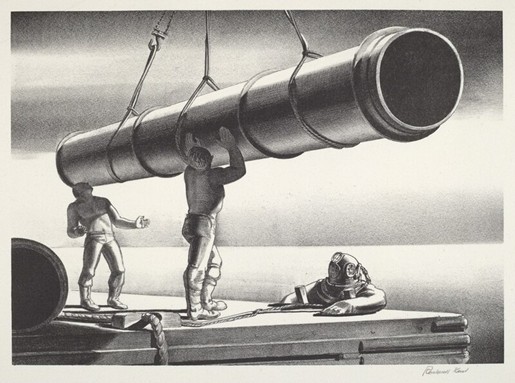
In his second chapter, Brittain focuses on the construction of the Inch pipelines, their reliance on land dispossession, and their effect on the American energy landscape. He hopes to examine this through a series of prints that depict the pipelines’ construction by artist Rockwell Kent. “I'm planning this summer to visit his home and studio in Maine just to get more of a sense of his process and think more about those prints in particular,” he said.
Alan Braddock, Ralph H. Wark professor of art history, environment & sustainability and American studies, serves as Brittain’s dissertation advisor. Braddock has published works of his own focused similarly on art and the environment, such as his 2018 book “Nature's Nation: American Art and Environment.”
“As a recipient of such a high-profile award, which is conferred by a national committee of leading senior scholars, Morgan will stand out among his peers in the field as someone already recognized as very promising,” Braddock said. “I am incredibly proud of Morgan for having won this award and cannot imagine anyone more deserving.”
This intersection of environment and art holds importance to Brittain as he looks to the future. Though he was already thinking about environmental issues and their relationship to visual art, Brittain hopes to find a way to approach this within his community.
“I wanted to think about this in order to bring about a greater awareness, not only in my circle, but in a broader audience, about how these systems really operate and how widespread and pervasive they are, and how art, too, is so much more than the surface we see.”