 Skip to main content
Etruscan Archaeology Students Explore Podcasting
Students in CLCV 349 “Etruscan Archaeology” are doing something new this year: producing podcasts. We sat down with Professor Swetnam-Burland and one of our majors, Riley Kozal (’28), to talk about the project – how and why Prof SB designed it, and what it is like to do a project like this as a student. We are including one of the student produced podcasts, and we hope you enjoy listening to it!
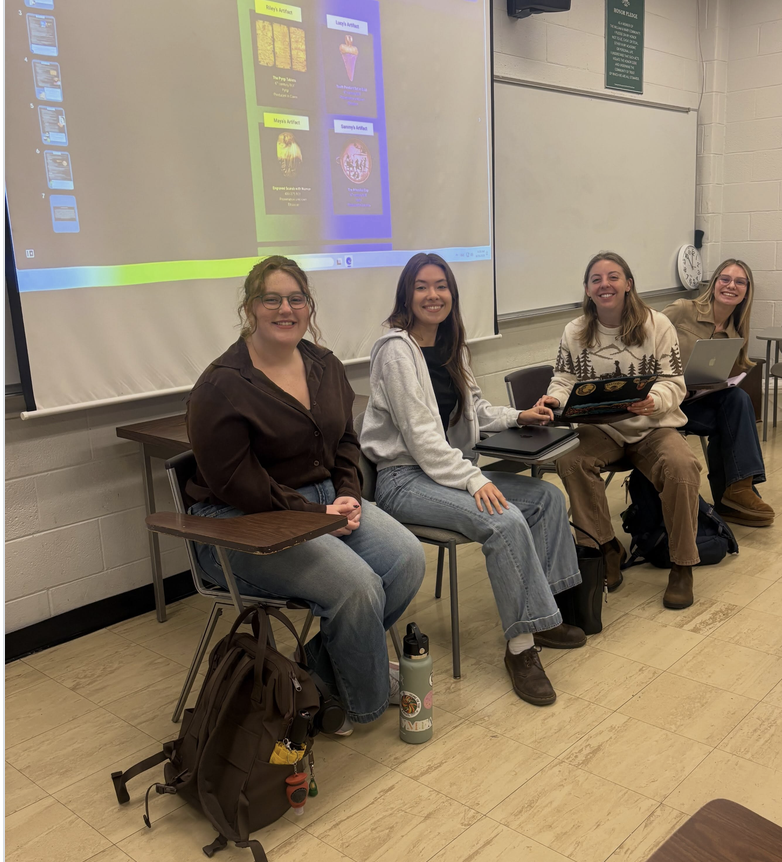
The students in this group were Maya Parfitt (’27), Riley Kozal (’28), Lucy Mehre (’28), and Sammy Scurry (’29). As you will hear, they are talking about the period in Etruscan history, c. 700 – 600 BCE, when settlements grew to become cities. These cities benefited from trade and interaction with many different peoples – Greeks, Phoenicians – living in the ancient world. Maya, Riley, Lucy, and Sammy test the theory of city formation espoused by the famous anthropologist V. Gordon Childe (1892-1957) and ultimately suggest that while his theories are useful, they could use some updating. Each team member selected an interesting object that they used to test the theory: a pendant made from a shark-tooth with an elaborate gold setting, the famous gold-foil tablets from Pyrgi, a scarab beetle carved from agate, which took an Egyptia-looking form but which included a scene drawn from Greek myth, and a Greek kylix or drinking cup, which was found in the Etruscan city of Vulci. We invite you to look at these objects while you listen to what they have to say!
Can you tell us a little bit about this project from the point of view of an instructor? Why podcasting?
Professor SB: “I think we all know that the specter of AI is everywhere these days. In my opinion, producing non-traditional written work like podcasts is a great way to incentivize students not to use AI, and to think for themselves. So the goal was to provide a structure that offered a lot of scope for creativity, and in which students worked together to create a product that would be both fun to make but also useful to the rest of the class when they were preparing for exams.”
Have you ever made a podcast yourself? How hard is it to make a podcast?
Professor SB: “I have experimented with podcasting, and attended the Digital Humanities Seminar held annual at the Universite de Montreal in 2025 – I got to be a student, and learned about the technical side, and how podcasts are produced. We also produced some for the Liber Memorialis Project. So much more goes into producing a podcast than you might thing. Even one that feels pretty ‘flowy’, like the one we’re sharing online about urbanism in the Etruscan period, requires a great deal of research and planning. And, a lot of work goes into the production, too. You have to edit out so many breathing noises or times when you pause and say “um….”, and of course if you want to add sounds, that also requires some editing.
What is your favorite part of the “urbanism” podcast that we’re sharing here?
First of all, I could tell how much fun the students in this group had with their project. When they are talking to each other, they sound like old friends. But also, each team member brought their A game. There is so much creativity here, and each student was so excited to share an object that they’d been working on with the team and with the class as a whole. Also, I thought it was really very funny! They did a fantastic job using sound effects to keep it interesting for the listener.
Riley, can you tell us a bit about yourself? What are your academic interests, and why did you decide to take this class?
I am a junior Classics major with a Concentration in Ancient Mediterranean Archaeology with a Religious Studies minor. I wanted to take this class for three main reasons. First, the course fulfills one of my elective requirements to graduate. Second, I took Roman Art and Archaeology with Professor Swetnam-Burland my freshman year; I found the Etruscans fascinating and wanted to learn more about the. Third, courses on the Etruscans are uncommon at most universities, so I wanted to take advantage of this unique learning opportunity. My academic interests tend to lean towards the overlooked cultures and civilizations in the Classical sphere, and how those cultures interact with some of the more famous players. I particularly love religious interactions between cultures.
What was your experience with making a podcast as a class project? Do you think you learned from it different than, for example, writing a short paper?
I feel the format of a podcast is better suited to the broad types of questions asked for this project. Especially when dealing with a topic as expansive as "urbanism", the podcast gives us a certain amount of freedom to explore our interests. Instead of trying to funnel it through a specific lens in short paper, we each got to bring something to the table and synthesize it together. The structure also required us to make the topics more accessible to a broader audience who may not be familiar with the Etruscans, which was a welcome change from the academic language I’m used to writing in. It was a challenge but one that was worth exploring. While I don’t believe academic papers should be phased out in favor of podcasts, it was a breath of fresh air. I got to use a little more creativity than what I am used to and make something that I am proud of with a fantastic group of my fellow students.