 Skip to main content

Operations research program prepares students to solve real-world challenges
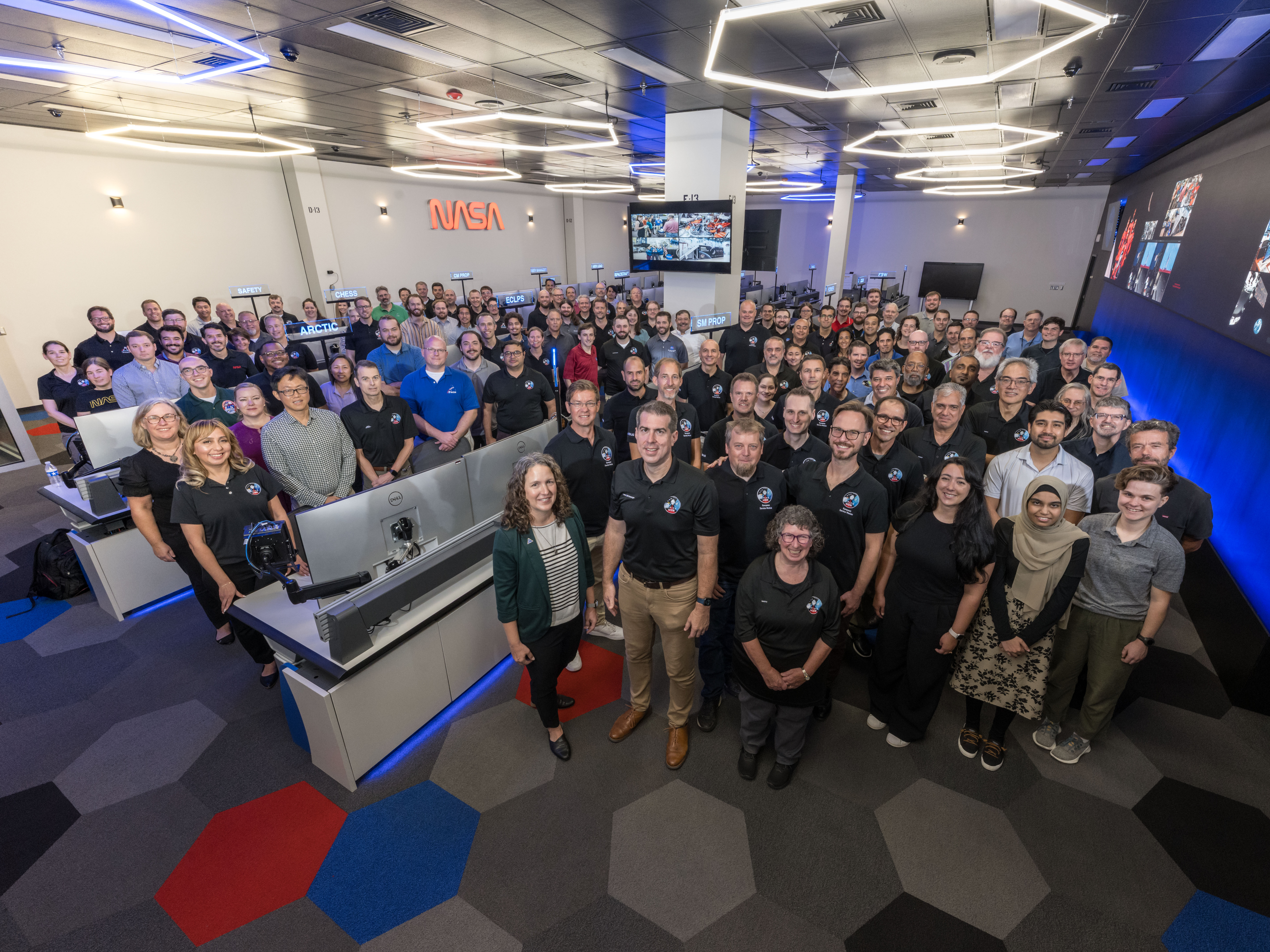
“When they say ‘Houston, we have a problem’ in movies, they are hailing Mission Control. However, when Mission Control has problems, they contact us,” said Elisa Leal Acevedo ‘25, an engineer in NASA’s Mission Evaluation Room (MER) during the Artemis II mission.
The MER monitors all data coming in from the Orion spacecraft, searching for anomalies. Acevedo, who graduated from William & Mary with a master's degree in computational operations research, utilized her operations skills to assist the Artemis II mission earlier this year.
The Computational and Applied Mathematics master’s degree with a Concentration in Operations Research (CAM-COR) is an updated name for a long-standing program at W&M. The new program, which took effect in August 2026, is also offered as a Bachelor’s-to-Master’s Accelerated Pathway (BMAP) for W&M undergraduates.
The core of the program consists of courses in operations research, mathematical modeling for random processes, probability and optimization. These theories are correlated to real-world business and safety challenges, such as optimal traffic light timing and customer queuing.
The program is led by seven distinguished professors, who come from a range of backgrounds that inform their respective classes and research, helping students connect mathematical modeling with real-world decision-making.
Graduates apply their degree in an array of fields. Recent CAM-COR graduate Acevedo worked six shifts in NASA’s MER in Houston for the Artemis II mission this past year. In her role as a subject matter expert on the Flight Software Console team, Acevedo monitored Orion’s Environmental Control and Life Support Subsystem’s software, making sure it was operating as expected in real time.
“My COR degree helped me apply the decision-making skills I developed in the program when encountering anomalies in the MER,” Acevedo said. These skills allowed her to quickly assess courses of action, analyze probability of recurrence and perform risk analysis. She also optimized limited spacecraft resources such as bandwidth allocations, considering operational constraints at the same time.
“Post-mission, I am now exploring software reliability methods that can be applied to the flight software on future missions,” she said.
While Acevedo’s work focuses on the depths of space, a current student is specializing in defense research. Anne Kredell ‘26 first took CAM-COR classes as an undergraduate at W&M and is now a master's student in the program. She applied her studies this past summer as an intern for the Naval Information Warfare Center in San Diego, where she focused on radio frequency machine learning.
Though this was a new area for Kredell, she was able to adapt and tackle the project. “My COR coursework prepared me to approach this challenge, and my mathematical skills allowed me to suceed,” Kredell said. “The technical skills and critical-thinking abilities I developed in those classes were integral to my success this past summer.”
Faculty in the program put the versatility of a CAM-COR degree on display through their diverse professional and research experiences, showcasing the breadth of opportunities the degree can support. For example, adjunct professor Dave Williams is a former chief operating officer of the U.S. Postal Service, while Rex Kincaid, Chancellor Professor of Mathematics, is conducting research in the marine science world. Kincaid is developing optimization models to determine the best locations to build new oyster reefs in the Chesapeake Bay.
Even closer to campus than the Chesapeake Bay, Larry Leemis, a professor for the COR program since 1993, conducts research for Colonial Williamsburg. In the 1990s, he worked to determine the optimal number of weekly tourist guides to print. Three decades later, Leemis is researching new topics for the Colonial Williamsburg Foundation, such as optimizing maintenance routines for equipment.
These professors, through studying a range of applications of operations research, utilize their experience to encourage students to find the next problem that can be solved with mathematical modeling.
After a fruitful internship, Kredell is eager to continue working in operations research, specifically within the defense sector, post-graduation. “This degree prepares me for a wide array of careers," she said. “Beyond the specific technical tools I am learning, the program is teaching me how to approach varying problems systemically and how to communicate my findings clearly.”
From Chesapeake Bay oyster health to NASA lunar missions, the CAM-COR master's degree program continues its legacy of instilling real-world problem-solving skills, preparing students to optimize systems across industries.
Applications for spring admission to the program are open until Oct. 15.