 Skip to main content

New equipment, new possibilities: Vlahakis transforms student learning through the Music Studio Technology Fund
Engineering and the arts are often seen as separate worlds, but not for local Williamsburg residents Nick and Kimi Vlahakis, who have spent years combining their shared passions to create opportunities for William & Mary students to learn, create and innovate across disciplines.
Their support has funded a state-of-the-art recording studio and equipment for the music department, along with educational spaces and scholarships.
Music was a lifelong hobby for Nick Vlahakis, but he made a career in engineering. After obtaining a master’s degree in mechanical engineering from Carnegie Mellon University, he served as a vice president of Hercules Inc., where he led innovations in the design and manufacturing of composite material rockets to launch heavy GPS satellites. After Hercules’ aerospace division was sold to Alliant Techsystems in 1995, he rose to the role of chief operating officer, overseeing aerospace and defense programs. When Vlahakis retired and settled in Williamsburg in 2006, he found more time to devote to his love of music. He built his own recording studio in his new house, which allowed him to draw from his knowledge of both engineering and music.
“It’s been an asset being an engineer,” he said.
Vlahakis has been a long-time supporter of music technology for students. In his hometown of Pittsburgh, he helped fund a recording studio for his alma mater, along with establishing a scholarship in engineering and computer science.
As he began engaging more with the William & Mary community, Vlahakis found purpose hosting students in his home recording studio, helping them record music based on their interests. He quickly learned that the university’s music department did not have a recording studio of their own, and he started to form a deeper relationship with the school by supporting its arts.
He became closely involved as the new Music Arts Center was being built and ahead of its opening in 2023. Through supporting the Music Building Enhancement Fund and Maintenance Fund, he was one of the leaders in helping to provide resources and planning as the recording studio and control room were being constructed, taking one of the early hard hat tours of the facility. “The intent for building the studio there was the closeness to the location and being able to do something with local talent,” Vlahakis said.
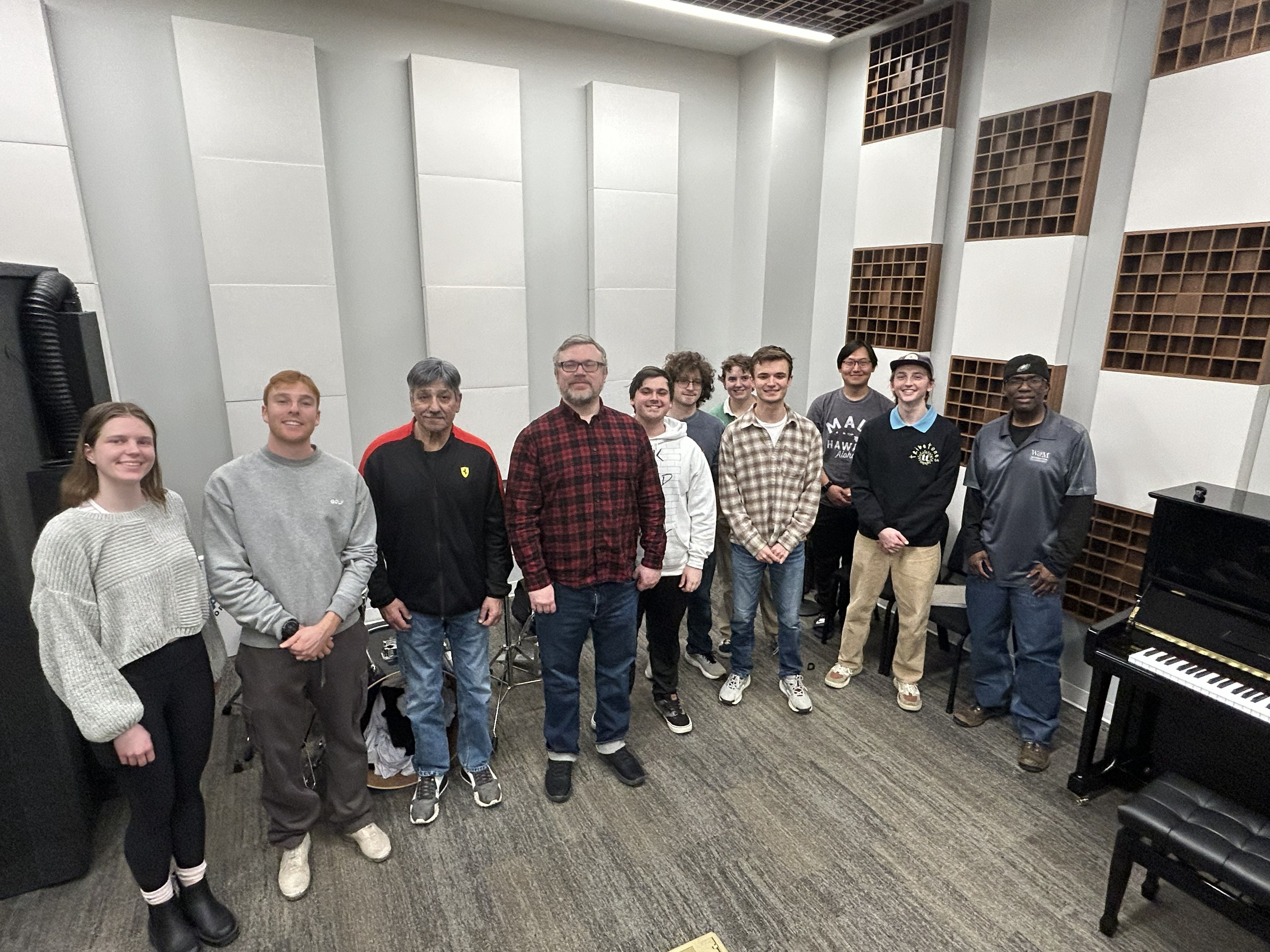 Since then, Vlahakis continues to support the purchase of cutting-edge music technology across the building by establishing the Music Studio Technology Fund, which covers more than just a recording studio. “I saw the recording studio as just a beginning for Kimi and me to get involved,” Vlahakis said.
The fund provided the opportunity to purchase new microphones, preamplifiers and soundproofing, as well as the wiring of the recording studio to the Comey Recital Hall for increased recording abilities. The recording studio now contains a full selection of recording, mixing and mastering equipment.
“Nick and Kimi have found a spot where we had a significant need and really invested in that. Their support has made such a tremendous difference for our students and faculty, not just the music department, but all throughout the arts,” said Gerald Bullock, executive director of development for the College of Arts & Sciences.
The couple have supported W&M beyond the arts through setting up the Elias Paparis Computer Science Scholarship, a fund that provides need-based support for undergraduate computer science students in the School of Computing, Data Sciences & Physics, in memory of the W&M computer center director who became a close friend of Nick and Kimi. They also support the Muscarelle Museum of Art, drawing on Kimi’s passion and expertise as a Byzantine iconographer. “They’ve embraced William & Mary as their own,” Bullock said.
Their contributions have served a wide range of applications, including the creation of the Experimental Project Studio, a space where stuents can explore new and innovative techniques for music production. It serves as a teaching space, where music professors guide the creation of contemporary music with students. The studio is equipped with computers and headphones, allowing students to explore sound hands-on in breakout groups.
David Dominique, Sallie Gertrude Smoot Associate Professor of Music, Music Theory & Composition, teaches courses in this studio, and mentors students who are interested in the experimental pathways of sound. “It’s exciting as a teacher to expose students to other ways of thinking about time, sound, music,” he said. “We’re fostering a community and space where students can indulge their creative ideas about music-making, design and build a curriculum from these resources.”
While the Experimental Project Studio is already serving as a cherished educational space, the new Sound Design Studio is nearing completion. The isolation booths in the studio will completely block exterior sound, making it an ideal set-up for designing and recording sound effects. Small sounds can be amplified in this space, where students can record voice interfacing, movie sound effects, singing and instrumentals.
“Many of our graduates have gone on to land jobs that incorporate both the expertise acquired in their respective majors as well as skills learned in our experimental music and recording engineering courses,” Benjamin Whiting, assistant teaching professor of music, said. “To say our program is a hotbed of activity would be an understatement, and we are all thrilled to see it continue to grow.”
This versatility of music technology has spurred collaborations and engagement across campus and beyond.
“I think this studio and the music technology will be beneficial to the whole community and school. I look forward to watching that grow,” Vlahakis said. “I think that will probably be the highlight. It'll go beyond what people thought it could be.”