 Skip to main content

Art imitates life: W&M professor connects dance to conservation
Moved by human-wildlife conflicts she learned about in Kenya, Leah Glenn, William R. Kenan, Jr. Professor of Dance, is collaborating with William & Mary conservation researchers to explore new ways to think about movement – from the dance studio to the African grasslands.
This past summer, W&M's Institute for Integrative Conservation (IIC) researchers and faculty traveled to Nairobi, Kenya for The Catalyst, a leadership summit for leaders around the world in the conservation field. Conservation organization directors from Nepal, Honduras, Madagascar, and Kenya met with IIC members staff to share ideas and challenges they face in the industry.
Glenn joined the trip along with her husband Steve Prince, director of engagement & distinguished artist in residence for the Muscarelle Museum of Art, who was teaching art at the summit. Though she attended as a guest, Glenn sought to learn more about the dance opportunities in Nairobi.
She discovered Dance Centre Kenya, a dance school that co-sponsors dance lessons for underserved youth. They connected her with Lifespring Christian Academy in Nairobi, a recipient of Dance Centre Kenya’s funding which provides free ballet classes for their students. Once she arrived in Kenya, she coordinated teaching a ballet classes at the school, although her main expertise is in modern dance. “I wanted to know what they needed,” Glenn said.
She taught a traditional-style ballet class, which included a barre warm-up and exercises in the center and across the floor. Glenn also taught them a section of her own choreography repertoire from her dance company in Williamsburg. Though they were aged eight to 14 and had a wide range of skill levels, the students were immersed in the lesson.
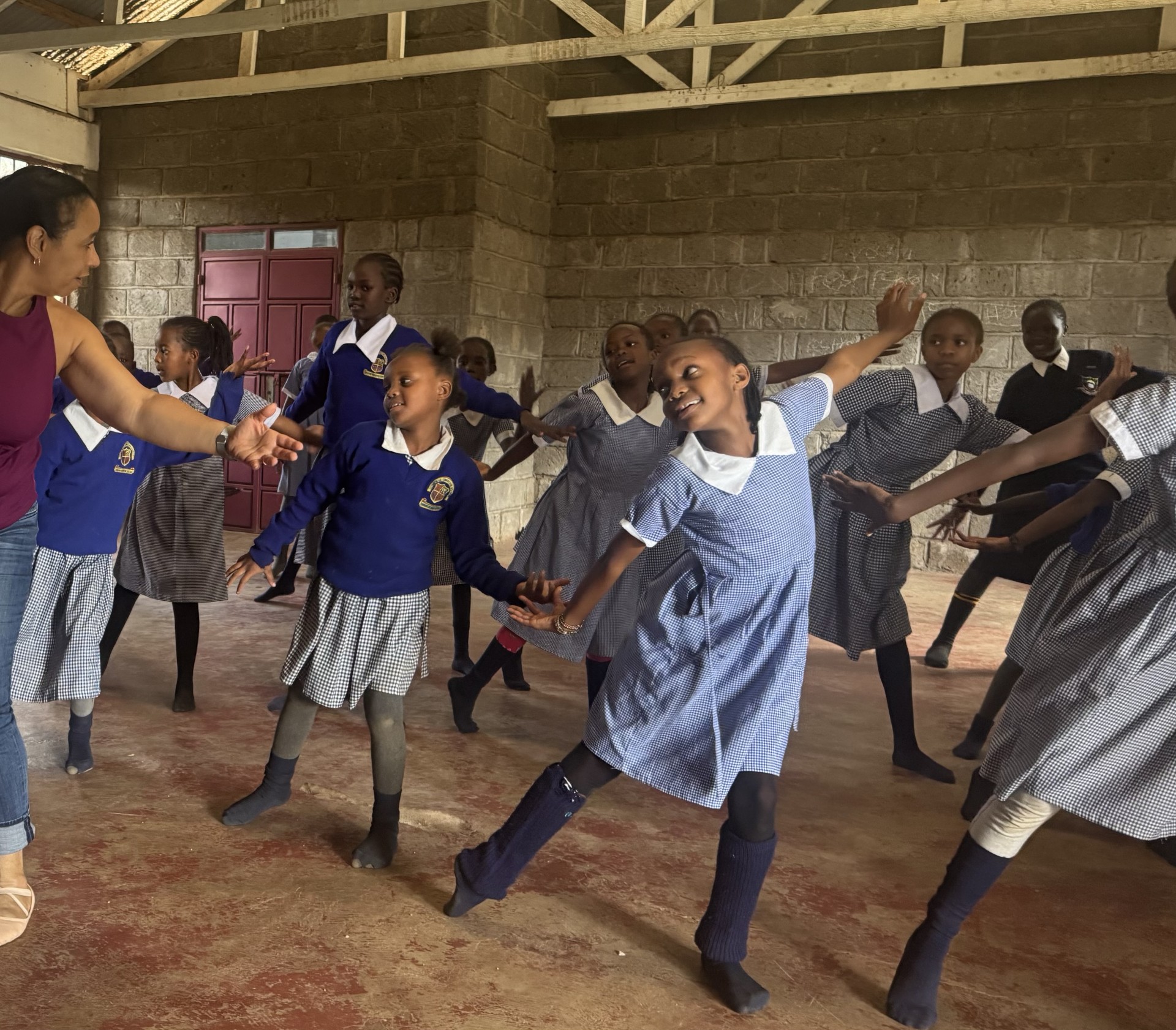
Beyond the impact on the students, Glenn came away with a deepened appreciation of how dance can unite people of different backgrounds. “It’s using dance as a means of communication to bridge differences between cultures,” Glenn said. “We’re using movement in dance as a catalyst for building community.”
Outside of the ballet studio, Glenn engaged with other communities in Kenya. Along with the IIC members, she visited Amboseli National Park and met members of the Maasai community who work with the IIC to address conservation challenges. While learning from the Maasai about land and water use challenges, Glenn found overlap between conservation and dance when observing human-wildlife conflict over limited natural resources like water and land. “Arts are a wonderful way to grapple with these issues,” she said.
Inspired by this intersection, Glenn came back to W&M in the fall eager to apply new ideas to her work. “I’m interested in finding spaces of synergy between dance and conservation,” she said.
In her COLL 100: Movement as Communications class, Glenn asked students to explore conservation challenges through dance. She invited Erica Garroutte, director of research for the IIC, as a guest speaker to teach the students about conservation issues.
Garroutte, who also went on the Kenya trip, gave examples of human-wildlife conflict over resources, and students improvised with short sections of choreography inspired by these prompts. Through dance, the students were able to analyze different actors in resource conflicts and considered how dance can help researchers understand complex challenges. “In a short amount of time, they were able to capture what it's like to live in conflict,” Garroutte said.
Much like Glenn in Kenya, Garroutte left the class inspired by the intersection of conservation and dance. “Dance is an incredible way to understand and think about movement,” Garroutte said. “It opened my mind to how dance can be a form of understanding these challenges and thinking through solutions in new ways.”
Beyond the dance studio, Garroutte is now looking for new ways to utilize the arts in conservation research. “When we do ecological research, we’re getting information but not capturing the whole picture. We’re missing out on capturing the ways we connect with each other and the environment,” she said. “How do we integrate across disciplines, bring in different perspectives and approaches? It’s the start of a conversation."
Along with teaching her COLL 100 class, Glenn is creating a piece inspired by the intersection of dance and conservation for members of Orchesis Modern Dance Company, a faculty-led student group. The final dance will be performed at Orchesis’ annual fall recital DANCEVENT on Oct. 29-31 at 7:30 p.m. and Nov. 1 at 2 p.m.
“Going abroad brings you a new perspective,” Glenn said. “I want to share that with my students through movement.”
DANCEVENT tickets are available to purchase and are discounted for William & Mary students.