 Skip to main content

Reimagining history with experimental opera
David Dominique, a composer and professor of music, is pushing the boundaries of his creativity, both in and out of the classroom. “Professor Dominique is a valued colleague whose forward thinking has brought renewed energy to the department,” said Richard Marcus, chair of the music department at W&M.
The Sallie Gertrude Smoot Associate Professor of Music and Guggenheim Fellowship recipient is currently developing an expansive, three-volume opera that merges historical research and speculative storytelling. Rooted in Richmond, "Steam" explores how narratives of the past, particularly those tied to slavery and rebellion, continue to reverberate today.
“I wanted to synthesize these different parts of my life,” Dominique said. “Journalism, community engagement, and my musical work had been operating separately. I wanted my music to feel more socially relevant, and to directly address those concerns.” 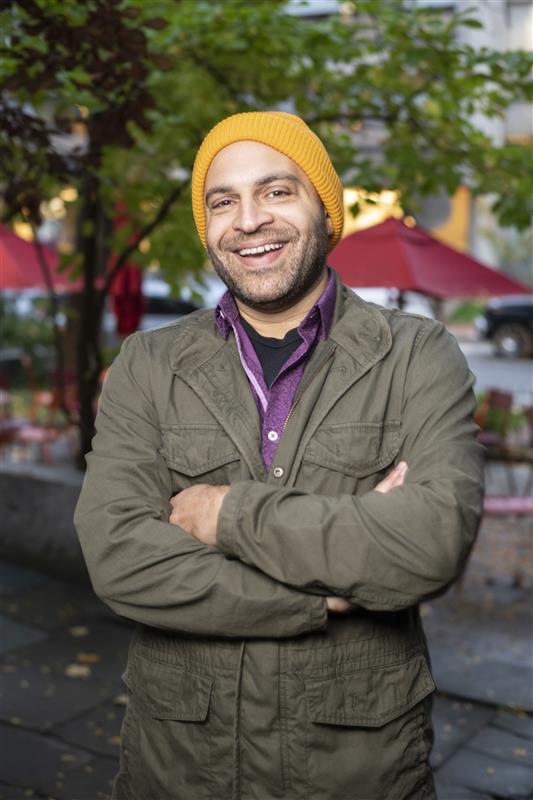
That impulse drew Dominique to investigate Richmond’s layered history, including the story of Gabriel’s Rebellion. While researching, Dominique came across “Black Thunder” by Arna Bontemps, a Harlem Renaissance novel that reimagines the rebellion, which became a framing device for his works. The project arrives during a period of significant recognition for Dominique. He recently received the American Academy of Arts and Letters Wise-Hinrichsen Award for music composition, following several previous nominations. He also received the 2026 Creative Capital State of the Art Prize, which is awarded to one artist per state. Dominique has used the funding from this award to support the production of “Steam.”
“It's kind of a lesson for me in persistence,” Dominique said, having previously been nominated for awards by the American Academy. “It was very exciting and affirming, and in a way like my own little comeback story.”
Rather than adapting the novel directly, Dominique and his collaborators, Kevin Jerome Everson, Commonwealth Professor of Art at the University of Virginia and writer and director Joseph Tepperman, constructed a narrative that differs from traditional historical storytelling. At the center of the three works is a fictional “imposter” figure claiming to be the real Bontemps.
“We needed something that could inject chaos, instability, and maybe even humor,” Dominique said. “Once we had that concept, things really started rolling.”
The imposter functions as both a narrative device and embodiment of the project’s central question about the ethics of adaptation.
“The imposter becomes kind of an avatar for ourselves, like thinking about how we make a piece of art out of something so loaded as the history of slavery and slave rebellions,” Dominque said.
That tension is key to the structure of the three operas. Instead of presenting a clear, linear narrative, the opera cycle unfolds across time and perspective. The first volume centers on an actor attempting to stage “Black Thunder” as the production falls apart around him. The second and third volumes shift focus to the imposter himself, moving backward in time, before ultimately uniting the past and present.
“If you only saw one of them, you’d probably have a lot of questions,” Dominique said. "And that's intentional. Each piece stands alone, but they’re all part of a larger system.”
Dominique continues to balance his creative endeavors with teaching, often integrating these roles. Dominique’s class instructions often reflect his current artistic interests, including modular synthesizers and visual media.
Dominique was a strong advocate for the expansion of music technology resources when he arrived at W&M in 2016. Students in Dominique’s Sound Design Workshop use the Digital Project Studio to “mold sounds created with cutting edge and vintage analog equipment into personal and compelling forms of expression,” Marcus said.
This approach echoes Dominique’s work on “Steam,” where experimentation and storytelling are equally important to the work.
The next phase of development will bring Dominique’s work to a wider audience. A spin-off piece, “The Imposter,” will premiere in Massachusetts before moving to France, while volume one of “Steam” is set to debut in San Francisco in June alongside the Left Coast Chamber Ensemble.
Dominique expects the audience’s response to vary slightly depending on the location of the performance. In Richmond, viewers may recognize the specific historical and political references, while international audiences may resonate with the wider themes of power and identity.
“The goal is to create something very specific but create meaning that goes beyond it,” Dominique said.