 Skip to main content

Bringing fiction to life at the Faculty Research Forum
“What does it mean to make art, and who gets to make it?” asked Brian Castleberry, director of the Creative Writing Program and associate professor of English, who opened the Faculty Research Forum with a question he said drives his work, viewing literature as part of the “creative endeavors that make humans vibrant.”
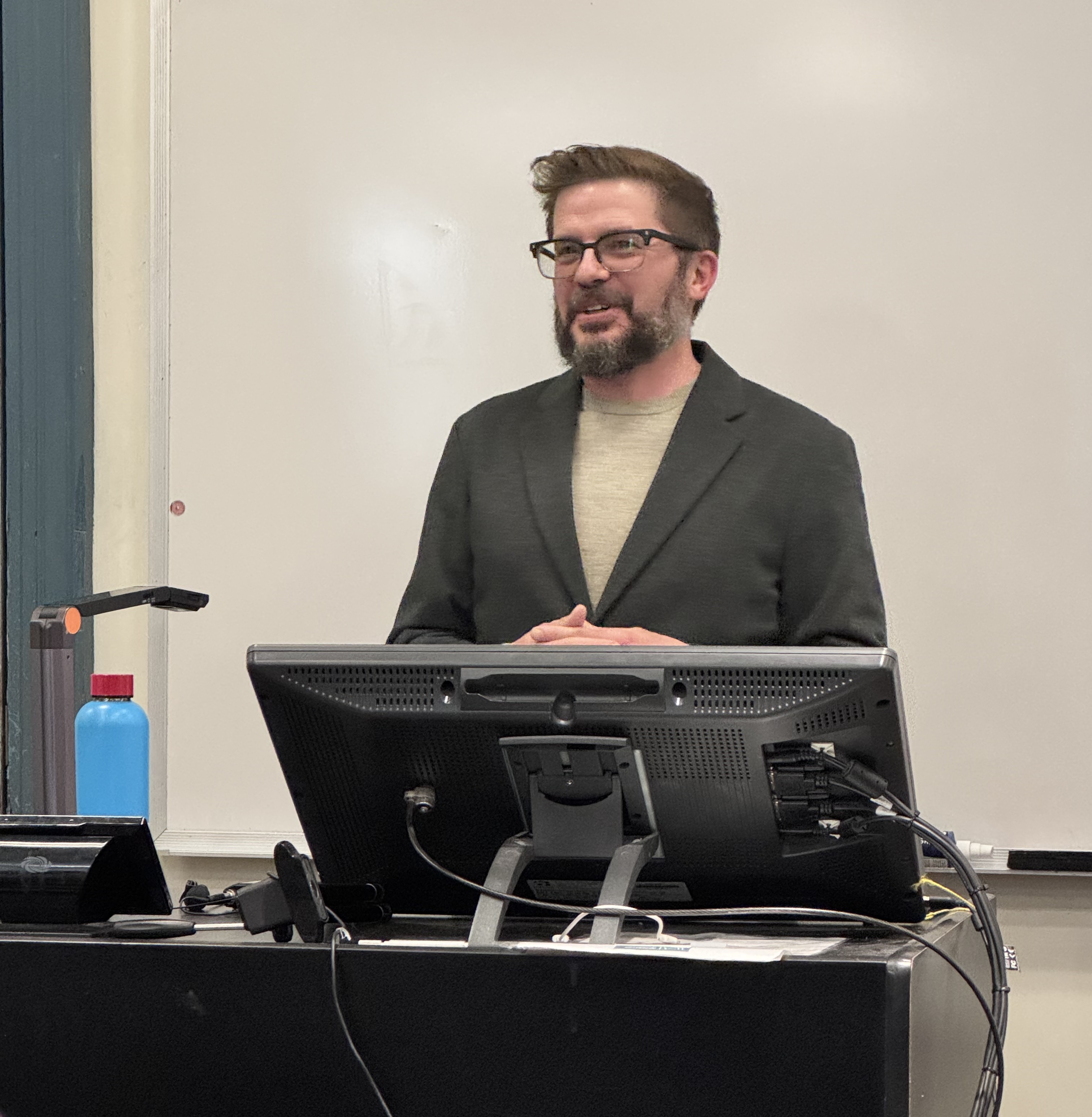
On April 21 in Washington Hall, Castleberry led the final Forum of the semester by reading excerpts from his novel “The Californians” as well as his current work in progress, “Wolfboy,” followed by a discussion on the process of writing fiction.
Sponsored by the College of Arts & Sciences, the Faculty Research Forum, launched in the fall, highlights faculty scholarship across disciplines.
 Audrey Horning, vice dean for research & graduate studies in the College of Arts & Sciences, called Castleberry’s talk both “inspiring and informative, as everyone present joined in to discuss the intricacies of plot, characters, and the often isolating process of creative writing."
Castleberry began by reading early chapters of his novel “The Californians,” which is a multi-generational story that traces art, ambition, and the American dream across shifting moments in California’s past and present.
Questions from the audience mainly focused on Castleberry’s creative process for developing a fictional world. “I had this idea, I didn’t know what to do with it, but I wanted to work through it," he said. For Castleberry, writing fiction is a process of using character, plot, and language to seek out truth and meaning.
Elaborating on his creative process, Castleberry noted the importance of emotional authenticity in storytelling, adding that writers are “just seeking some kind of truth — an emotional truth [of our characters].”
When audience members asked how he crafted such vivid details, Castleberry said that “so much of being a writer is being observant of everything.”
After he read “Wolfboy” excerpts, Castleberry spoke about the art of authorship. Both addressing audience questions as well as personally reflecting on the beauty and beauty and labor of being a writer, he stressed the role of research when writing a novel.
“I love doing research; it’s really central to my process. I want to know so much more than what finds its way into the text,” Castleberry said, recounting the countless hours he spent gathering information to funnel into his characters. He recalled even playing golf for the first time as research for writing a scene in which his character swings a golf club.
When creating characters, Castleberry said that “there’s always that initial kernel idea I have to write down. I have to get to the point where I see the characters in their world.” He described character development as central to the craft of authorship, requiring writers to move beyond initial ideas and into a deeper, lived understanding of their characters, which could also become autobiographical at times. “All writers use parts of themselves while writing. It’s hard to see characters without parts of yourself,” Castleberry said.
This part of the Forum resonated with Natalie Vipond ‘29. “I really liked hearing him talk about the writing process. There were things I could relate to, especially the emphasis on character development," Vipond said.
In addition to exploring the art of authorship, the Forum cultivated a sense of community, inviting open dialogue between the speaker and audience. This exchange encapsulated the collaborative nature of writing, even within such a personal craft. As Castleberry put it, “Writers need community and other writers to support us.”