 Skip to main content

A discussion about Health Policy on the Peninsula
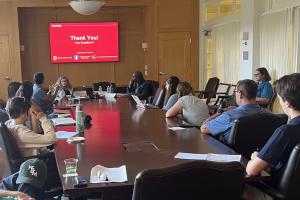 On September 17th, the William & Mary Public Policy Program and the Schroeder Center for Health Policy hosted Health Policy on the Peninsula, a panel discussion centered on findings from the 2025 Community Health Assessment and the evolving public health approaches across Greater Williamsburg.
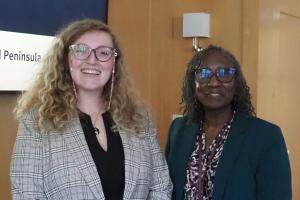 The panel discussion brought together two experts involved in the Community Health Assessment who oversee various local public health and services initiatives: Tes La Dieu, MPH, Community Health Improvement Manager and Public Information Officer for the Hampton and Peninsula Health Districts, and Barbara Watson, Director of the James City County Department of Social Services. Together, they provided vital perspectives on how regional health systems assess community needs, address social determinants of health, and build community trust.
With nearly 3,000 community responses, the 2025 assessment seemingly underperformed the prior 2022 survey, which garnered about 20,000. However, despite the higher volume of responses, La Dieu pointed out that the earlier survey’s respondents were predominantly older, white, and female—failing to represent the demographics of the broader community. To correct the skewed sample in 2025, the team hosted targeted listening sessions with community partners representing underrepresented groups such as The Humanization Project and 100 Black Men. The 2025 survey also received feedback from approximately 150 professional stakeholders who serve local communities.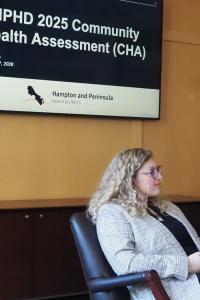
Cardiovascular disease, firearm violence, substance use, and infant mortality remained persistent priorities carried over from 2022, with mental health surging as a new top concern among community respondents. While stakeholders similarly ranked mental health as a primary issue, they diverged from residents by prioritizing chronic physical conditions, such as diabetes and obesity. The survey also sought to identify top social determinants of health, which are the external factors that underlie health outcomes. While stakeholders flagged environmental conditions such as mold, air quality, and drinking water safety, community members pointed directly to living needs, including affordable housing, food access, parenting support, and community violence.
To respond to these social determinants, La Dieu highlighted various community initiatives that target the root causes of poor health outcomes across areas ranging from cardiovascular health to firearm violence. These initiatives, she explained, are rooted in a holistic approach to health, requiring providers to consider challenges beyond the immediate health concern and address an array of external factors, such as housing instability, financial troubles, or food insecurity. By fostering a variety of programs and partners across the region, local and state agencies connect residents directly with specialized community organizations better equipped to resolve these issues.
La Dieu also emphasized the health department’s vital role in stigma reduction, particularly in addressing substance abuse disorders. She explained that when public campaigns portray seeking help as dirty or frightening, “you’re probably not getting your story across to the people you want to actually serve.” Instead, she recommends person-centered language as an alternative approach that encourages people to seek support and helps the community understand that substance abuse is something that anybody can experience.
 As for Social Services, Watson explained the agency’s role in addressing structural barriers and policy challenges to ensure that residents receive needed services. These responsibilities include navigating impending federal changes to Medicaid work-reporting requirements and mitigating coverage disruptions. Watson detailed extensive outreach and education efforts aimed at minimizing the number of residents who slip through the cracks. “We don’t want to create more barriers,” Watson said, stressing that effective outreach sometimes means meeting families where they are, both physically and circumstantially.
By the end of the discussion, the panelists emphasized trust as central to effective public health delivery. Watson highlighted the importance of ongoing relationship building and active listening. Echoing this sentiment, La Dieu underscored that agencies must show up consistently without imposing top-down mandates that overlook preexisting community solutions. To ensure that any health program or policy intervention is effective, institutional leaders must build and maintain this trust.