 Skip to main content

John McGlennon is interviewed for the Swiss public radio program, "A Whole World"
Listen to the Swiss public Radio program, A Whole World. In this episode, Professor John McGlennon, the Class of 1935 Professor, discusses concerns about the various influences shaping the narrative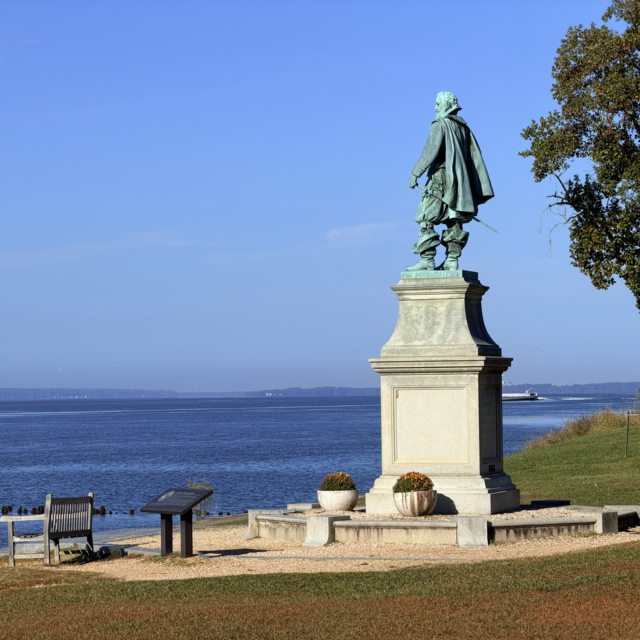 related to the study and documenting of American history. Swiss public radio took their program to historic Jamestown Island.
Professor McGlennon's remarks are translated below:
Interviewer
And what do we do with this history? We went looking for the answer at the venerable College of William & Mary, one of the oldest in the country.
John McGlennon
Isn't that the question we're always faced with as a society? Which point of view will be preserved and protected? In the end, I think it's the one who can tell the story best who will ultimately prevail.
Interviewer
Professor John McGlennon, a political scientist, helps us understand the impact of this reinterpretation of history. At Jamestown, there was quite a debate over a sign that offered a somewhat broad perspective, precisely by addressing who belongs to the American nation—including slaves. We also know about the Trump administration's efforts, you know, to remove, to partly rewrite history, to take down signs. The Smithsonian museums — we were there with Mickaël Peukert earlier — which are also under enormous pressure to present a version of American history that is positive, or that is considered by the government as, as positive. Is that significant? Is that anecdotal?
John McGlennon
I think there is a lot of concern about these attempts by the American government to change the narrative around American history, especially at our university. Because so much effort is being put into documenting what happened and revising our work where necessary. It allows us to confront the darkest aspects of our history, especially in this region where what was to become a beacon of democracy for the entire world was born.
Interviewer
But does that mean we can now read history differently, uh, depending on which side of the political spectrum we're on?
John McGlennon
To some extent, it's a question of what we choose to highlight and what we choose to leave in the background. But there is no doubt that those who have spent many years studying and documenting American history are deeply concerned by these attempts to change the narrative of this country.
Interviewer
Why is this such an important issue? What, fundamentally, is the connection between identity and American history?
John McGlennon
It's a very interesting question. Studies and polls have been conducted in European countries and in the United States. People were asked what they considered to be historically fundamental to their nation. And the answer in some places was “art”; in other places, it was “food.” But in the US, it was all about governmental institutions, the rule of law. There is an inherent connection between our history and our system of government, and that is crucial. It is one of the most important aspects of the American experience. The idea that our identity is so closely intertwined with democracy and with the creation of a system of government that has challenged over the years, has its fundamental roots in the democratic experience.
Interviewer
There are also other aspects of national identity – Americans fought to win their freedom from the British during the Revolution, and citizens took up arms. How important is military force and military power to Americans? How do you define that?
John McGlennon
Yes, it is very special. We see an extraordinary level of patriotism expressed across the country, whether at parades or demonstrations, or through commemorations of the sacrifices made by our veterans to protect freedom. Of course, we can also point to the battlefields located just a short distance from here. In Jamestown, these are battlefields from the Revolutionary War. This region was not a major theatre of conflict during the Civil War, but it was during the Revolutionary War against the British Crown. One thing we can say about this region more broadly – not just Jamestown or Williamsburg, but Virginia as a whole – is that it has played a central role in American military defense for a very long time.