 Skip to main content
Senior & Honors Research
One of the strengths of the Geology program at William & Mary is the requirement that students complete an independent research project during their senior year. While all majors are required to complete a research project and submit a thesis, students who wish and meet the requirements may complete Honors theses upon the successful completion of a defense. Check out recent student research featured in W&M News.
Independent and original research is a valuable part of an undergraduate education in Geology, and all majors complete a research project during their senior year. Senior research is a year-long program of independent research that culminates in a formal written thesis and oral presentation. The research is carried out in close cooperation with a faculty advisor, although the responsibility for successfully completing the project lies with the student. Senior research is your opportunity to explore a particular subdiscipline of geology in detail and to apply the research skills that you have mastered in your geology coursework to a specific research question that you find fascinating.
Honors research is a year-long program of research and study that students with a keen interest in the earth sciences might want to consider. Honors research is intended to be a self-motivated and self-driven project. Honors research entails 1) writing and presenting a strong research proposal, 2) data collection throughout the academic year (and commonly during the summer), 3) a comprehensive written examination based on course work, and 4) a thesis and final presentation to a faculty committee and the department. How does Honors research (GEO 495-496) differ from senior research (GEO 491-492)? The simple answer is that Honors research requires more time, a greater commitment, and a few more challenges than Senior research.
Completed Senior & Honors Theses
Completed Senior Theses submitted since 2021 are available for download through Swem Library at W&M ScholarWorks. For theses before 2021, please contact the department directly.
Completed Honors projects are available through the Charles Center and theses submitted since 2014 are also available for download through Swem Library at W&M ScholarWorks. For theses before 2014, please contact the department directly.
The following students submitted a thesis in partial fulfillment of the requirements for the degree of Bachelor of Science in Geology from William & Mary in 2025:
Nathaniel Ingle, "Investigating the Petrogenesis and Metamorphic History of Kyanite-Bearing Rocks in the Virginia Piedmont" (Honors)
Annike Wolle, "Age, Origin, and Tectonic Significance of the Arvonia and Buffards formations in Virginia’s Piedmont" (Honors)
Emily Kelley, "Comparison of garbenschiefer fabrics and regional deformation features in the Chopawamsic terrane of Virginia" (Honors)
Sean Carlucci, "Molluscan Assemblages and Sedimentology of the Paleocene Aquia Formation"
Lucy Cross, "Assessing Molluscan Paleoecological Changes Across the Beginning of the Mid-Pliocene Warm Period (Yorktown Formation, Virginia)"
Cooper Graves, "Radon and Marine Mammal Bone Density, Mineralogy, and Preservation in the Yorktown Formation"
Kaila Bertha, "Investigating Mt. Rainier Lahars and Social Vulnerability"
Gavin Nagle, "Mapping Groundwater-Forest Interactions in Humid Environments"
Angelina Harris, "Quantifying the Influence of Soil Type and Topography on Live Fuel Load in Sedgwick Reserve, California"
Kate Marston, "Using sediment core chronology to measure the effects of an eroding channel on a Lake Matoaka delta"
Emily Seemar, "Impacts of stormwater runoff on sediment characteristics of a millpond tributary"
Katie McGushin, "Hillslope Aspect Controls on Bioturbation and Dry Ravel Transport on a Semi-Arid Landscape Traced with 137Cs"
Brooke Spencer, "Investigating Hunting Pressures on White-Tailed Deer in the Middle Woodland at Maycock’s Point (44PG40)"
Annabelle Marcais, "Sources of Carbon Flux Through Tidal Inlets in a Transgressive Barrier Island System"
Julia Zeman, "Assessing the Impact of Beach Nourishment on the Morphology and Sedimentology of Coastal Foredunes in the Outer Banks, North Carolina"
Noah Rupert, "Tracing Water Tracks: Building Predictive Models for Locating Permafrost Flowpaths Using Machine Learning"
Zea Nims, "Quantifying Hillslope Asymmetry in the Virginia Coastal Plain"
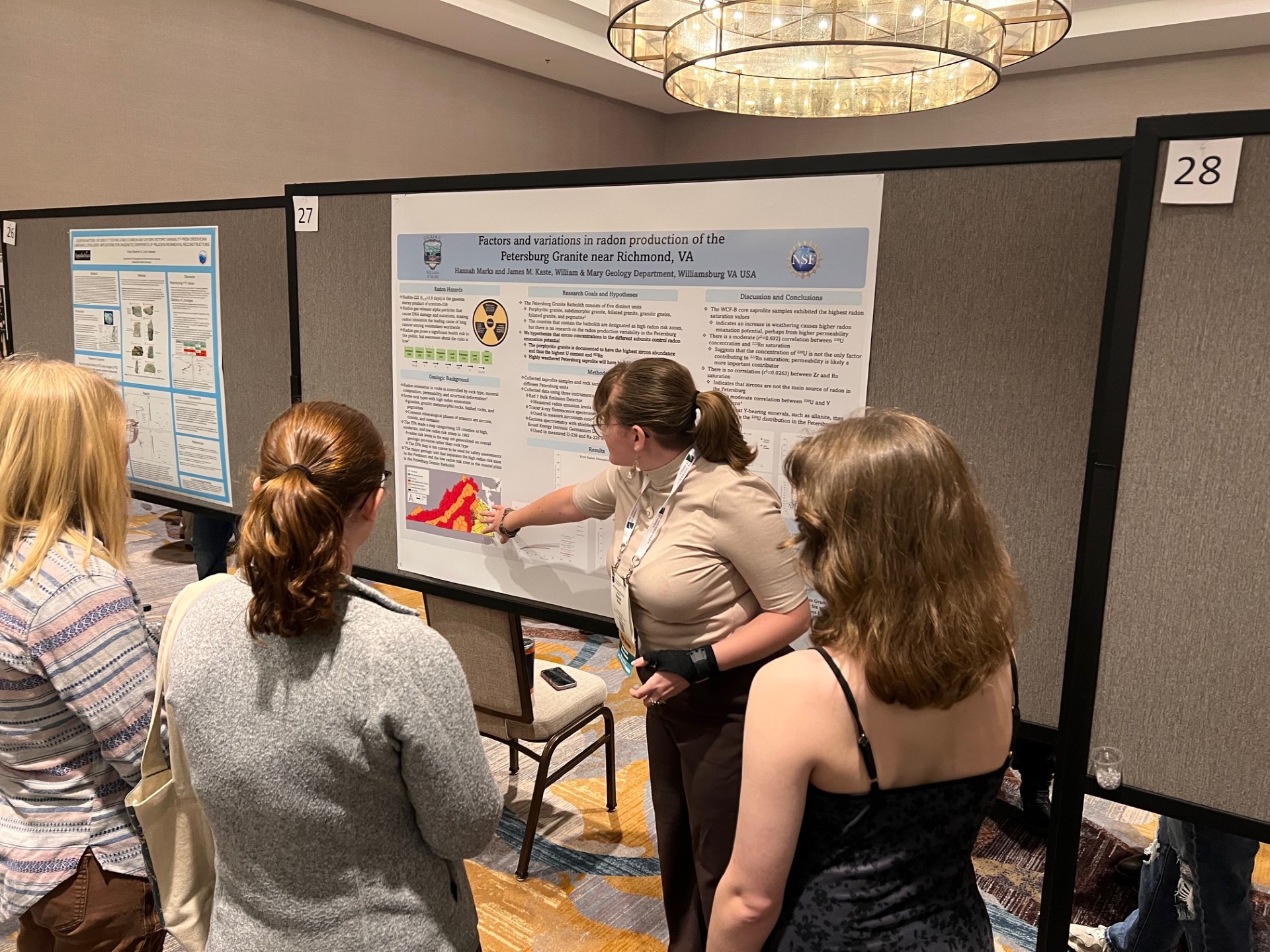
Hannah Marks, "Variations in radon production of the Petersburg Granite near Richmond, VA"
Katie Tognotti, "Correlating entrapment stress and pressure: an evaluation of elastic barometry using Raman spectroscopy of Dutchess County, New York quartz in garnet inclusions"
Caroline Kenney, "Structural Geometry and Deformational History of the Spotsylvania High-Strain Zone, Virginia"
Zack Benson, "Provenance of Sandstone Blocks from the 17th Century Governor's Well Site, Jamestown, Virginia"
Tori George, "Accessibility Rocks: advancing geoscience education and outreach at the William & Mary Geology Rock Garden"