 Skip to main content

More Than a Reading from A. Van Jordan
On September 9th, the Tucker Theater was filled with John Coltrane and neo–noir film clips in a whirlwind of jazz, social commentary, and arthouse movies — courtesy of renowned poet and first speaker of the 2026 edition of the Hayes Writers Speaker Series, A. Van Jordan.
Jordan is the author of five collections of poetry and held positions at both the University of Michigan and Stanford University. His work has received numerous accolades, including a Whiting Writers Award, an Anisfield-Wolf Book Award, a Pushcart Prize, a Guggenheim Fellowship, and the 2024 Hurston Wright Legacy Award. He is a poet who undoubtedly “changes the way you see.” But, more than anything, he describes his work as a response to media that continues to inspire his craft.
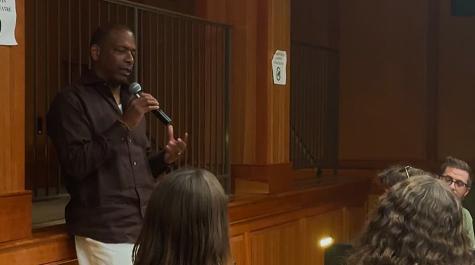
As Jordan stood in front of the theater, it was evident that he is a poet of many hobbies. In his adoration for eclectic jazz collectives, foreign films of revenge, and Spike Lee, he cites himself as a poet who “brings something new” to these source materials. Here, he read from The Cineaste, a collection inspired by his love for moviegoing, and When I Waked, I Cried to Dream Again, a collection celebrating Black youth amidst the threat of police violence.
The presentation moved between widely different pieces of media, all woven together simply by his adoration for each one. He discussed his poem titled “Old Boy,” a response to the Park Chan-Wook film of the same name, and “Such Sweet Thunder,” his poem inspired by Duke Ellington’s performance at the Shakespearean Jazz Festival. He became delighted by the ways figures like Hank Cinq and Billy Strayhorn appear throughout his poetry, even playing clips from their jazz suites to play an ending with an impossible saxophone note. His discussion of “Do the Right Thing,” a poem again drawing inspiration from Spike Lee’s career-defining 1989 film, demonstrated his curiosity toward these multimedia topics not commonly linked together. In these works, he revisits transformative art through poetry; however, perhaps Jordan’s goal is not to simply retell. Rather, he recontextualizes them by integrating his own identity, memories, and feelings to reveal something deeply personal in the source material.
Jordan is unafraid of writing about personal connection to historical discrimination, particularly surrounding racially charged violence. Inspired by Shakespeare’s The Tempest and the methodical way he builds characters before revealing them on stage in works like Othello and Macbeth, Jordan considers how police violence can be premeditated similarly through words. He connects phone calls to police dispatchers with violent encounters involving Black individuals, personifying objects of violence in boyish language and, in doing so, humanizing them.
He recited “Fragments of Tamir’s Body,” a poem directly affected by the 2014 police shooting of 12-year-old Tamir Rice. Similarly, “Airsoft” focuses entirely on the fake, plastic airsoft weapon held by Tamir at the time of his murder, imagining Tamir gripping the gun tighter as if tightening laces, running with playful carefreeness because, at last, “everyone runs faster with tight laces.”
Jordan also included a poem about John Coltrane’s “Alabama,” combining his love for jazz masters with his mission to artistically advocate for civil rights. He retells Coltrane’s performance of the titular song only a few weeks after the 16th Street Baptist Church bombing, declaring, “there’s the space that was love.”
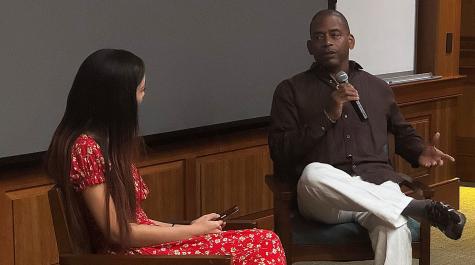
In the student-led Q&A following his presentation, Jordan cites the importance of spectatorship in his work, specifically in the act of looking back at oneself through a poetic lens. This perspective was evident throughout his poetry readings– his poems center on art he personally indulges in, but zoom out to something broader that has everything to do with the poet’s own identity. In his 2005 collection M-A-C-N-O-L-I-A, he explores the life of MacNolia Cox, the first African American to make the final round of the National Spelling Bee in 1936. Cox was blocked from winning by one single, unlisted word: “nemesis.” In his work, Jordan identifies with this once-thirteen-year-old girl. After all, between his poetry and her spelling bee, they both spell the same words.
Ultimately, A. Van Jordan’s edition of this year’s Hayes Speaker Series was electric, captivating viewers with his most beloved clips of poetry, cinema, and jazz. However, his most powerful mode of poetry lies in his passion for individual experience, for Black memorabilia, and for civil arts as a whole.