Skip to main content

Accessibility Module
Acquia Web Governance (formerly known as Optimize) accounts are currently only available to Cascade Managers and designated points of contact in the Content Cleanup & Accessibility Compliance project.
There are a variety of views and report options available within the Acquia Web Governance accessibility module to help you review and remediate potential accessibility errors. We recommend the Checklist view which offers a helpful overview and prioritizes issues that you must fix, warnings that are likely to be issues, and potential issues that require manual review to ensure compliance.
Access the Checklist
- Log in to Acquia Web Governance.
- Select your domain or group name to access the Dashboard.
- Select Accessibility. This brings you to the Summary screen.
- Select Checklist. This view organizes the flagged checks into three categories: Issues to Fix, Warnings and Issues to Review. Focus your efforts first on Issues to Fix.
- Next to each check you will find additional information.
- Select the Help center (grad cap) icon for a detailed explanation of the check.
- Select the count of affected pages to open the list of affected pages.
- Select Inspect page with browser extension (mag glass icon) to view details while viewing the page in your browser — see below for further instructions.
News Stories: Additional guidance will be provided regarding the retention of archival news stories and borrowed news stories. Prioritize accessibility efforts on content outside of news folders until guidance has been provided on the retention of archival news stories.
Locate the Issues on Your Pages Using the Browser Extension
If you have the browser extension installed:
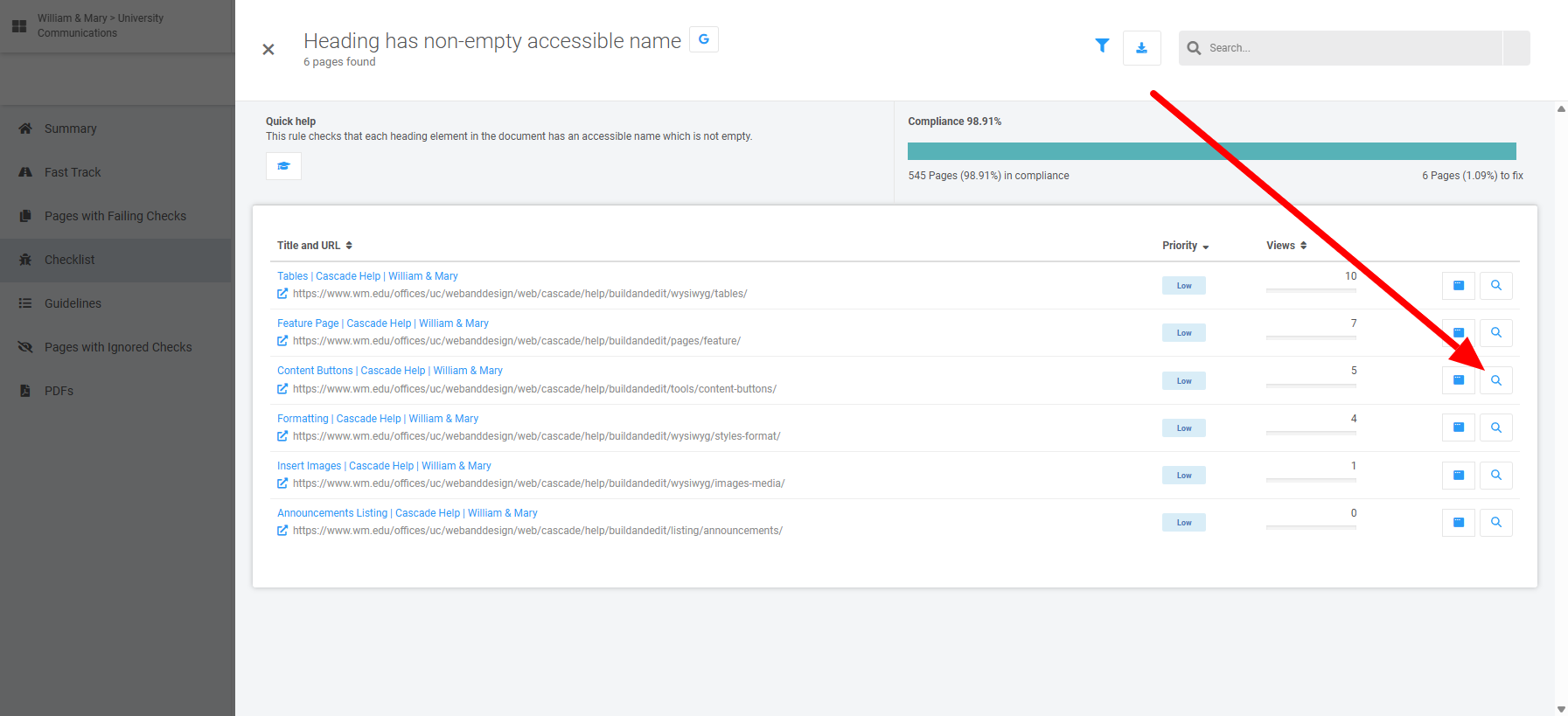
- Follow steps 1-5, above, and select the mag glass icon by each page in the list (see Screenshot 1). This will open the page in a separate tab of your browser and the Acquia Web Governance information panel will slide out from the side.
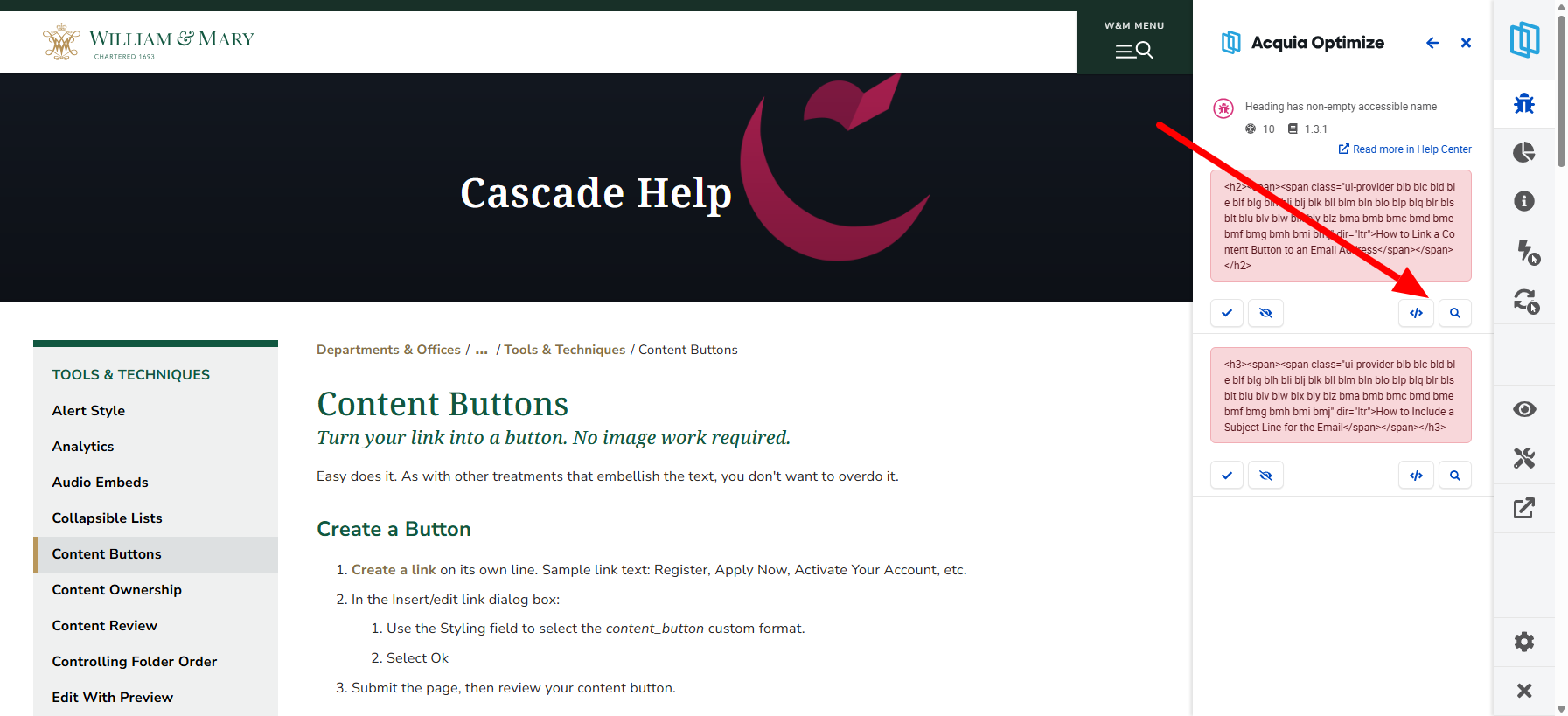
- The Information panel includes options to help locate the flagged content (see Screenshot 2).
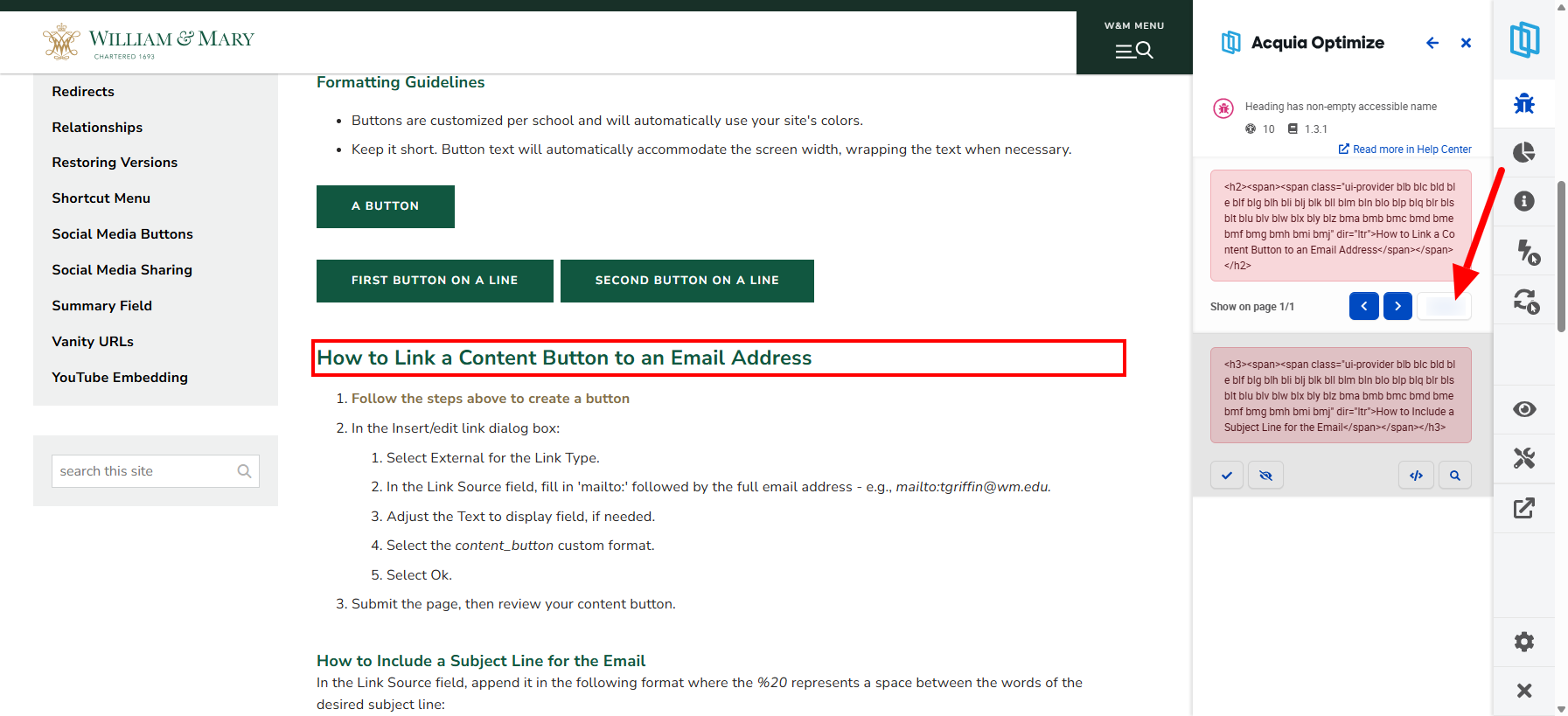
- Select the Highlight (mag glass) icon to highlight the affected content on the page (see Screenshot 3). Tip: If your page includes collapsed or hidden content, first expand all content.
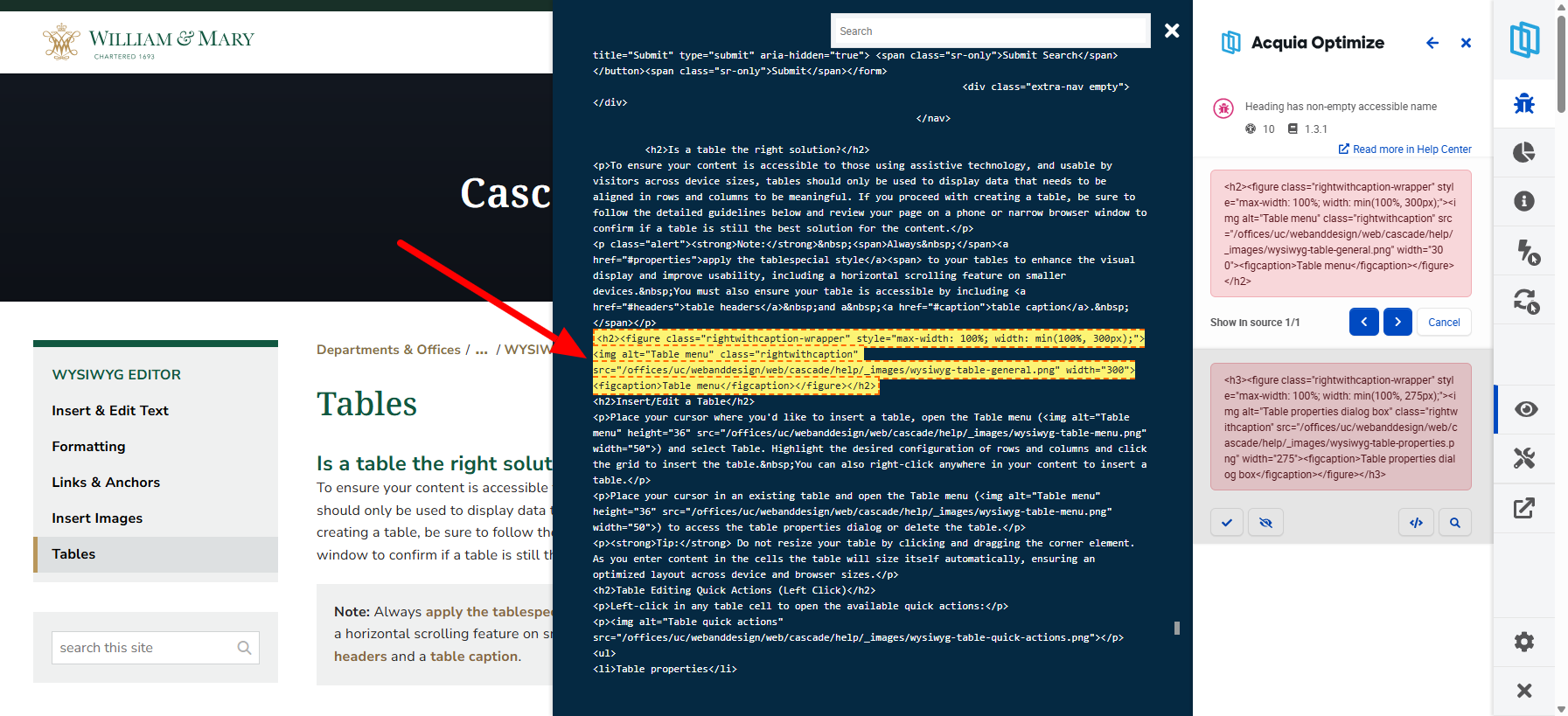
- If it cannot visually highlight the issue, select the HTML (< / >) icon by each rule and the extension will try to highlight the issue in the source code of the page (see Screenshot 4). While you may not be familiar with html, look for context clues that will help you then locate the issue on the visible page.
Tip: You can also use the browser extension while viewing any of your webpages to see the latest scan data about the page.
Optional: Mark Issues to Fix and Warnings as "Fixed"
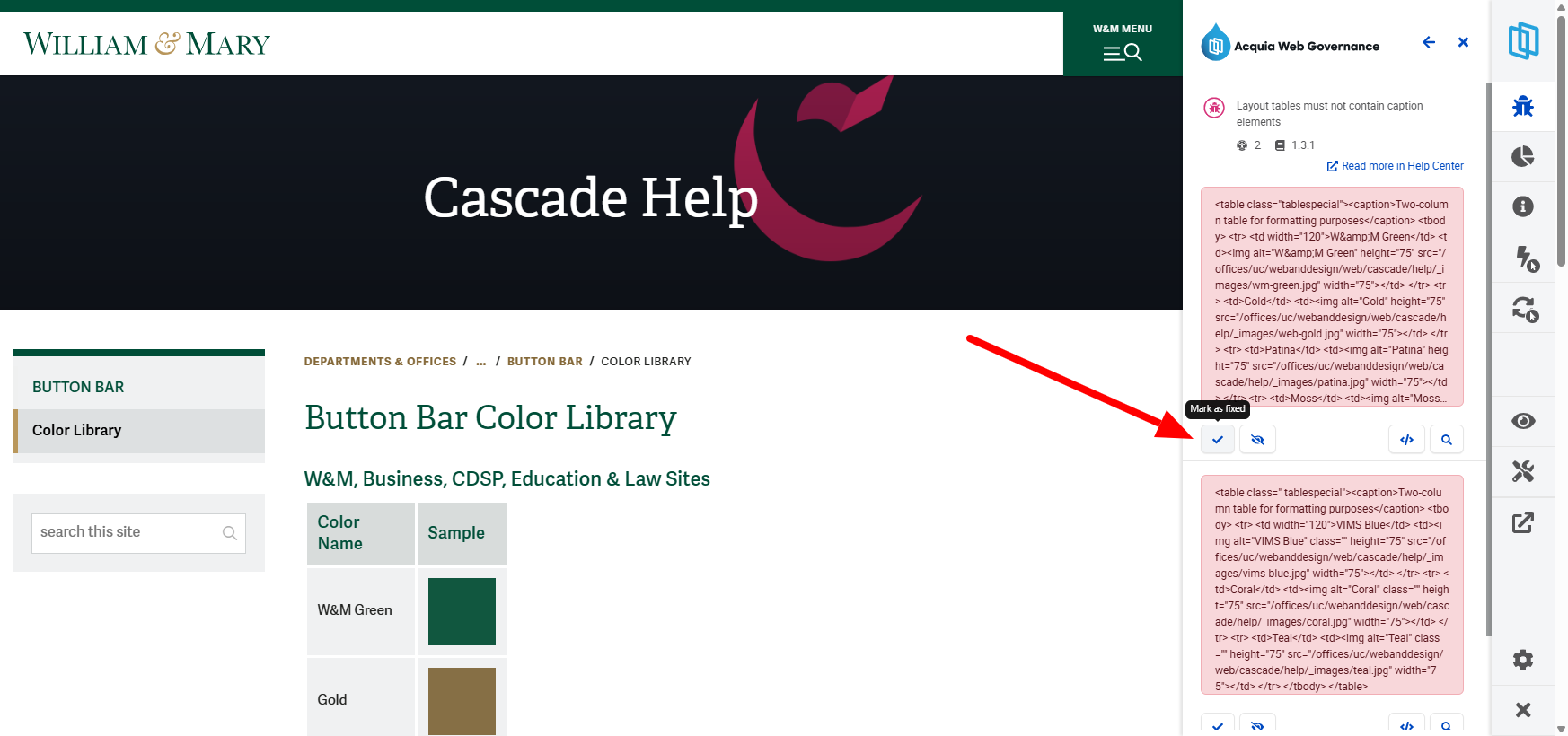
Using the tables below that explain each issue or warning as guidance, you can mark each snippet as "Fixed" as you go to remove it from your checklist. The next weekly scan will re-surface that snippet if it still detects an issue or warning. A button to mark items as fixed appears within the browser extension (see Screenshot 5) and within the accessibility module on the Page Details screen. If you mark something as fixed inadvertently, simply await the next week's scan to check the snippet again.
Optional: Mark Issues to Review as "Reviewed"
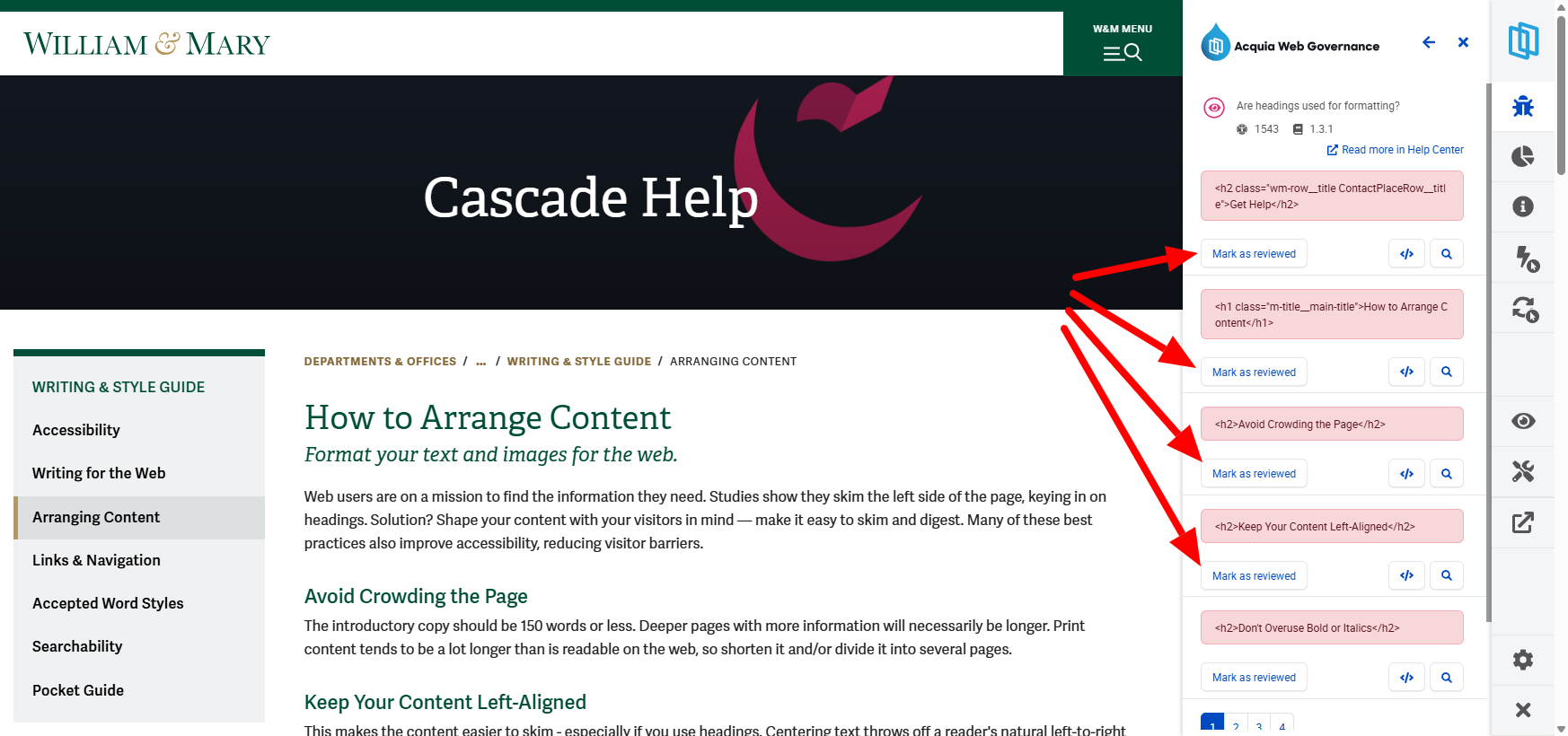
Using the table below explaining items to review as guidance, you may mark a snippet as "Reviewed" to permanently remove it from your reports if you are confident it is compliant. A button to mark items as reviewed appears within the browser extension (see Screenshot 6) and within the accessibility module on the Page Details screen. We cannot undo this action.
Example: Under Issues to Review you see a number of your pages flagged for "Are headings used for formatting?" You select the count of pages flagged for this issue to view the list and you select one of the pages for details. You manually review all headings on that page and are confident they are not being used for visual formatting and they follow proper hierarchical structure. You may mark that issue on that page as "Reviewed."
Accessibility Checks Configured for Content Editors
The accessibility checks in Acquia Web Governance for "William & Mary" and the school domains have been configured to ignore most issues that would require access to the page templates or source code to remediate. This keeps the checks focused primarily on content issues considered actionable by our Cascade editors. As a result, accessibility compliance scores are skewed higher than the posted industry averages on the Accessibility Summary view.
Review additional guidance for Cascade editors and POCs working on accessibility compliance for the federal and state regulations.
Issues to Fix (Levels A and AA Required)
These are issues that can be machine-tested and are therefore errors that must be fixed for compliance.
| Name of Check | Explanation | Suggestions |
|---|---|---|
|
Button is missing an accessible name |
May indicate a template issue |
|
| Complex data table is missing ID and/or header attributes to associate headers with data cells | Likely indicates that a table has two layers of header cells or other incorrect use of header cells |
|
| Element marked as hidden must not be included in tab navigation | May indicate a template issue |
|
| Elements intended as presentation-only contain focusable content |
Indicates the use of links in collapsible list headings (these elements serve to open and close the expandable content and must not also include links) |
|
| Form field is missing an accessible name | Cascade sites have a very limited use of form fields but if the issue is listed, it indicates there is one that needs remediating for compliance. |
|
| Heading is missing an accessible name |
Likely indicating:
|
|
| Iframe element is missing an accessible name | Indicates an embed in the source code of the page is missing a required element |
|
| Image is missing alternative text |
Indicates an image on the page with no "alt attribute" in the source code. This is rare, but it may occur on some older pages. |
|
| Incorrect use of ARIA state or property | Likely indicates one or more aria labels in the source code of the page that were copy/pasted in through the WYSIWYG editor inadvertently |
|
| Layout tables must not contain caption elements |
Likely indicates the use of a table for layout/formatting purposes, which must be removed Note: All tables in Cascade require a caption be provided, so tables must only be used to organize data meaningfully into rows and columns, where a caption is appropriate. Collapsible lists are a unique exception. They are used for layout/formatting purposes, but they are handled uniquely in the source code to ensure they meet accessibility requirements. |
|
| Layout tables should have an empty summary attribute or none at all |
This will be rare and indicates an old hidden table summary is still included in the source code of the page. Cascade now uses a caption to provide a description to those using screen readers. |
|
| Link is missing an accessible name |
Indicates a link in the source code with no visible link text on the page, or a linked image with no alt text for the image.
|
|
| Page is missing a title |
This will be rare and indicates the page includes a link for visitors to an element such as a row or deprecated page type. |
|
| Scrollable content is not accessible using the keyboard |
This is less common, but identifies large tables that may be causing an issue on some devices. |
|
| Table header is not associated to any data cells | Indicates that table header cells do not have a scope assigned |
|
Warnings (Levels A and AA Required)
These are issues that will require your manual review. They may be issues for you to address, but they require your manual investigation to confirm.
| Name of Check | Explanation | Suggestions |
|---|---|---|
| Are the hidden images decorative? |
Indicates an image marked as decorative, or missing alt text, may include meaningful content and it needs reviewing |
|
| Are white space characters used to format tables? | Likely indicates an editor has tried to adjust the visual layout or meaning of the content using multiple spaces — the scan will flag the use of three or more adjacent spaces. |
|
| Do links with the same name serve the same purpose? | Indicates the page is using the same link text repeatedly which makes it more difficult for a visitor using a screen reader to determine which links to visit; frequent culprits are link text such as "learn more" or "click here" |
|
| Do the iframe elements with same name have same purpose? | Indicates multiple embedded elements on the page that need to be reviewed to ensure the details in the embed are unique enough for those using assistive technology to tell them apart |
|
| Is the image alternative text descriptive enough? |
Indicates images and graphic elements that do have alternative text in place Your task is to confirm if the text serves as a good alternative for the image — it should clearly describe its purpose or meaning. If the description is too vague or generic, users who rely on screen readers may not understand the image's relevance or intent. |
|
| Is there a text alternative for the multimedia file? |
Indicates links multimedia file types (including GIFs) that may be missing a text transcript |
|
Issues to Review (Levels A and AA Required)
Reviews require manual judgement. While these are included in the count of "failing issues" they are not necessarily an issue at all. These are flagged for content elements that require proper usage to avoid accessibility barriers and their location is simply being identified for you to encourage regular review to assure compliance — they can only be verified as accessible through your manual review.
| Name of Check | Explanation | Suggestions |
|---|---|---|
| Are all visual lists correctly coded as lists? | Identifying possible use of text numerals, dashes, etc. to simulate a list without using proper ordered or unordered list formatting |
|
| Are headings used for formatting? | All pages that include headings are flagged for this review. |
|
| Are the table captions identifying the table? | All tables with captions are flagged for this review. |
|
| Does text over background image meet minimum contrast requirements? |
Indicates an image on the page may contain text with poor contrast (the luminosity contrast ratio between text and background color in all images must meet specific standards). We strongly recommend no text content be communicated in images unless it is a logo or similar brand mark that is not trying to convey content. This ensures that the text can be resized, read by screen readers, and adapted to different user needs. |
|
| Does the audio file have a text transcript? | Indicates use of an audio file |
|
| Do the images contain text? |
Indicates a suspected image with text in it that requires manual review to verify False positives will be caused by overlays or gradients in the images typically associated with text, or by patterns or other design elements misinterpreted as text. We strongly recommend no text content be communicated in images unless it is a logo or similar brand mark that is not trying to convey content. This ensures that the text can be resized, read by screen readers, and adapted to different user needs. |
|
| Is table markup used for all table information consistently? |
Indicates that the page may be presenting content in a tabular manner other than using a true table, for example multiple spaces or pipe ( | ) characters used to visually organize content. Pages may also be listed for this review if there are hidden elements in the source code organizing the content in an inaccessible manner. |
|
Is the heading descriptive enough? |
All pages that include headings are flagged for this review. |
|
| Is the image a flickering GIF? | Indicates use of a GIF file with a width and height larger than 25 pixels |
|
| Is the pre element used to create a table? | Typically only indicated for pages containing visible code samples and will be rare. |
|