Skip to main content

Data Governance
William & Mary manages institutional data as a critical university resource entrusted to our care.
Data governance provides the shared responsibilities, standards, and practices that help W&M define, protect, manage, share, and use institutional data responsibly.
It helps ensure that data can be trusted and appropriately used to support university operations, reporting, analytics, planning, decision-making, and emerging uses of technology. W&M’s governance framework applies to institutional data across academic, administrative, operational, reporting, and analytic activities.
Our Approach
W&M’s approach to data governance establishes clear responsibility for how institutional data is defined, managed, protected, and used.
It brings together university leadership, functional experts, technology professionals, data professionals, and the people who create and use data every day.
Governance Helps W&M:
- Establish clear responsibility for institutional data
- Create shared definitions and business rules
- Identify trusted sources
- Improve and maintain data quality
- Manage access and appropriate use
- Support consistent reporting and analytics
- Provide clear paths for resolving definition, quality, access, and cross-functional data issues
- Prepare trusted data for advanced analytics and responsible uses of AI
W&M Data Principles
W&M’s approach to institutional data is guided by these principles:
- Data is a sustainable W&M asset.
- Data quality and informed usage are shared responsibilities across W&M faculty, staff, and students.
- Data is secure and used in legal, ethical, and responsible ways; privacy is respected.
- Data is defined collaboratively through stewardship and trusted institutional understanding.
- Data is timely, accessible, and appropriately available for approved use.
- Data flow, movement, and usage are actively managed and communicated.
- Data literacy, curiosity, and learning are institutional responsibilities supported across the university.
- Data is understood and used within the appropriate operational and business context.
- Decisions are made using trusted, high-quality institutional information.
- Trusted Analytics and Reporting depends on aligned definitions, governed business rules, and trusted data meaning.
- Data analytics, automation, and AI-enabled capabilities are used responsibly, transparently, and ethically in support of W&M’s mission and decision-making.
- Governance and stewardship support shared understanding, collaboration, operational alignment, and trusted institutional decision-making across William & Mary.
Shared Responsibility for DataEveryone who creates, manages, accesses, analyzes, or uses university data has a role in maintaining its trust and appropriate use.
|
||||||||||||||||||||||||||||||
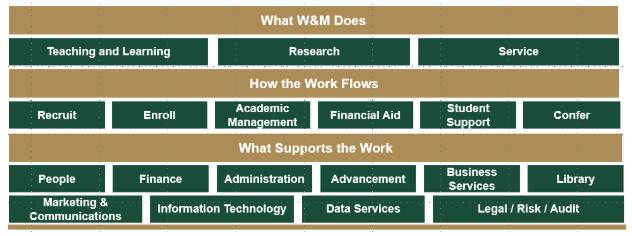
From University Activity to Trusted DataTrusted data starts with understanding the university activities that create and use it. W&M’s Activity Model provides a shared view of what the university does, how key work flows, and what supports that work.
These activities create and use institutional data. Data governance provides the shared meaning, stewardship, quality, trusted sources, access, and responsible-use practices needed to turn that data into trusted information. |
||||||||||||||||||||||||||||||
Protecting and Using Data ResponsiblyManaging university data responsibly means considering how information is accessed, protected, shared, retained, and used throughout its lifecycle. W&M uses governance, security, privacy, access controls, stewardship, and university policies and standards to help ensure institutional data is available to people who need it while being appropriately protected. Access to institutional data is based on factors such as role, business or academic need, authorization, data sensitivity, and responsible use. W&M works to use only the information needed for the intended purpose and to support responsible use of data in reporting, analytics, automation, and AI. This includes coordinating priority legal, regulatory, privacy, security, and reporting requirements so responsibilities and obligations are understood and monitored over time. |
||||||||||||||||||||||||||||||
Data Quality and TrustTrusted decisions depend on trusted information. W&M works to identify and address data that may be incomplete, inaccurate, inconsistent, outdated, duplicated, or unclear. Data quality is a shared responsibility involving the functional areas that understand the information, the technology and data teams that manage it, and the people who use it. For institutional reporting and analytics, W&M also works to establish consistent definitions, business rules, timing, and trusted sources so information can be understood and used appropriately. |
||||||||||||||||||||||||||||||
Governance Across W&MData governance is coordinated across the university through the Data Governance Advisory Council and supporting teams and working groups. The Data Governance Advisory Committee (DGAC) provides university-wide guidance and oversight for institutional data governance and helps align governance priorities with university strategy, operational priorities, reporting obligations, analytics needs, and institutional risk.
Supporting teams help put governance into practice across university activities:
|
||||||||||||||||||||||||||||||
Governance in PracticeW&M is continuing to mature its data governance and data management capabilities through a coordinated W&M Data Program beginning January 2027. The program is focused on strengthening shared definitions, stewardship, data quality, trusted sources, access, regulatory reporting, records retention, reporting and analytics, and related data management practices across the university. This work is being implemented over time and reflects an ongoing leadership focus on making institutional data more trusted, usable, and responsibly managed. Progress will be demonstrated through defined responsibilities, operating practices, and evidence that priority capabilities are working as intended.
|