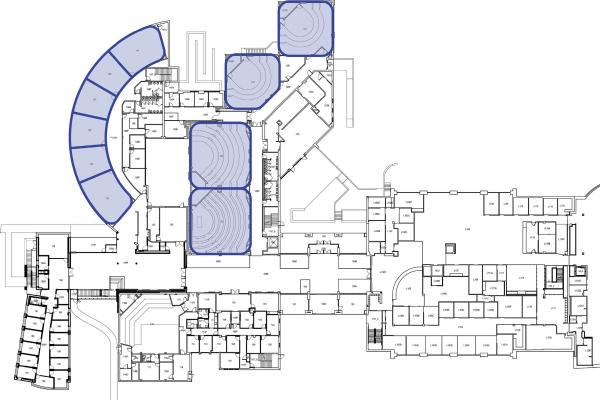
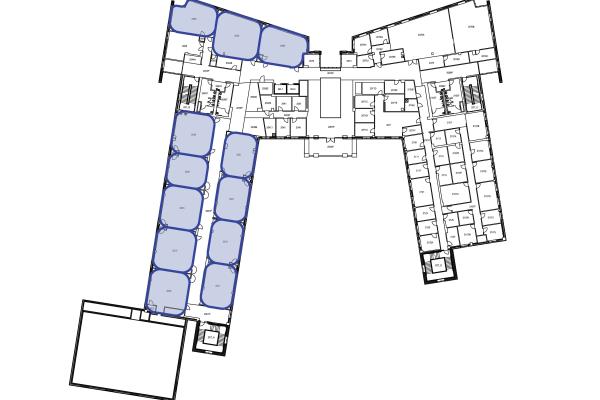
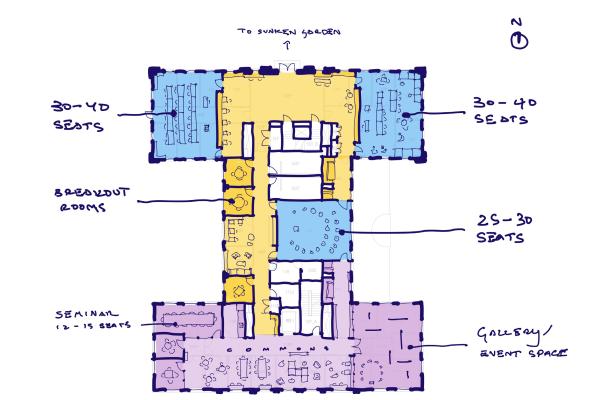
Learning Spaces Prototypes
Instructional Neighborhoods
To support a vibrant academic core, the plan strengthens existing clusters of buildings — creating active, diverse learning spaces that are always within easy reach for students and faculty. These instructional neighborhoods form a framework for investing in facilities that work together as a connected ecosystem, offering more than the sum of individual classrooms. Within each neighborhood, a mix of classroom sizes and types ensures that students and faculty can access the right spaces near their home departments or buildings.
Renovation Strategy
Not all classrooms are created equal, and future investment can be tailored to the unique characteristics of each room. The Learning Space Plan guides investment in classrooms by providing a clear framework for
different types of renovations. There are four main categories:
- Maintain & Support: Ongoing investment is needed to keep classrooms in good condition. This includes routine upgrades to room fit-out and technology — such as projectors, furniture and finishes — to ensure consistency across the classroom inventory. Sample buildings in this category include Chancellors, School of Education, Music Arts Center and Swem Library.
-
Minor Renovations replace or refresh most elements within an existing classroom envelope. Typical improvements include new paint, carpet, ceiling/lighting, window treatments, furniture and updated technology. The Law School and Boswell (interim) and Jones (interim) are included in this category.
-
Moderate Renovations involve reconfiguring interior partitions to right-size classrooms, or modifying tiered floors to better support active learning and flat-floor layouts. Building such as Small, Andrews, and James Blair would be suitable for moderate renovation. These projects may also create small-scale informal learning spaces.
-
Major Renovations are holistic projects that fully reimagine academic spaces. Major renovations are part of large-scale capital projects that address not only classroom needs but also overall building program, infrastructure and deferred maintenance.
Together, these investments ensure that every instructional neighborhood contributes to a stronger, more accessible learning environment.
 Skip to main content