Close menu William & Mary

Learning Spaces Plan

The Learning Space Plan (pdf) establishes a path for the enhancement, investment and transformation of learning spaces at William & Mary. The plan codifies principles and guidelines, leverages capital investment and establishes instructional neighborhoods to optimize the quality and quantity of learning space on campus over the next ten years. The Learning Space Plan serves as a roadmap for transforming our physical environments into dynamic, inclusive and future-ready settings that empower every learner to thrive. 

Collapsible table listing Learning Spaces Planning Committee members.

Learning Spaces Planning Committee

  • Carrie Cooper (Chair), Dean of University Libraries
  • Adam Barger, Executive Director, Studio for Teaching & Learning Innovation
  • Gerald Bullock, Executive Director of Development, Arts & Sciences
  • Jason Chen, Associate Professor of Educational Psychology
  • Morgan Cook-Sather '25, W&M Student Representative
  • Andrew Crawford, Deputy Chief Information Officer
  • Alana Davis, Associate Provost and University Registrar
  • Tatia Granger, Associate Professor in Organizational Behavior
  • Amber Hall, Senior Project Manager; Facilities Planning, Design & Construction
  • Richard Whitmore, Deputy Athletics Director, W&M Athletics
  • Graham Henshaw, Assistant Provost for Entrepreneurship
  • Margaret Hu, Professor of Law
  • Brian Kreydatus, Professor of Art & Art History
  • Henry Millar '24, W&M Student Representative
  • Wilmarie Rodriguez, Ed.D. '21, Asst. Vice President for Student Success
  • Dan Runfola, Assistant Professor of Applied Science
  • Margaret Saha, Chancellor Professor of Biology
  • Martha Wescoat-Andes, Senior Associate Provost for Planning & New Ventures
  • Tim Russell, Director, Strategic Space Planning

Learning Space Principles

The Learning Space Principles were developed in collaboration with the Learning Space Planning Committee and are intended to guide the planning, design and renewal of all campus learning environments. Informed by input from faculty, staff and students during the planning process, they are intended to serve as a common reference point for all types of learning environments — from classrooms and labs to studios and informal gathering areas—ensuring that every space supports meaningful, student centered learning.

  • Support multiple modalities.

    Learning environments should support multiple learning modalities such as lecture, discussion, breakout groups and discipline-specific activities (e.g., dance, art, theater).

  • Encourage idea sharing.

    Learning environments should have ample writing surfaces and display screens to allow for seamless sharing of ideas and information.

  • Create a safe & supportive environment.

    Learning environments should be comfortable spaces, support well-being and provide diverse seating options.

  • Foster interaction.

    Faculty and students should be able to interact easily and naturally, before, during and after class.

  • Enable easy movement.

    Instructors and students should be able to move smoothly throughout the entire learning space.

  • Promote informal learning.

    Formal learning spaces should be complemented by adjacent informal learning areas for breakout sessions or after-class discussion.

  • Integrate technology.

    Technology should be integrated to support learning activities; digital and physical learning environments should be unified.

  • Embrace universal design.

    Prioritize universal design and accessibility to better address learning variability.

  • Expand sharing & interdisciplinarity.

    Learning spaces should support shared use and interdisciplinary activity.

  • Strengthen central management.

    General-purpose classrooms should be centrally managed, with departmental assignment of specialized learning spaces.

Learning Spaces Prototypes

Instructional Neighborhoods

To support a vibrant academic core, the plan strengthens existing clusters of buildings — creating active, diverse learning spaces that are always within easy reach for students and faculty. These instructional neighborhoods form a framework for investing in facilities that work together as a connected ecosystem, offering more than the sum of individual classrooms. Within each neighborhood, a mix of classroom sizes and types ensures that students and faculty can access the right spaces near their home departments or buildings.

Renovation Strategy

Not all classrooms are created equal, and future investment can be tailored to the unique characteristics of each room. The Learning Space Plan guides investment in classrooms by providing a clear framework for
different types of renovations. There are four main categories:

  • Maintain & Support: Ongoing investment is needed to keep classrooms in good condition. This includes routine upgrades to room fit-out and technology — such as projectors, furniture and finishes — to ensure consistency across the classroom inventory. Sample buildings in this category include Chancellors, School of Education, Music Arts Center and Swem Library.
  • Minor Renovations replace or refresh most elements within an existing classroom envelope. Typical improvements include new paint, carpet, ceiling/lighting, window treatments, furniture and updated technology. The Law School and Boswell (interim) and Jones (interim) are included in this category.

  • Moderate Renovations involve reconfiguring interior partitions to right-size classrooms, or modifying tiered floors to better support active learning and flat-floor layouts. Building such as Small, Andrews, and James Blair would be suitable for moderate renovation. These projects may also create small-scale informal learning spaces.

  • Major Renovations are holistic projects that fully reimagine academic spaces. Major renovations are part of large-scale capital projects that address not only classroom needs but also overall building program, infrastructure and deferred maintenance.

Together, these investments ensure that every instructional neighborhood contributes to a stronger, more accessible learning environment.

Conceptual Designs

These images are conceptual designs. Additional planning and design will follow the normal capital project process as each individual process secures projects. 

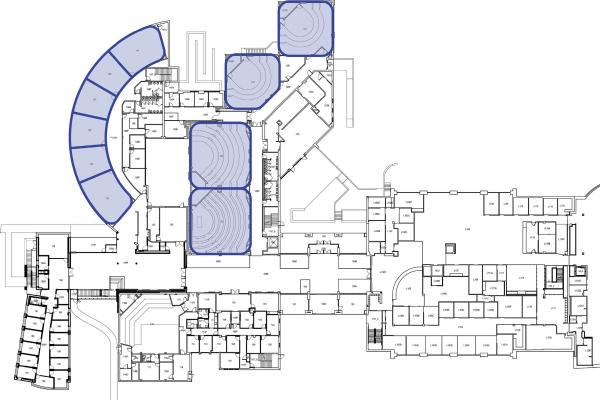
Conceptual plan of improvements to a School of Law classroom showing specific rooms targeted for renovations.

Law School

An example of minor strategic renovation. While room sizes are generally adequate for current and estimated future enrollment, there is an opportunity to provide some additional flexibility for a range of teaching styles and co-curricular and special events within existing spaces.

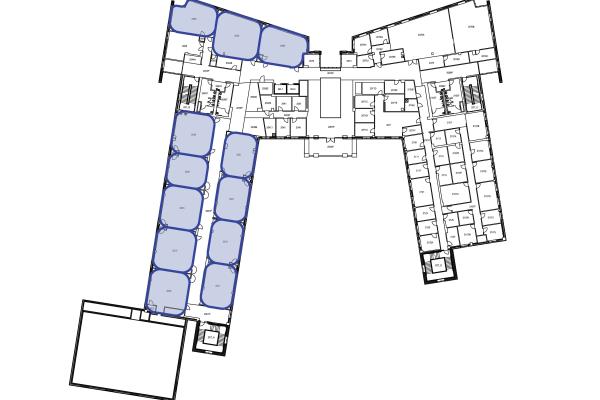
Conceptual plan of improvements to a School of Education classroom showing specific rooms targeted for renovations.

School of Education

An example of strategic minor renovation. Classrooms within the School of Education have flexible layouts that can easily adapt to a range of teaching and learning activities. The Learning Spaces Plan recognizes that these spaces must continue to be sustained into the future, including replacement and evolution of technology reaching the end of its lifespan.

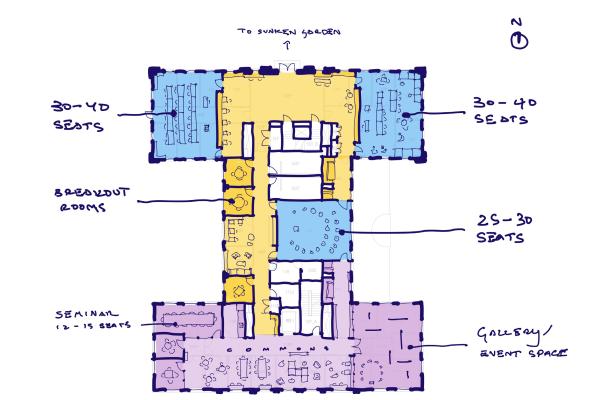
Conceptual plan of improvements to a building in Historic Campus showing the specific rooms targeted for renovations.

Historic Campus Traditional Building

An example of major strategic renovation. Historic buildings can present unique challenges when renovating for contemporary learning spaces. With that in mind, there are creative ways to work within these constraints and find a balance between meeting contemporary needs while respecting history.

Read the Campus Comprehensive Plan

If you experience any difficulty accessing the information due to a disability, please contact us at [[campusplan]] for assistance. The following is provided in PDF format.