 Skip to main content

Building trust and confidence one word at a time
By Kate Hoving
If you have ever tried to speak in something other than your native language, you know how easy it is to get tongue-tied or embarrassed. And negotiating life in a new environment while also getting used to a new academic routine and expectations is challenging in any language.
Various apps promise simultaneous translation and conversational fluency in just a few weeks, but they’re not much help when you’re trying to chat casually with a fellow student over coffee or speak up in a class. And then each time it doesn’t go easily, you’re more likely to retreat further into silence or worse, isolation. For international students, not being able to communicate well or navigate a new system can have real consequences for their degree and career outcomes.
To address this need, the Office of International Students, Scholars and Programs (ISSP) at the Reves Center, manages two programs: the Virtual Conversation Partner Program (VCPP), for help in language skills; and the International Peer Leader Program, which provides guidance and friendship to new, incoming students.
Lauren Devan is International Programs Coordinator & Advisor at the Reves Center and matches student partners for both programs in June in preparation for fall semester. The conversation program is voluntary and meetings are virtual.
Students are matched from all across campus, regardless of school affiliation. So, a student in the College of Arts & Sciences may be matched with a student from the Business School. Or two students within the same college with different academic programs may be matched together, such as a history major and an anthropology major. However, in general, undergraduates are paired together and graduate students are paired together.
The VCCP has a clear framework and process. “After I pair the students, I send them both a template for an agreement, where they not only affirm their commitment to the program, but also lay out the parameters. They agree how many times they will meet, at what time. They also decide what things they are and aren’t going to talk about. They decide these things between themselves.”
Once they have crafted their agreement, the students send it to Devan. “Then I’ll begin sending them bi-weekly emails, where I suggest a fun topic for them to discuss, just in case they get stuck.” They’re not obligated to keep to the suggested topic, but the emails help to give the program structure and also help Devan stay in touch with the students to see how things are progressing.
Once the students arrive on campus the program officially ceases. “Usually just before orientation, my emails stop. I do encourage people to stay in contact with one another, but it’s really in their hands after that.”
Coming to W&M
Sulaiman Khan is a PhD student in applied science in CDSP with a focus on biomaterials, musculoskeletal disorders and tissue engineering. He is from Pakistan and in the second year of his program at William & Mary. He is both an International Peer Leader and a Virtual Conversation Partner, and he volunteers because he understands the challenges for a first-time international student. It was not his first time studying abroad when he came here -- he had done his master’s in Malaysia, an internship in Taiwan – and he was proficient in English, but it was his first time studying in the U.S., and he still felt he needed to improve his skills. “We’re taught British English in Pakistan, so it could sometimes be confusing, with the different words of American English.” He took theater and presentation classes to improve his public speaking.
This past summer, he was in Williamsburg, busy going to the lab every day for his research, but he missed being able to talk with family and friends back home because of the time difference. “I was looking for a way to connect with people, and although I had a couple of conversation partners already, I said to Lauren, ‘Oh, I can take one more.’”
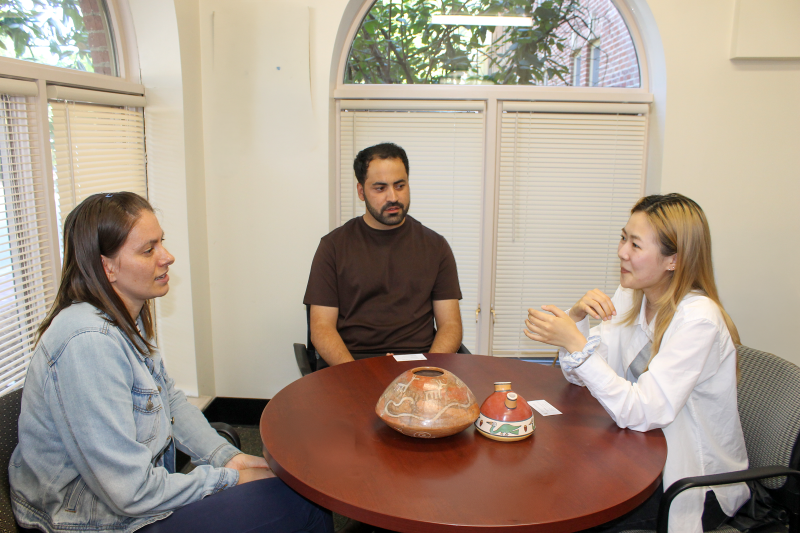
And so Devan matched Khan with Zhi Yang, also a PhD student in CDSP, but with a concentration in data science. She was arriving at William & Mary this fall from China, and although she had visited the U.S. once before with a friend as a tourist, this would be her first time as a student.
A dialogue begins
Yang signed up for VCCP because she felt she needed to improve her spoken English skills. “I knew to succeed I needed to talk in class or need to attend a conference or give a talk in public,” she explains. “If I were afraid to talk with other people, it might affect my PhD program. I needed to find the courage to practice communication, so I joined the program to improve my English. I also wanted to know different people from different countries.”
For their first meeting, they stuck to the fundamentals. They introduced themselves, learned how to pronounce each other’s names and talked about their research.
But it was a major step for Yang. “In our first conversation, my English was not very good, and there were so many words I couldn’t understand,” she remembers. “But when the conversation continued, suddenly I could understand some of what he said, and I began to talk. Before that, I hadn’t talked to anyone in English for that long. Sulaiman has helped me improve a lot.”
Khan established an easy pace, understanding that the first and most important thing he needed to do was establish a bond and trust between them.
“I was trying to be friendly and also keep that professional distance between us,” he explains. “I wanted to help her feel that this was a safe space to communicate with me.”
One thing that helped establish an initial comfort level, was that Khan had learned some Chinese during an internship in Taiwan. “I spoke a few words– words like Xièxiè, which means thank you – so that she would see me as a good partner.”
He also resolved not to rush Yang or the process.
“It was important to be patient, to wait for her, to pronounce the correct words and help her understand the different meanings. I wanted to let her take her time.”
They met six or seven times over the summer, and their talks became easier and more comfortable. The length of their meetings varied – 30 or 40 minutes or sometimes an hour – depending on what they were discussing. “We were flexible with the time,” Yang says, “and that made it more comfortable. If we had to fill a set amount of time, it might have felt more forced.”
Adjusting to being on campus
Because Khan is also Yang’s International Peer Leader, their connection continued after VCPP finished. “I’ve been guiding Zhi’s transition to William & Mary.”
It isn’t common for conversation partners to be Peer Leaders, too, but in this case, it has made Yang’s experience even smoother. “The International Peer Leader (IPL) Program is a virtual summer program where IPLs mentor a group of new undergraduate or graduate international students by answering questions before and after their arrival and helping to welcome new students to the W&M community,” Devan explains. “IPLs introduce new students to the university from a student perspective and help guide new students through their William & Mary experience. It differs from the VCPP program in that VCPP is specifically for English conversation. It just so happens that in this case Khan is both her peer leader and conversation partner.”
The two met in person during orientation. Khan began including her in activities right away. “We were having a dinner that included international students from all over -- China, India, Pakistan, Bangladesh -- so I invited her.” He cooked roast lamb, and other students brought dumplings and assorted delicacies.
Yang appreciated his invitation and learned something new and unexpected about her conversation partner. “He’s a chef! It was delicious!”
She also learned that although she had worried about meeting people and fitting in, thanks in large part to Khan’s mentorship, she already was feeling she belonged.
 Life as students
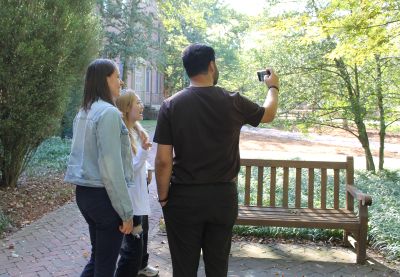
Khan has continued to assist Yang with guidance in matters – large and small – that are new for her, for example reminded her to pay her health insurance premium before the deadline.
Both students have support from their graduate supervisors as well.
It’s helped Yang, that she was able to work with her supervisor, Jindong Wang, assistant professor of data science, before she came to campus. “He is also from China, so we can communicate very well.” But Wang has found other ways to help her feel at home. “On weekends, he will ask me whether I need to go to the supermarket, and he will take me there.”
According to Khan that kind of thoughtfulness from faculty is not uncommon, although it may come in different forms.
“My supervisor is Assistant Professor of Applied Science Indranath Mitra, who is from India,” Khan explains. The relationship between Pakistan and India is complex and often tense. “When I was gaining admittance to William & Mary and getting my visa, there was a border war between the countries. And [Professor Mitra] emailed me, ‘You don’t have to worry about these things. We are good to each other. Just ignore the politics. Come to the U.S.”
Life in Virginia
There will always be adjustment in moving to a new place, especially when it’s to Williamsburg.
It’s a radical change for Yang. “I used to live in Shenzhen, and it’s a big city, and quite different from Williamsburg, which is a small town.” And the difference for Yang is not just in square miles and amenities. “The buildings are very low compared to where I lived before. I was on the 18th [LD1.1]floor. It was very stressful for me. I couldn’t see the sky. But when I came here, I could see the sky and the sunset. I can see very far away, with a clear view of the horizon. It opens my mind and comforts me when I go home after class.”
Khan has also embraced the differences. “I’ve been to a lot of places. I was in Malaysia. I’ve been to Taiwan, The Netherlands, Singapore, my home country, Pakistan. I love Williamsburg. And really, it all depends on your circle and on the activities you do and the people you meet. I feel as if I’m home.”
Measuring success
So how is success measured in these programs?
For Devan and the staff of Reves, the goal of VCPP and the International Peer Leader program is to make sure the new students get connected to other people and resources on campus. That surely happened.
Yang began the summer with the goal of feeling more comfortable speaking in English and making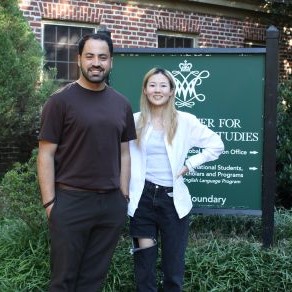 friends with other international students. She has achieved that.
Khan, who feels deeply his commitment and responsibility in both programs, measured success a little differently, and his feeling of accomplishment came from an astute and characteristically sensitive observation.
It came to him at that first party on campus to which he’d invited Yang, when he saw her taking photos with the other guests.
“She told me, ‘I got a lot of friends!’ Then she connected with everyone on Instagram. They exchanged numbers, and she has been quite busy with them ever since. And I thought to myself, ‘That was my goal. She’s okay now.’”