Faculty Mentors
Dr. Robert Rose, Dr. Heather Broughton
Project Description
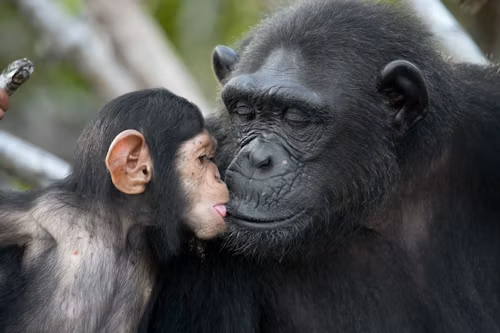
Across eastern Democratic Republic of the Congo (DRC), some of the world’s most important remaining forests face growing threats, placing exceptional biodiversity at risk. Grauer’s gorillas and eastern chimpanzees are among the globally threatened species found in these forests, yet much of their remaining habitat lies outside formally protected areas. Their long-term survival therefore depends on effective, community-based approaches to conserving forests at landscape scales. The Nkuba Conservation Area (NCA), established in 2012 through a partnership between the Dian Fossey Gorilla Fund and local communities, offers an important opportunity to understand what effective conservation can look like in such a landscape. Encompassing ~2,400 km² of intact forest within a biodiversity corridor between Maiko and Kahuzi-Biega National Parks, the NCA has maintained relatively stable ape populations over the past decade, in contrast to declines documented elsewhere across their range. Understanding the ecological conditions underlying this stability could provide valuable lessons for sustaining threatened species and their habitats beyond the boundaries of formal protected areas.
Despite this apparent conservation success, fundamental aspects of Grauer’s gorilla and eastern chimpanzee ecology remain poorly understood. We propose to combine remote sensing, geo-referenced species occurrence data, and complementary ecological information such as forest phenology to examine how forest conditions shape habitat use within the NCA and surrounding landscape. We will characterize spatial and temporal variation in forest structure and land use, then use these data to model habitat use and identify similarities and differences between the two ape species. Specifically, we will (1) identify key areas of habitat overlap and differentiation and (2) assess how habitat use and forest conditions have changed since the onset of conservation efforts. By linking landscape-scale environmental change with ape ecology, this project will generate insights into why populations may persist in this landscape and provide an evidence base for strengthening community-based conservation and management of this critical forest ecosystem.
Skills and Prereqs
Background in GIS required.
Travel
Research will be done remotely from Williamsburg, but will focus on the Democratic Republic of Congo
Notes for Applicants
This project is a good fit for students interested in primate conservation, landscape ecology, remote sensing, GIS, and community-based conservation. Students should be comfortable working primarily with spatial and ecological datasets and bring strong analytical skills, attention to detail, curiosity, and an interest in understanding how landscape change influences threatened species and their habitats.
Number of Students
One
Project ID - Format
27-008-27- CRP Year
Interested in this project?
Review the CRP application requirements and submit your application by October 25, 2026.
 Skip to main content