 Skip to main content
Washington Hall
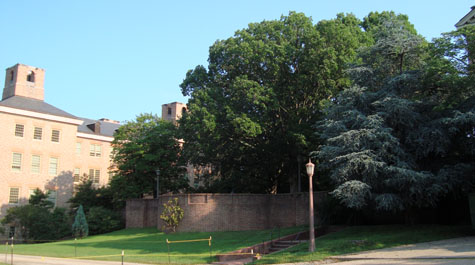
Cedrus atlantica glauca
The Blue Atlas Cedar (right), at the southwest corner of Washington Hall.
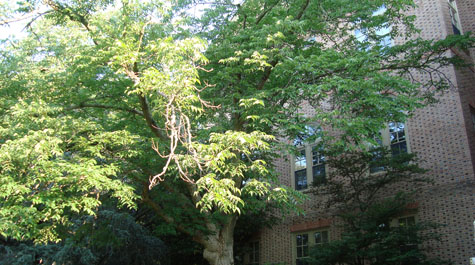
Phellodendron amurense
Amur Corktree.
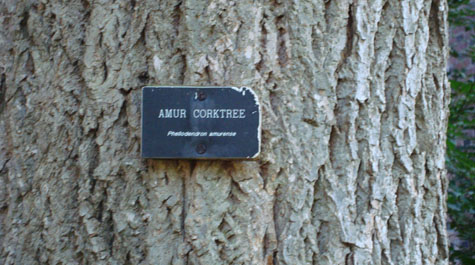
Phellodendron amurense
Closeup of the Corktree, showing its distinctive bark.
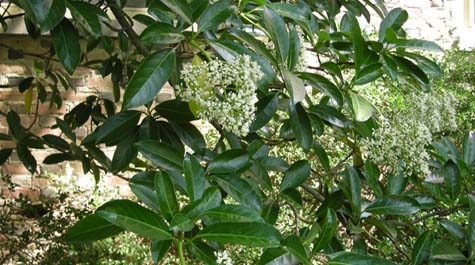
Camellia sp.
Delicate white blossoms appear on this Camellia in early June.
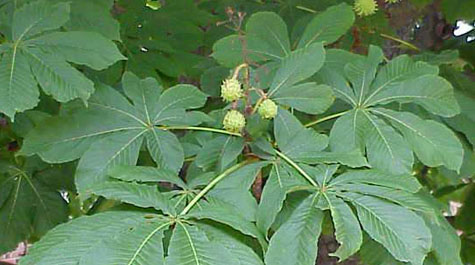
Aesculus hippocastanum
The leaves and immature fruit of the Horse Chestnut.
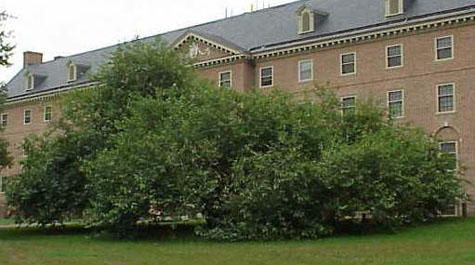
Morus alba
A low, spreading White Mulberry, framed by Jefferson Hall.
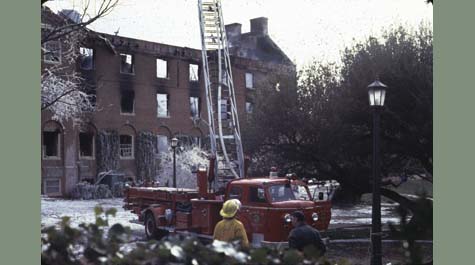
1983
The Mulberry tree largely escaped damage in the 1983 fire at Jefferson Hall.
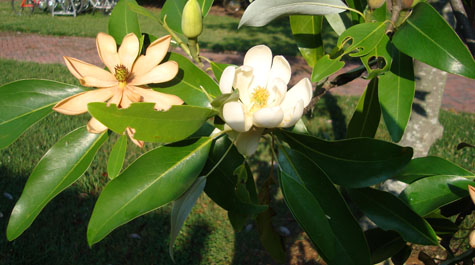
Magnolia virginiana
Sweetbay Magnolia.
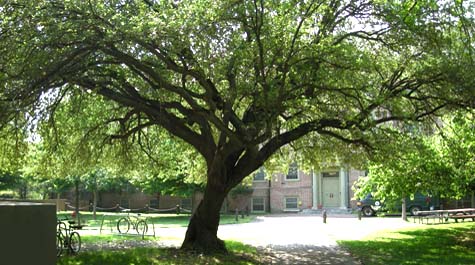
Quercus virginiana
The Live Oak is prized for its graceful, spreading habit.
The Southwest Tree Cluster
The southwest corner of Washington Hall features a striking ensemble of trees that offer unique textures throughout the year:
- Blue Atlas Cedar (Cedrus atlantica ‘Glauca’): Known for its magnificent silvery-blue needles.
- Amur Corktree (Phellodendron amurense): A unique species native to China that adds structural interest to the grouping.
- Horse Chestnut (Aesculus hippocastanum): Completes this diverse botanical ensemble.
- Camellia (Camellia species): Provides seasonal floral interest near the building.
Notable and Award-Winning Oaks
South of Washington Hall, you will encounter species that challenge the typical image of an oak tree:
- Loquat Oak (Quercus rysophylla): Introduced from Mexico in the 1970s, this semi-evergreen oak features elongated, deeply veined leaves. It was honored as "Tree of the Year" in 2016 by an International Horticultural Society.
- Live Oak (Quercus virginiana): An iconic evergreen oak native to the Southeast and one of the earliest cultivated species on the William & Mary campus.
The Historic White Mulberry
Standing as a witness to campus history, the mature White Mulberry (Morus alba) in this area is a rare specimen.
- Origins: The species was originally introduced in colonial times to support a silk industry that never fully materialized.
- Significance: This specific tree is potentially one of the largest and oldest of its kind in the United States. It famously survived the Jefferson Hall fire in 1983 and is noted for its unusual spreading growth habit.