 Skip to main content

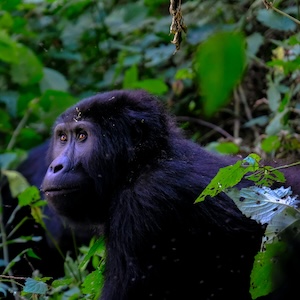
Spatiotemporal Patterns of Waterborne Disease Transmission between Livestock, Gorillas, and Humans in Bwindi, Uganda
Research Location:
Bwindi, Uganda
Conservation Partner:
Conservation Through Public Health and Makerere University
Faculty Mentors
Dr. Scott Ickes, Dr. Sapana Lohani, Dr. Heather Broughton
Student Researchers
Saoirse Dowd '27, Major: Integrative Conservation; Minor: BiologyHelen Tiffin '26, Majors: Geology and Integrative Conservation
Akumu Mary (Makerere University)
Kizza Steven (Makerere University)
Project Description
W&M and Ugandan students worked withConservation through Public Health to explore potential patterns of water-borne disease transmission between livestock, gorillas, and humans in Bwindi, Uganda.
The impacts of climate change on health and disease incidence, particularly zoonotic diseases, are well documented and are on the rise. For nearly 20 years, Conservation through Public Health (CTPH) has been conducting a comparative disease analysis of zoonotic disease prevalence among gorillas, livestock, and people living near the critical Mountain Gorilla habitat in Bwindi Impenetrable National Park (BINP).
Using a mixed methods approach, W&M and Ugandan students explored spatiotemporal patterns of water-borne disease transmission to explore the associations and impacts between gorillas, livestock, and people. From community surveys, the research revealed water scarcity may be influencing how humans use water and are potentially vulnerable to waterborne diseases. Fecal analysis revealed that livestock may be transmitting waterborne disease through non-water borne diseases, suggesting that managing livestock is key to prevention of disease in gorillas and humans. This research will inform CTPH's management of cross-species disease transmission, which is vital for the survival of mountain gorillas and the health of local communities.
Project ID - Format
25-002-25 - CRP Year