 Skip to main content

Development of Inexpensive and DIY Water Sensors to Advance Community-Led Nature-Based Conservation Solutions
Research Location:
Lake Aloatra, Madagascar and Williamsburg, Virginia
Conservation Partners:
Conservation International Madagascar and the Moore Center for Science
2026 Student Researchers
Amany Shahata '27, Major: Biology, Minor: Integrative Conservation (intended); 2026 CRP
Abby Lane’28, Major: Biology, Minor: Integrative Conservation; 2026 CRP
Past Student Researchers
Mandy Joyce '26, Majors: Integrative Conservation and Environmental ScienceCy Strain-Seymour '26, Majors: Computer Science and Linguistics
Leo Eichers '25, Major: Chemistry; Minor: Geology; CRP 2024
Jacob Timko '24, Major: Biology; Minor: Biochemistry; CRP 2024
Fiona Gordon '25, Major: Physics; CRP 2023
Sophia Holincheck '24, Majors: Chemistry and Computer Science; CRP 2023
Faculty Mentors
Dr. Nathan Kidwell and Jonathan Frey (2023-2024)Project Description
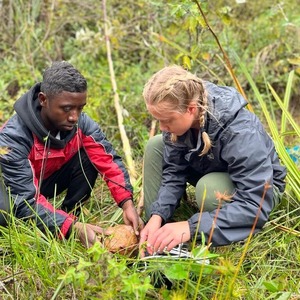
A team of William & Mary and Malagasy students is working with Conservation International Madagascar, the Moore Center for Science, and faculty mentors to develop a low-cost, do-it-yourself water sensor that will support community monitoring of watersheds in Madagascar.
To effectively protect nature from the cascading impacts of climate change, local communities need support in designing, implementing, and evaluating potential solutions. Nature-based solutions (NBS) leverage sustainable planning, environmental management, and engineering practices to protect or restore natural ecosystem processes. These solutions are essential in promoting adaptation and resilience, especially in water management. However, for NBS to effectively support resilient water resources, local communities need efficient and accessible tools to monitor the impact of their conservation efforts.
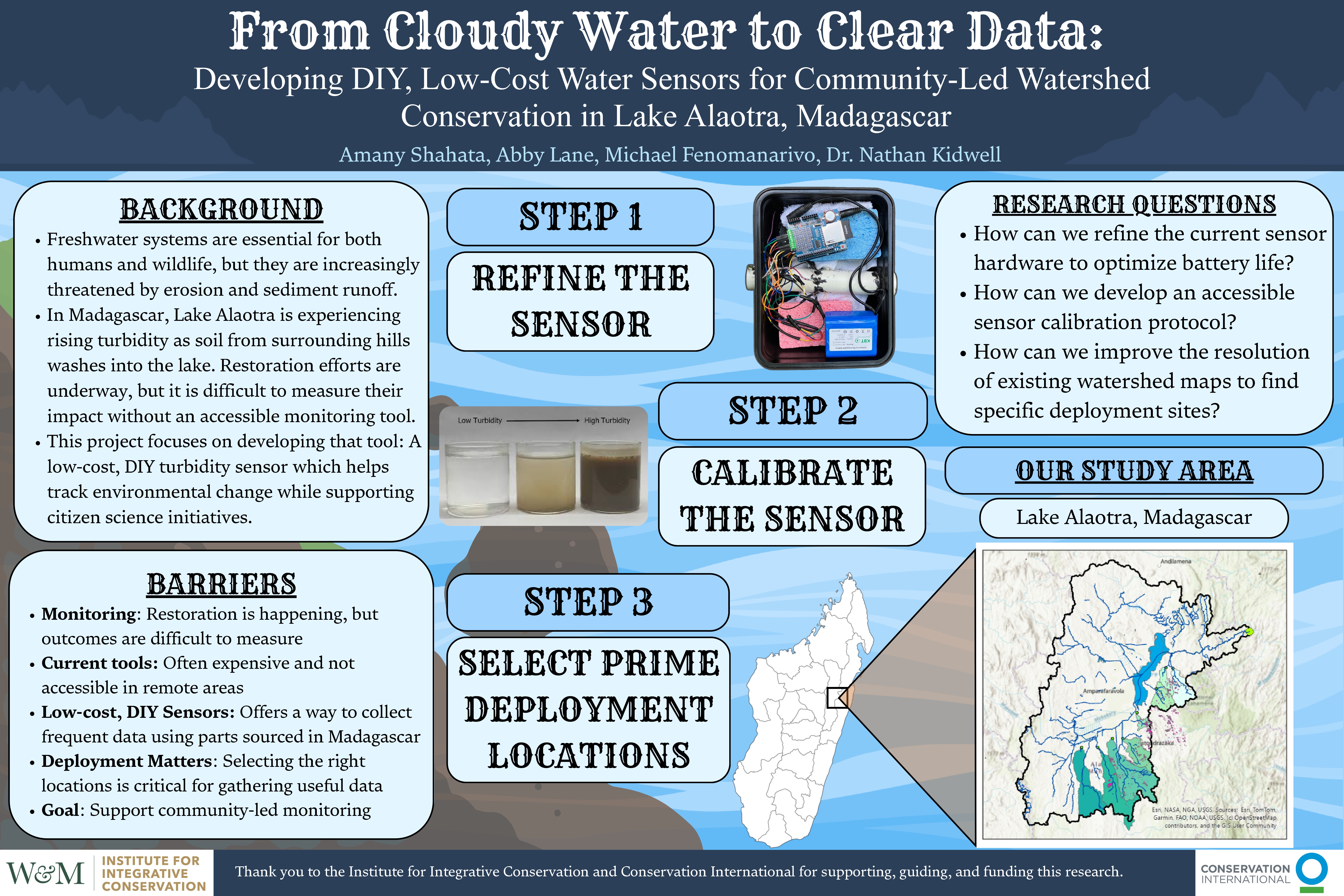
Currently, monitoring community-led NBS is limited by the high costs and inaccessibility of scientific water monitoring tools. To overcome this challenge, there is a need for a low-cost, accessible water turbidity sensor that local communities can develop, maintain, and use to track the effects of NBS in protecting water resources against climate change.
Conservation International (CI)'s Priceless Planet Coalition Project supports Malagasy communities in restoring forest ecosystems to strengthen ecosystem services and enhance the local economy. Despite their success in advancing community-led forest restoration across the Lake Aloatra region of Madagascar, CI and local communities lack the necessary tools to monitor the impact of these landscape-scale restoration efforts on water ecosystems.
To address this gap, William & Mary and Malagasy students are collaborating with CI Madagascar staff, the Moore Center for Science, faculty from the W&M Chemistry Department and MakerSpace, and local communities around Lake Aloatra to develop a low-cost, accessible turbidity sensor that can be made in Madagascar and used by local communities to monitor restoration impacts.
In 2023 and 2024, teams of William & Mary and Malagasy students successfully built a water turbidity sensor out of materials that could be found in Madagascar (e.g., tupperware, sponges, tubing, etc.) for under $30 USD that can be built by and mainted by communities in rural settings in Madagascar. In 2025, a student team worked with their Malagasy partners from CI and local communities to explore where across the watershed the turbidity sensors could be deployed and how to manage and communicate the turbidity data collected by the sensors to support communities with their restoration. In 2026, a student team will work alongside communities and CI Madagascar to improve the sensor and to scale up the community monitoring of restoration across the watershed using the low-cost sensor.
Learn more here: https://www.linkedin.com/pulse/collaborative-innovation-low-cost-water-jd3ye/?trackingId=iXjrgvFsS3qB6TjM3H3qeA%3D%3D
Caption: