 Skip to main content
People are the Solution in Conservation: A new DC Winter Seminar Course
People are the ultimate solution to the conservation challenges we face. Human society is straining the natural and physical systems of the planet through actions such as over-extraction, consumption, habitat change, and pollution. Though this is bad news for biodiversity, it also means that changes to people’s behavior can be at the heart of sustainable and achievable action that reduces these threats. This is the premise of a new winter seminar course that the Institute for Integrative Conservation (IIC) recently taught to eager undergraduates based out of the William & Mary Washington Center: CONS 415 People-centered solutions for conservation and climate.
|
|
|
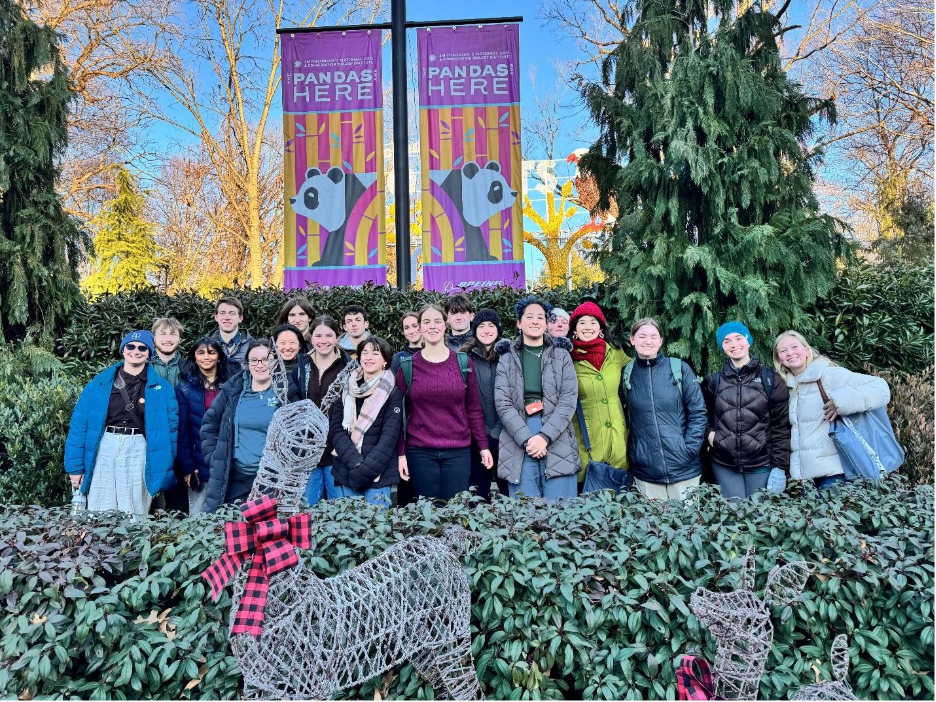
CONS 415 students learning about people-centered conservation at the National Zoo. Photo credit María Isabel Dabrowski. |
The IIC partnered with a non-governmental organization (NGO), Rare, who were crucial to the success of the course. Rare has a tremendous track record of working with communities around the globe to co-design behavior change programs that bring about benefits for people and the environment.
“Rare brings decades of leadership and deep expertise in conservation behavior change, and partnering with them gave our students the incredible opportunity to learn directly from practitioners who are driving conservation impact around the world. Even more importantly, through Rare’s connections, students worked on a real-world conservation challenge, moving beyond theory to design solutions that matter in practice.” – Robert Rose, Executive Director, IIC
Not only did students learn the core principles and methods of behavior-centered design, they applied this to generate recommendations that would increase uptake of composting by residents of multi-family apartment buildings in Arlington, Virginia. Food waste is a significant source of methane, a highly potent greenhouse gas. Reducing food waste can save residents money, increase sanitation, and provide compost that can grow further plants and vegetables. If we can increase composting, everyone wins.
Kate Mannle and María Isabel Dabrowski from Rare expertly structured applied classes and data collection sessions in partnership with community clients: EcoAction Arlington and Arlington County Government.
“There’s a moment when behavioral science insights click for a person; you can see them actively thinking about the role behavioral levers and frameworks can play in their work. To see an entire class of driven students come to this realization and apply their understanding to a real project is an absolute inspiration.” – María Isabel Dabrowski, Senior Outreach Associate, Rare
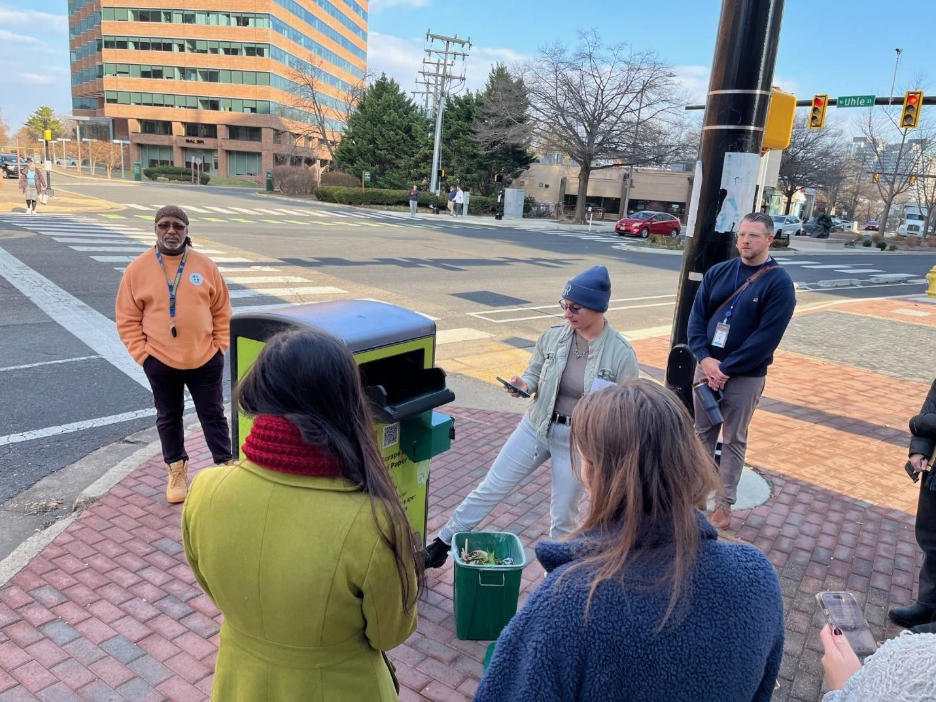
Arlington County has deployed Big Belly receptacles in communities to promote composting. The IIC class worked toward solutions that would increase people’s use of those bins outside apartment complexes. EcoAction Arlington works with community groups to promote environmental action, including composting.
|
|
|
W&M student Icarus Landaker using a Big Belly food waste receptacle in Arlington, Virginia, while Bill Campbell (orange shirt) from EcoAction Arlington looks on. Photo credit John Swaddle. |
Students in the course conducted a focus group with apartment residents, made direct observations at the apartment building, and consulted with Rare mentors and community partners to generate behavior-based recommendations. This culminated in a dynamic pitch competition, where teams summarized their innovations.
“The quality of the pitches was truly impressive. Students clearly listened closely to community members and partner organizations, and you could see those insights thoughtfully reflected in practical, innovative solutions.” – Kevin Green, Senior Vice President of Global Solutions, Rare
|
|
|
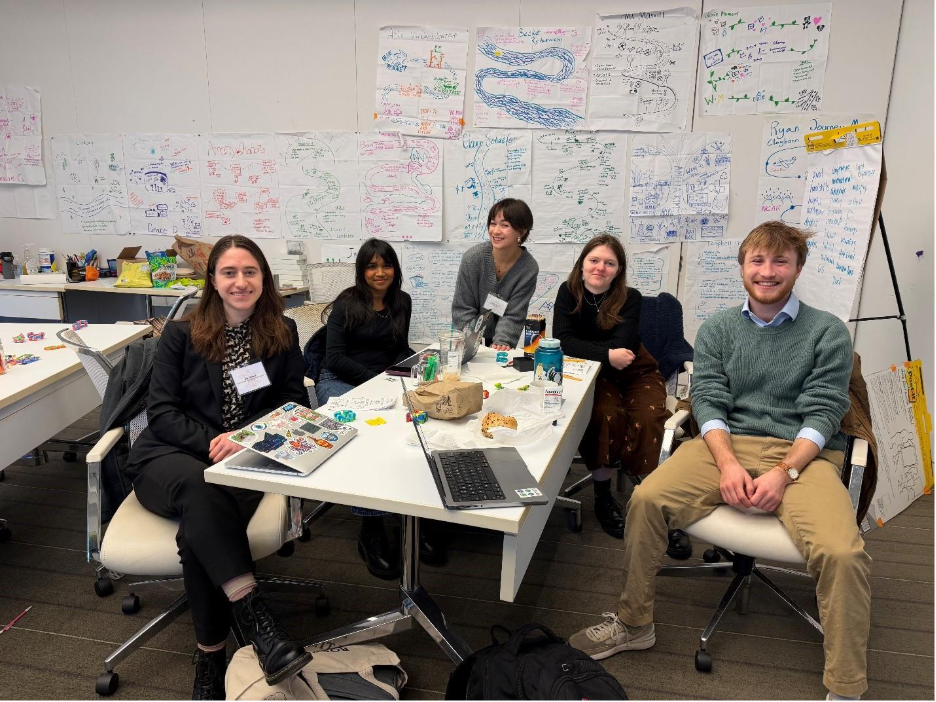
W&M students Anna Rousos, Gracie Gomes, Grace De La Cruz, Jamie Plumeri, and Jacob Herz (left to right) working on their team’s solutions at the Rare offices. Photo credit María Isabel Dabrowski. |
These innovations included working with existing building community events (e.g., free food distribution Wednesdays), removing friction points (e.g., offering free kitchen composting containers to residents), tailoring information campaigns (e.g., strategically placed flyers), and continuing to foster relationships with building management and residents.
“The student presentations were simply superb. I was blown away by the level of critical thinking, empathy and care that the proposals exhibited.” – Bill Campbell, EcoAction Arlington.
Not only did the students produce actionable ideas, they also learned a lot along the way.
“Centering people and behavior change in conservation can empower communities to practice sustainable behaviors that align with their goals instead of working against them. I hope to take this perspective into my future work in environmental policy… I wasn't sure exactly where my professional career was headed before my time in DC, and I've learned through this program that that is okay. I had the opportunity to listen to and speak to so many interesting people with very different perspectives, careers, and paths to where they are now. There is no formula for a successful conservation career — you have to make your own. After getting these insights, I know now that I want to do environmental policy work and that I can forge my own unique path to get there." – Grace De La Cruz (’27)
This course typifies the approach of the IIC. We live at the connection between knowledge and action in conservation. Students addressed an important conservation challenge, supported the goals of community partners, gained incredible professional skills, and made career connections. This impact helps foster the next generation of conservation problem solvers.