Skip to main content
Institute for Integrative Conservation students and alumni inspire on Homecoming & Reunion Weekend
Williamsburg, VA — This October William & Mary welcomed thousands of alumni, students, faculty, and friends back to campus for its annual Homecoming & Reunion Weekend. This year’s Tribe celebration was infused with special events highlighting the university’s Year of the Environment, and Institute for Integrative Conservation (IIC) alumni took the stage in several signature events connecting W&M's impact on students and the professional field of conservation.
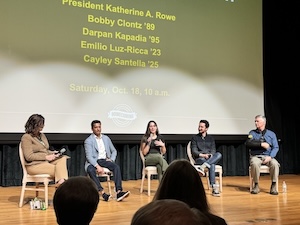 William & Mary alumni Cayley Santella ’25 and Emilio Luz-Ricca ’23 joined the Presidential Conversation, discussing their time at W&M and the IIC, their current conservation work, and how their conservation career paths were inspired and enabled by their experiences in the IIC Conservation Research Program (CRP).
The CRP is a unique program that matches W&M undergraduate students and IIC faculty mentors with external conservation partners to collaboratively develop year-long applied research projects that address real conservation needs. Over the summer, students in the program collaborate to conduct research that advances the goals of its conservation partners. Students are supported in the summer with a stipend provided by the IIC.
 While in the CRP program, Emilio worked on a project in collaboration with IIC partner U.S. Fish and Wildlife (USFWS). They integrated artificial intelligence and thermal imagery to streamline monitoring and counting of Sandhill Cranes, an important North American migratory species. Their innovative work is already improving wildlife monitoring.
Emilio's current research applies machine learning, remote sensing and other tools used to create predictive models that explore how species are responding to human disturbance. He is pursuing his PhD at the University of Cambridge Department of Zoology in the United Kingdom, where he is in the Conservation Science Group and Energy Group. He is part of the AI for Environmental Risks Centre for Doctoral Training, a researcher at the Cambridge Center for Carbon Credits, and a member of Churchill College.
Cayley, along with W&M student Sofia Politte '26, completed CRP work in 2024 with the Virginia Department of Wildlife Resources (DWR). They conducted action-oriented research to increase understanding of decision-making processes that support safe wildlife crossings and reduce animal-vehicle collisions in Loudoun County.
Cayley and Sofia identified key stakeholders, evaluated the effectiveness of proposed mitigation sites using camera traps, and studied strategies for successful implementation. Part of a multi-year initiative, their research was grounded on the 2023 site mapping research by Alexa Busby '24 and provided a foundation for traffic noise studies conducted by Taylor Uem '26 and Percy Zimering '26. Having just graduated in spring '25, Cayley is already working professionally on wetlands delineation as a staff scientist for an environmental services consulting company.
The Conservation Research Program was also highlighted in the success of two other students who spoke at the annual W&M Scholarship Luncheon. Economics student Michael Foley ’26 spent 2023 working with IIC partner Amboseli Ecosystem Trust and Maasai communities in Kenya. Mentored by IIC Research Director Erica Garroutte, Assistant Professor of Integrative Conservation and Sociology, Fernando Galeana Rodriguez, and Graham Henshaw, Director of the W&M Alan B. Miller Entrepreneurship Center, Michael explored equitable governance and benefit sharing in carbon markets as viable livelihood and conservation strategy for Maasai communities.
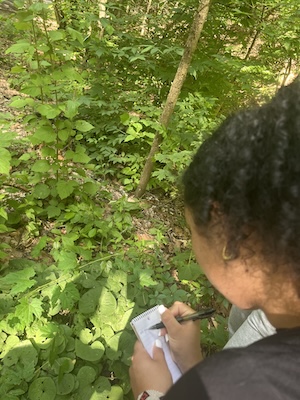 Cindia Romero Araujo ‘26, a Biology major minoring in Education Policy and Equity, applied her passion for conservation, education, and policy to her own CRP project. Mentored by Dr. Troy Wiipongwii, IIC Director of Innovation and Entrepreneurship in Conservation, Cindia discussed her work with IIC partners in the Traditional Eastern Woodlands Foodways Alliance conducting multidisciplinary research to inform the implementation of Indigenous food system and incorporation of Indigenous foods into child nutritional programs. She explored ecological metrics for consideration in scaling Indigenous food systems and agriculture and contributed to a database of Indigenous plants and agricultural practices. After graduation, Cindia hopes to pursue a Juris Doctorate and work in the field of education or environmental law.
The IIC Conservation Research Program is advancing the careers of W&M students by connecting them with leading conservation professionals, and offering hands-on research experience, mentorship, and opportunities to present their work on a global stage. Engagement of W&M undergraduate students in applied research through the CRP increases the capacity of conservation organizations for research, exploration, and innovation, advancing partner goals and positively influencing the field of conservation.
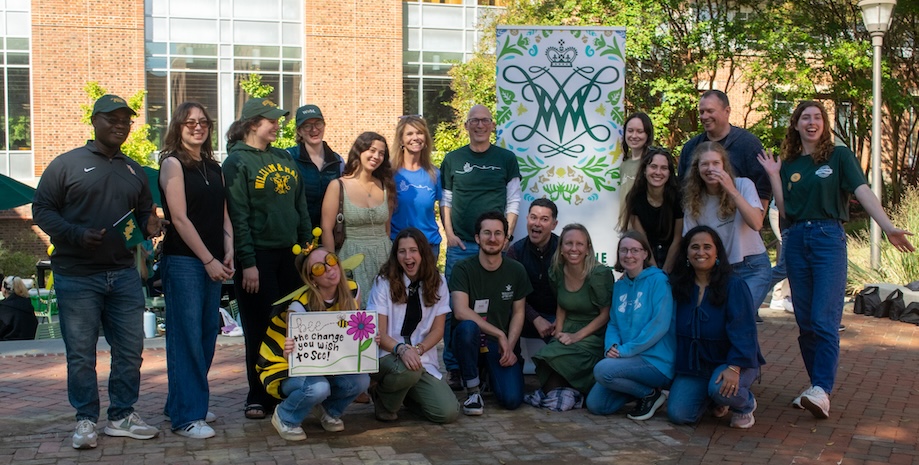
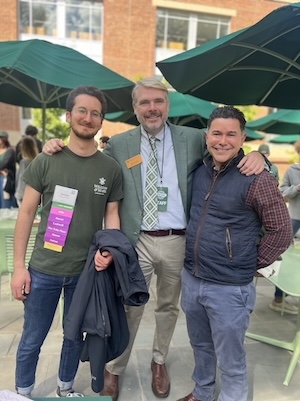
It wouldn’t be Homecoming without the tailgates, and the Institute for Integrative Conservation, together with William & Mary Libraries and William & Mary Whole of Government Center of Excellence, hosted a festive one on the Swem Library patio. We were thrilled to celebrate alongside our students and ever-growing network of alumni. Watching graduates—now flourishing in their conservation careers—connect and share experiences with current students was truly inspiring. Together, they represent the next generation of conservation leaders: diverse, interdisciplinary, and guided by innovation, a spirit of collaboration, and a deep empathy for people and planet.