Skip to main content
Institutional Effectiveness
As part of the university’s commitment to continuous improvement, W&M’s faculty establish student learning expectations and the administration and staff identify institution-, organization-, and unit-level goals that align with the university’s mission and with Vision 2026, the current strategic plan. Ongoing cycles of evaluating the extent to which these expectations and goals are achieved and seeking improvement based upon analysis of the results drives progress and innovation, enhances educational quality, and empowers the university community to flourish through evidence-based planning and decision making.
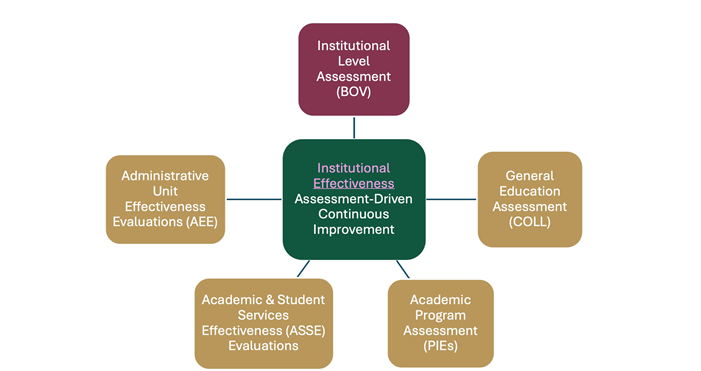
The Office of Institutional Accreditation & Effectiveness oversees assessment of general education and academic programs, as well as evaluations of administrative units and academic and student support service units. For more information on these processes, select the desired item from the menu at the left.
To operationalize this commitment to mission-aligned, evidence-based improvement, the university’s institutional effectiveness framework is driven by a continuous improvement cycle focusing on General Education Assessment (COLL) and Academic Program Assessment (PIEs) to maintain rigorous standards for student learning. This is paired with two specialized areas of evaluation: Administrative Unit Effectiveness (AEE) for university administrative offices and Academic and Student Services Effectiveness (ASSE) for units dedicated to serving students and supporting their success. Together, these four pillars utilize evidence-based analysis to refine educational quality and operational performance across the institution. This internal process is supported by the high-level governance of the Board of Visitors, who provide oversight for long-term planning and budgeting.