Skip to main content

Standard Operating Procedures
Standard operating procedures (SOPs) are required for laboratory tasks that present hazards, either chemical or physical. If a laboratory worker needs specific instructions in order to understand the hazards present, how to mitigate them, and how to respond appropriately to an incident if one were to occur, the task requires an SOP.
Tasks that require SOPs are routine in nature. For instance, how to use a specific piece of equipment that presents hazards, how to work with a particularly hazardous chemical, or processes that involve transporting hazardous materials or items between spaces.
William & Mary’s Chemical Hygiene Plan (CHP) outlines the requirement for writing, maintaining, and training on SOPs in each laboratory.
W&M SOP Standard Format
Standard operating procedures must be published in the standard format found in the CHP. The Word document of the standard format can be found in this Box folder. Utilize this when writing your SOPs.
W&M Shared Campus SOPs
Many departments may perform the same tasks as other departments. A shared Box folder has been developed to share SOPs across campus. You may join this folder and download any SOPs that apply to your laboratory. If you would like to contribute to this folder, email safety@wm.edu.
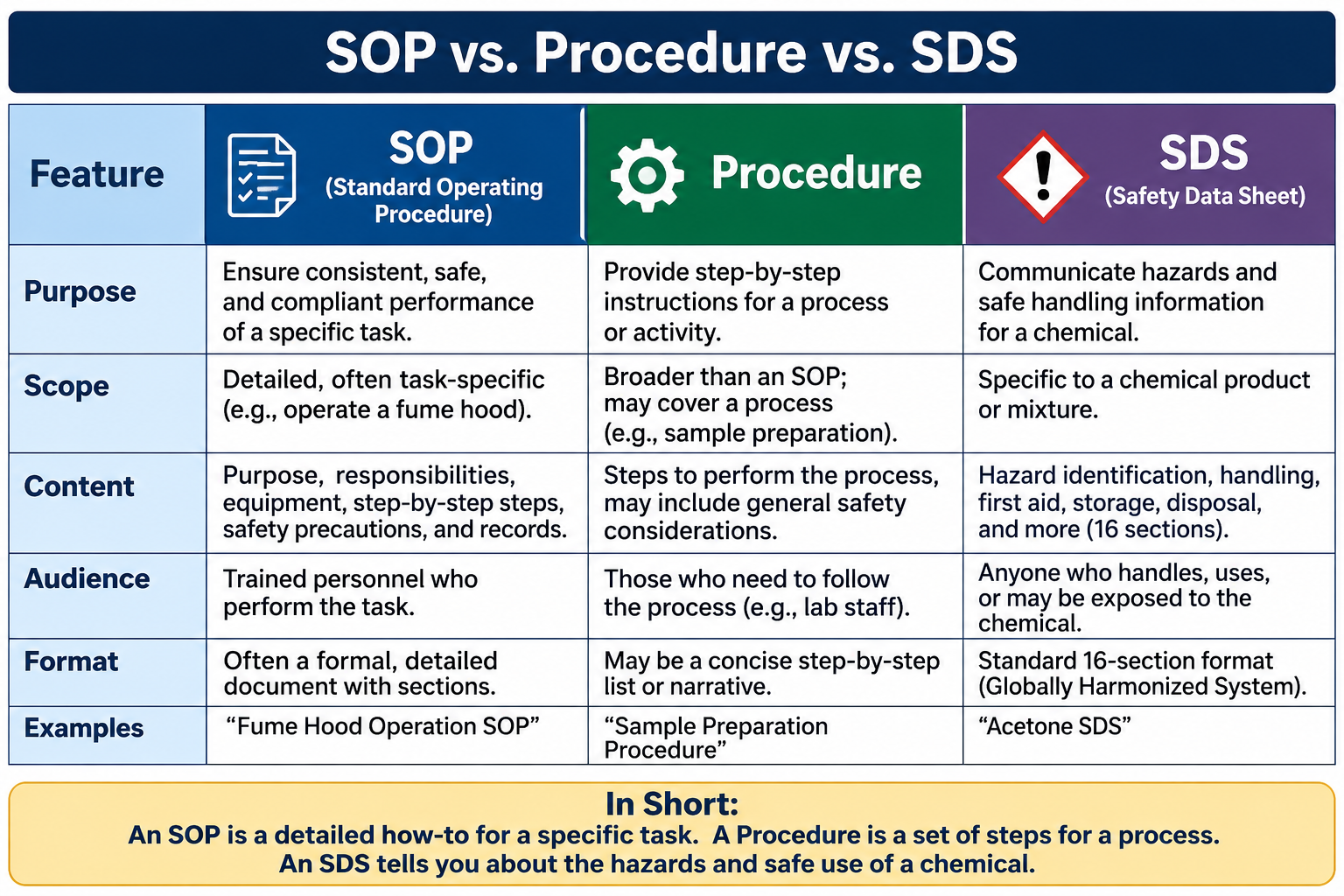
SOP vs Procedure vs SDS: What is the difference?
It can be easy to get confused on what should be included in an SOP vs a laboratory procedure, and how an SDS can tie into both. The table below is meant to highlight the differences between them.