 Skip to main content

W&M grad student awarded for cancer research through yeast model system
As a student in William & Mary’s biology master’s program, Keegan Sweeney ‘26 is fascinated with the translational aspect of research — how studying organisms such as yeast can improve our understanding of how cancer cells function in the human body — which can potentially lead to life-saving medical advances.
His interest in pathology, or the root causes of diseases, is what led him to biology professor Oliver Kerscher’s lab.
“When I was coming into my master’s program here, I really fell in love with the idea of working in an organism to try to figure out human-based diseases and their effects,” Sweeney said. “I think this work is really going to be beneficial in some way.” 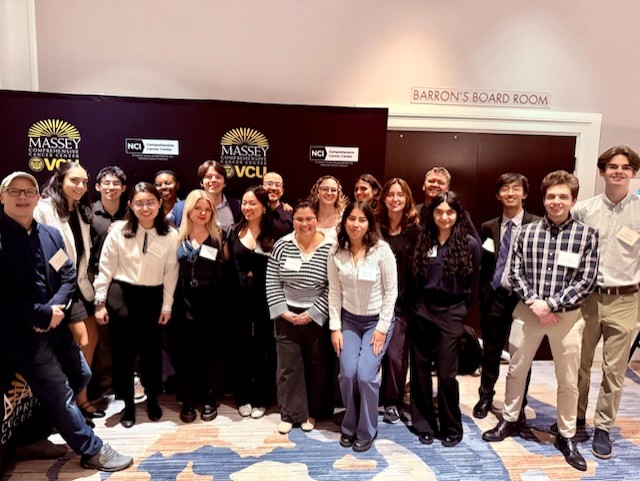
Sweeney joined a delegation of 17 William & Mary biology undergraduate and master’s students from Kerscher and associate professor Matthew Wawersik’s labs who attended the Commonwealth of Virginia Cancer Research Conference in Richmond, presenting six posters and giving one talk.
The biannual conference, held Nov. 14-15, featured cancer researchers and students from universities across Virginia, including W&M, Virginia Commonwealth University, University of Virginia, Virginia Tech and Old Dominion University.
For many biology undergrad students, it was their first time attending a conference, according to Kerscher, who added that “all of them did a phenomenal job presenting their research.”
Sweeney won the Top Presentation Award for his talk titled, “The SUMO Balancing Act: Insights into Cellular Robustness from Yeast to Cancer.” His presentation drew from his master’s research project that he is currently working on in the Kerscher lab.
SUMO, which stands for small ubiquitin-like modifier, is a small protein that attaches to other proteins in the cell to regulate its functions.
“One important cellular function that SUMO regulates is cell division,” Kerscher explained. “Cell division helps children grow and heal wounds when we get injured, but it can also go awry in diseases such as cancer, when cells multiply in an uncontrolled manner. That’s why understanding the function of SUMO is essential for cancer research.”
In Kerscher’s lab, Sweeney studies the function of SUMO during cell division of a stress-tolerant yeast strain, which acts as a model organism. Sweeney tested to see if modifying the SUMO pathway would affect the stress tolerance of the yeast.
“What we found is that by modifying these pathways, we reduced the tolerance of our yeast to stress, and that’s an analogy for reducing the robustness of cancer cells,” he said.
The research forms the basis of understanding how cancer forms, what allows it to persist against stress, and how targeting the SUMO pathway could potentially be used in cancer treatments.
“If we could learn how to regulate or down-tune the role of SUMO in these yeast cells, we could maybe apply that newfound knowledge about SUMO in the fight against therapy-resistant cancers and antibiotic-resistant infections,” Kerscher said.
Kerscher’s lab has been working on the SUMO project since 2018 and has received funding from the National Institutes of Health since 2022. 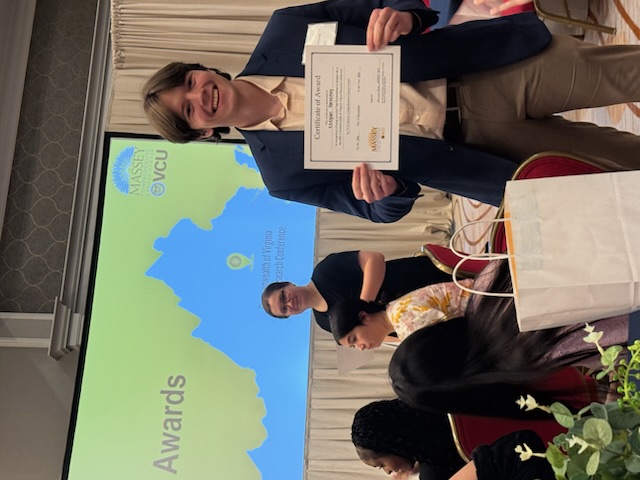
Sweeney was the only master’s student who presented at the conference alongside doctoral students and postdoctoral researchers from other labs during the Drug Development, Administration, Testing, and Biomarkers session. He felt confident presenting in front of the distinguished crowd thanks to the science communications skills he’s gained from the biology master’s program at W&M. He said he practiced his talk numerous times in front of diverse audiences, from fellow students and professors to curious friends and family.
“I knew I had the skills and the chops to do it, but I was surprised I got the award — I wasn’t expecting it. Everyone there had really good research as well. It was very interesting to hear their talks,” Sweeney said.
His yeast research offered a fresh perspective on studying SUMO pathways, as most of the presenters there were working primarily in mammalian cell lines and human cells.
From hearing different perspectives and learning about new types of research to networking with other professionals in the field, the cancer research conference was an invaluable experience for budding research scientists like Sweeney and his classmates.
“It’s like a cauldron of a lot of ideas bubbling together, mixing around, and getting those connections and quick glimpses of what Ph.D. life is like and what life following Ph.D. life is like, I thought was really fascinating,” he said.
Sweeney plans to continue his cancer biology research in a Ph.D. program after he graduates from W&M. He is particularly interested in studying pancreatic cancer, one of the most aggressive and deadliest forms of cancer.
“The big focus of cancer biology right now is pancreatic cancer and that’s something I want to study, how to detect it earlier on so it’s more easily treatable,” Sweeney said. “I want to be a part of that narrative to help.”
Sweeney will give his next talk at the Graduate Research Symposium Feb. 26-27 alongside other biology graduate students. He’s looking forward to another opportunity to share his research with a broad audience and learn from his peers.
“I’m excited not just to share my research, but to listen to other people’s research [presented] to the public and the broader community in Williamsburg and William & Mary,” he said.