 Skip to main content

The Department of Classical studies hosted scholars from all over the world for a conference on ancient theater
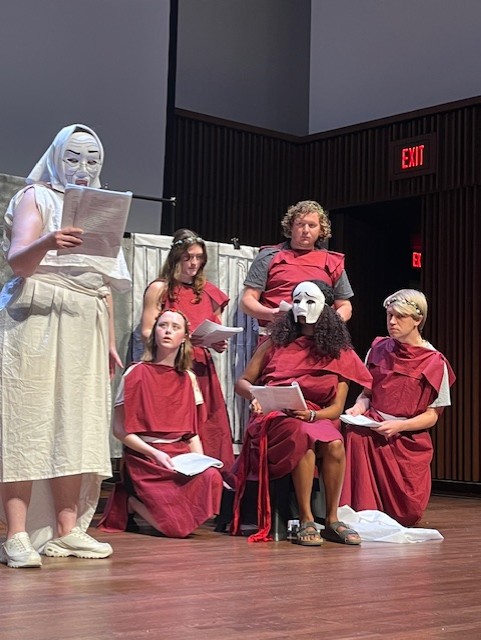 In late April, scholars from all over the world came to William & Mary for a two-day conference on Greek and Roman theater and performance. Speakers presented papers on various aspects of Greek and Roman theater, illuminating the multifaceted nature of ancient drama as performance, civic event, spectacle, and occasion for reception. Professor Naomi Weiss of Harvard University gave an excellent keynote lecture, titled “The Poetics of Proliferation in Euripidean Tragedy.” Altogether, the talks demonstrated how the interdisciplinary and international study of ancient drama is a flourishing and thought-provoking field of inquiry.
In addition to the scholarly papers, the conference featured performances of ancient Greek tragedies by students in Professor Paga’s “Greek and Roman Tragedy” course. Over the course of the Spring semester, the students abridged their plays, assigned traditional acting roles (three actors to share all speaking parts), developed a multi-person chorus that spoke and moved in unison, and designed the set background, costumes, and masks. The performances truly brought to life the ancient plays and were enjoyed by a large audience of W&M students, faculty, the international speakers of the conference, and community guests.
Conference Program
Friday, Apr. 25-26, 2025
Panel 1: Sophocles On and Off Stage
-
A. Sigelman (Bryn Mawr): Verbal Narratives of Off-Stage Events
-
J. Moore (UVA): A House of Her Own: Cavern as οἴκησις in Sophocles’ Antigone
-
V. Dimoglidis (University of Cincinnati): Imitating Philoctetes: the mimetic mode of the chorus in the Parodos and the first Stasimon of Sophocles’ Philoctetes
-
L. Bos (University of Amsterdam): Sophocles’ Philoctetes from the spectators’ viewpoint
Panel 2: Performing Aristophanes
-
D. Williams (UVA): Science, Nature, and Divinity in the Parodos of Aristophanes’ Clouds
-
S. Nooter (University of Chicago): Thesmophoriazusae: Voice and Body
-
J. Radding (University of Chicago): A Megarian walks into the Agora: Performing Dialect in (and for) Aristophanes
Keynote Address
N. Weiss (Harvard): The Poetics of Proliferation in Euripidean Tragedy
Panel 3: Material and Materiality in the Greco-Roman Theater
-
T.J. Smith (UVA): Illustrations of Greek Drama: Fifty Years of Pots and Plays
-
S. Gonzalez (Harvard): The Isolated Mask: Pentheus as “Art Object” in Euripides Bacchae
-
J. Paga (W&M): Epiphany on the Skene Roof
-
D. Wilson (Kings College London) : How the Orchestra got its Shape
Panel 4: Drama in the Italic Peninsula
-
B. Peruzzi (Rutgers): Greek Theater, Language, and Cultural Entanglements in Apulia: the Cultural Context(s) of Pots with Theatrical Representations
-
A. Roy (Idaho): A Different Type of Meta: Comedy, Audience, and the Roman Triumph
-
M. Brown (W&M): Pseudolus and the Sibyl
Panel 5: Stage and Direction
-
E. Aprilakis (Texas A&M): The Dramatic Koryphaios: Choral Spokesperson or Prima Ballerina?
-
A. Cohen (Randolph College): The Importance of Staging a Chorus "the Way the Greeks Did"
-
D. Molinari (Princeton): Implicit Stage Directions in Greek Tragedy: A New Approach
-
V. Liapis (Open University of Cyprus): Performing the Parodos of Seven against Thebes
Panel 6: Actor and Audience in Greek Tragedy
-
S. Olsen (Williams): The Intimacy of Actor Assignment in Euripidean Tragedy
-
E. Weiberg (Duke): Affective Violence and Women as Spectators of Greek Drama
-
J. Gibert (CU Boulder): Off-stage singing and human sacrifice in ‘The New Euripides’