 Skip to main content

VIMS Gloucester Point: Chesapeake Bay Hall Replacement
In 2021 through 2022, the Center was contracted to investigate several archaeological sites at the Virginia Institute of Marine Science (VIMS) at Gloucester Point. The proposed Chesapeake Bay Hall Replacement Capital Project has an Area of Potential Effect that encompasses four archaeological sites: 44GL0034, 44GL0355, 44GL0356, and 44GL0358.
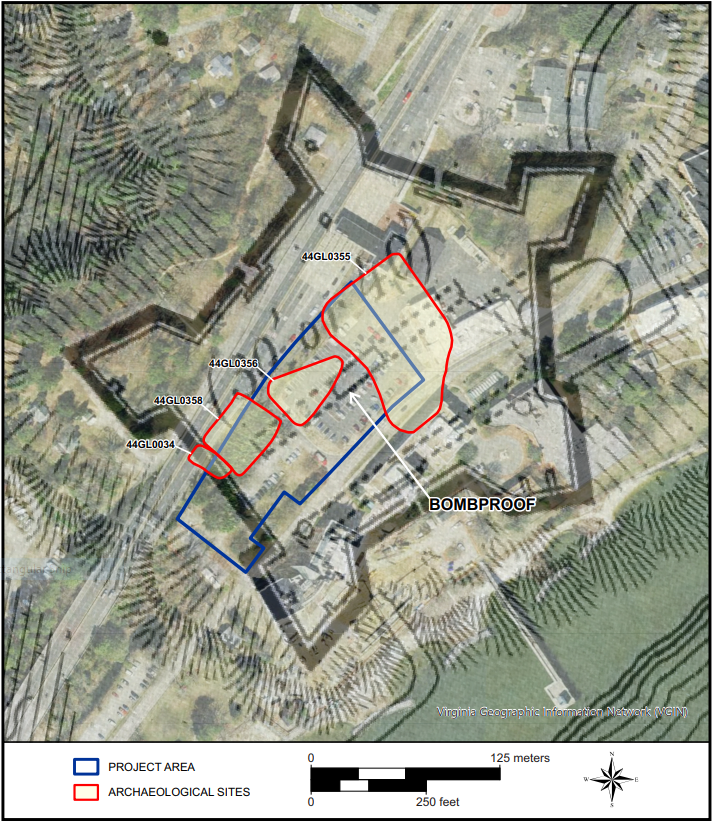
While components of domestic resources from the Revolutionary War all the way through World War II are documented here, the majority of research is on the Civil War era, because these sites fall within what was once a 15-acre Civil War fort. Various levels of investigations on portions of these sites have occurred since the 1990s. Along with recovering hundreds of artifacts, researchers in prior decades identified surviving portions of earthworks of the fort constructed by the Confederate Army in 1861, then subsequently occupied and modified by Federal forces as "Fort Keyes" in 1862.
One of the most noteworthy features of the area is the remnants of Federal Army Sibley tents. Archaeological remains of Sibley tents are exceptionally rare, and the examples in Site 44GL0358 may represent the only such features found in the region to date.
The Chesapeake Bay Hall Replacement Capital Project provided the Center the opportunity to undertake intensive research, fieldwork, and study of the four archaeological sites that the project could not avoid. The Center's researchers compiled and examined all prior investigations, including those completed by the Center's own staff in past decades. Extensive fieldwork was carried out, along with further intensive historical research to provide context for the interpretation of of features. The end result is one of the Center's largest technical reports to date, which details the Center's research methods, historical context, archaeological evaluations, data recovery, artifact descriptions, a historical and archaeological perspective on camp life 1861-1865, and even a macrobotanical analysis carried out by archaeobotanical consultant Justine McKnight. View her website here.
The Center's entire 400+ page report is available as the Technical Report Series 37. Learn more about viewing the Technical Report Series here.