Skip to main content

Broadway Landing: Union Army Installation
Nicholas Bolash, a Jamestown High School senior, researched the history of the lost town of Broadway, focusing primarily on the landing area used by the Union Army during the Petersburg campaign of 1864-65. The ultimate goal of Nick's research was to reconstruct the layout of Civil War-era Broadway Landing as a guide for future archaeological research. By searching primary and secondary sources, including the Official Records of the Union and Confederate Armies and some rare books, Nick found a great deal of information pertaining to this important period of the town's history. Period photographs and maps indicate the locations of military and civilian structures that once occupied the land along the Appomattox River. The site of a pontoon bridge, the town of Broadway had about five recorded houses at the time of the Union occupation. The research also uncovered details about the men who called this town home for about ten months. Nick's research included visits to the Broadway Landing site and review of tax records on microfilm at the Library of Virginia. This research also provided a better understanding of how important this now-unknown town was during the siege of Petersburg as a transportation, communication, and supply center.
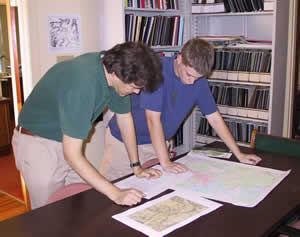
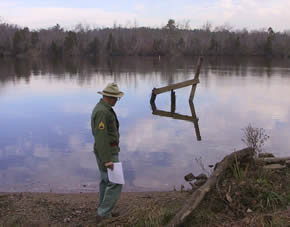
Photos: (L) Nick Bolash, on right, compares copies of Civil War era maps with a modern topographic map as part of his research. (R) Nick has also visited the Broadway Landing site with local archaeologist/historian Steve Thomas (seen below) in an effort to situate features of the Union installation on the landscape.
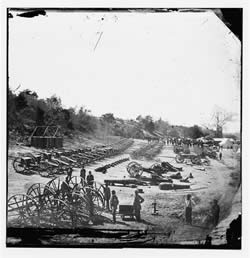
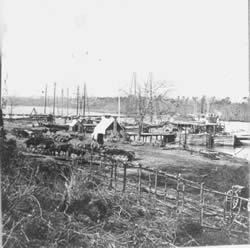
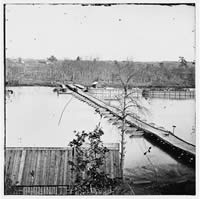
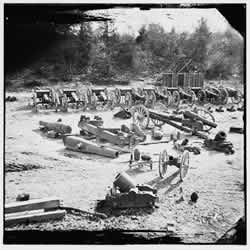
Photographs
These views show the intense activity at Broadway Landing during the Civil War. After a devastating explosion on the ordnance wharf at City Point, artillery unloading operations moved to Broadway. Units of the First Connecticut Artillery assembled supplies and ammunition for the massive guns bombarding the city of Petersburg to the south. A key pontoon bridge at Broadway allowed Union commanders to move units quickly between Bermuda Hundred and the Petersburg operations.