 Skip to main content

Innovating for Inclusion and Impact
By Kate Hoving
“Before you become too entranced with gorgeous gadgets and mesmerizing video displays, let me remind you that information is not knowledge, knowledge is not wisdom, and wisdom is not foresight. Each grows out of the other, and we need them all.” — Arthur C. Clarke
Every day brings another news analysis, commentary or meme focused on AI and machine learning and its effect.
It can be difficult to discern fact from fearmongering and real potential from marketing hype.
There is someone who can provide insights and guidance based on experience, but that person is not in Silicon Valley.
She is in Cape Town, South Africa.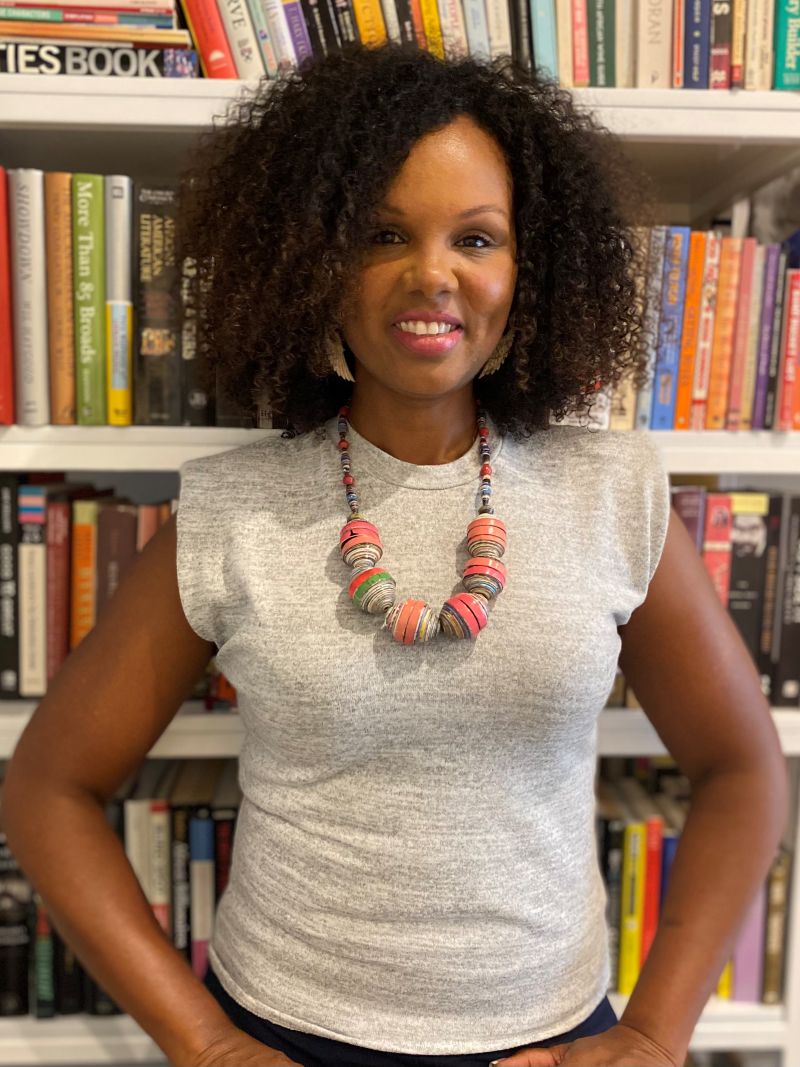 Saidah Nash Carter ’96, co-founder of Bright Insights Global LLC and self-described Intentional ML/AI Evangelist, has built a successful and singular career in innovation, development and communication.
Carter’s mission is not about proselytizing as much as it is promoting the understanding, adoption and ethical use of Artificial Intelligence and Machine Learning technologies.
“For me, it means that I believe deeply in the power of technology to help solve human challenges,” Carter explains. “It is, at its core, a tool; one that can -- and should -- be used for the betterment of humanity. Machines learn through training data sets, and the more intentional we can be about how we train these machines, and for what purposes we are doing so, the more useful these technologies will be.”
She also thinks beyond just the technology to the tools that can be built with these technologies. “We will be able to build tools for restoring, for being more responsible, for not harming and, ultimately, for being more regenerative as we think about resources moving forward and the relationship between resources and technology and social impact and technology.”
A global mindset
Carter came to W&M not for computer science studies, but for international relations and Chinese, which she had studied in high school in Washington, DC. “William & Mary had a very robust Chinese program and at the time, a relationship with Beijing Normal University (BNU).” Carter studied abroad in China over a summer and fall semester. And then the following summer, she worked for Victoria Cruises as a translator for the mostly English-speaking passengers on a cruise up and down the Yangtze River. “I’ll never forget it. It was incredible.”
She grew up in a family that valued and enabled international experience and had been a foreign exchange student in Seoul in high school, but what she found through W&M was something new and transformational. “The experiences in China changed my life, my relationship with the world. It was such a shift. In an interesting way, it also made me thankful for home. I had a new appreciation for my American roots, my family and culture. I discovered that I could like and live in China and still be grounded in my country and my patriotism; that I could be connected with home but also connected with the rest of the world. Travel really opens you up to your place in the world as a global citizen.”
Following curiosity to become a leader in innovation
Carter’s first job out of college wasn’t in Chinese studies or international relations or AI development. But it turned out to be the perfect launch pad. She began her career at Thomson Reuters as a sales assistant, working for the senior vice president of sales for the Americas.
“I only did that job for a year and a half, but looking back, I can see it was a foundational role, because it showed me what the revenue engine was - the sales team. Every company of that size will have some version of a sales team, and it was helpful to understand that early.”
Thomson Reuters is an information services company -- a data business – though it is known by many for its media business that initially sold its services to newspapers.
“Eventually they developed a website and a brand, but the business model was to sell news to news outlets. You see the Reuters byline in the New York Times, or wherever else you read your news.”
Although she did not want to continue in sales, it was a valuable experience. “When I talk to young people about my career, I explain that I try to follow my curiosity and keep it interesting.”
So, following her curiosity and the needs of the organization, Carter moved from sales into marketing and ultimately migrated to product development for global media. From there, she worked in strategy and business innovation, ultimately taking her to senior vice president of innovation and founder of Thomson Reuters Date & Innovation Labs in Cape Town and Head of Innovation in Africa.
Opportunities for innovation in the mobile revolution
“Innovation is one of those words that means everything and nothing all at once,because it’s so broad. Initially, it meant building new news products for what was then the early internet. So it was asking questions like, ‘How are people going to read news online? What does that even look like, because they’re used to holding a newspaper?’ I am in that bridge generation. I remember newspapers being delivered but also adapting to consuming content very differently.”
Working on product development and innovation — and that curiosity of hers— propelled her beyond news content delivery to the broader data and financial business and what would become the “mobile frontier.”
“My journey to Cape Town was linked to the belief that the company should be innovating in Africa during the mobile revolution. There is good space to innovate in emerging markets. And we got really excited about the opportunity to tap into what was a very mobile-first and almost mobile-only environment. It was an opportunity to connect mobile tools and solutions relevant across markets. We built some really leading edge and impactful products.”
She had been lobbying for an innovation lab in Africa for a year already and had a plan in place, so when she got the go-ahead from the C-Suite she was ready to go. “We ended up being the only Thomson Reuters Labs in an emerging market within a global ecosystem of seven labs total.”
Creativity and innovation with a purpose
“My professional work has always been in line with the UN’s Sustainable Development Goals and innovation with purpose. It is about making the world and the planet better than we found it for our children and for future generations.”
Carter is pragmatic about what making the planet better entails. Both at Thomson Reuters and now as head of her own business and member of the boards of NGOs and foundations around the world, she sees herself as part of a larger team.
“Thankfully, there are many organizations I work closely with that are committed to—and doing the good work of — leaving this place better than we found it. We must work across many disciplines, industries, governments and academia. It will take an interdisciplinary and radically collaborative approach to solve our biggest challenges.”
Building a better present and future
Carter describes Bright Insights Global as a boutique consultancy with a portfolio of projects at the intersection of innovation, inclusion and impact.
Big Labs for Good, which is essentially Bright Insights Global’s research arm, is an example. “We’re builders, we love to tinker around and imagine buildable solutions to the world’s biggest challenges. I’m loving our work with machine learning with smaller language models; “small and slow” community data sets; regenerative agriculture and collaborating with leading African universities in data science. All of this is in service of university and industry collaboration for responsible R&D.
She is drawn to data science innovation, given her background at Reuters. “I am intrigued by the space to innovate data science -- to think about data more expansively and also to think about building AI that is pro-nature and sustainable.
For example, the Bankable Farmer Research Initiative (BFRI) is dedicated to leveraging data science, alternative data sets, and innovative risk modeling approaches to improve financial service accessibility for small commercial farmers in sub-Saharan Africa. This commitment aims to tackle the ongoing issue of restricted credit access for these farmers, which arises from a lack of credit history and profile.
Data and stories: remembering and engaging across generations
Another project Carter and her team have developed is Ask An Elder, a crowd-sourced, intergenerational, storytelling initiative.
“I work with young people in Cape Town as much as I can. One of the programs that we work on here is storytelling, because I am fascinated by storytelling and stories as data sets within the contexts that we’re talking about, such as training data. Ask an Elder is about gathering knowledge and sharing stories and wisdom from lived experience.”
“I wasn’t sure that that the young people were going to be interested, but I was blown away by their level of interest. They have inspired me by the stories they have discovered and by their entrepreneurial spirit.”
The inspiration Carter derives from that and from all her projects, sparks creativity for future ideas. But the thread that flows through every idea and innovation Carter and her team explore is how to make the world better for future generations.
“It’s our North Star.”