 Skip to main content

Alumnus Abroad
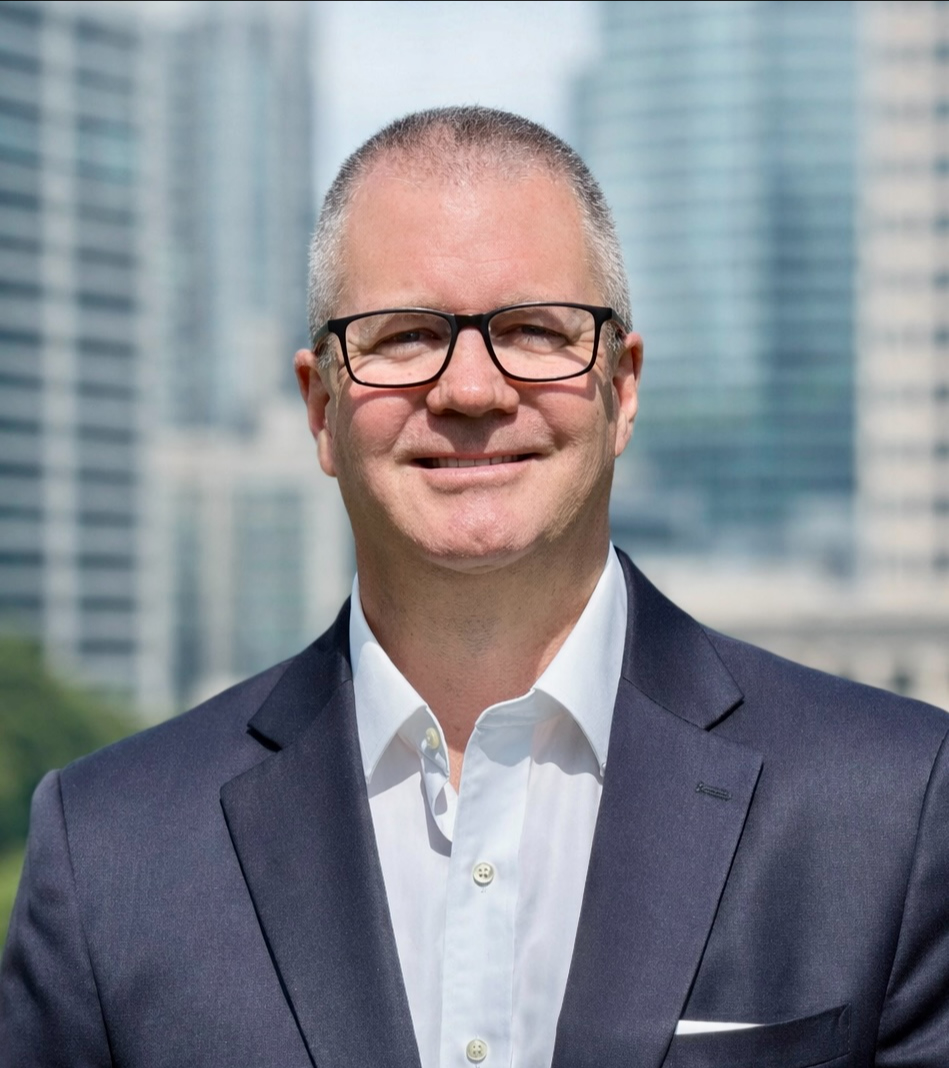
Q&A with David Link '89
Q: Where were you born? What do you consider your hometown?
I was born in Charlottesville, Virginia, and wherever we have lived — and we have lived outside the United States for nearly thirty years now— I have considered myself a Virginian first and foremost. More than ten of my ancestors are documented patriots of the Revolutionary War; others fought, on both sides, in the Civil War. They originally came from Germany, France, England and Ireland, from the 1600s through to the 1800s. I carry that link to America’s past with gratitude. I feel at home in – and consider myself a Washingtonian, a Manhattanite, a Parisian, and a Melburnian — and why I hold, with real thankfulness, the citizenship of three democracies: the United States, France and Australia.
Q: Why did you choose to attend William & Mary?
My father went to William & Mary, and so W&M was already a part of our family’s story. And besides the in-state tuition, I also chose it because it was demanding and considered the most rigorous university in Virginia. And it was smaller and more human in scale than other Virginia schools, and it carried three centuries of history with it. I wanted somewhere that would challenge me – and W&M did.
Q: What was your major? Any reason(s) you chose it?
Business, with a concentration in management. I knew I was drawn to the world of business but I didn’t yet know which part of it. William & Mary’s business school was fantastic as it was both broad and deep in what it offered — and the liberal-arts setting around it exposed me to areas well beyond my core area of study.
Q: Did you have a favorite course or courses while you were at W&M?
Yes – the ones taught by the most notable professors! “Cocktails with Coles,” taught by one of the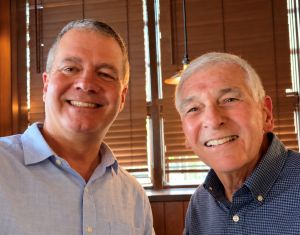 business school’s iconic long-serving professors, taught me that serious material and joy are not opposites. “Busi-ness Law”, taught by Professor Ned Waxman, was absolutely brutal and the first time that I had been ex-posed to what the real legal world can be like – and the importance of always being 200% prepared. The so-ciology class I took due to the liberal-arts curriculum required of me interested me in areas that I was sur-prised to find my interest drawn to. And the French courses that I took that were taught by Professor Ronald St. Onge. I began French to satisfy the fresh-man requirement; then because of something I liked in his teaching I eventually ended up taking one or two classes a year pass-fail in whatever Prof. St Onge taught. In my senior year I even ended up taking a graduate-level seminar – way above my skill-level - in seventeenth-century French poetry (I won’t quote Bill Murray from Groundhog Day here). I am grateful for Prof. St. Onge, as his teaching eventually played a part in my living and working in France for many years.
Q: Did you study abroad while you were a student? If so, where and why?
I did not — though I have now spent a good part of my life since making up for it! My window onto the world as a student was Professor St. Onge’s classes, and also a really good course on modern business relations between Japan and the United States. It was only four years after graduation, when Accenture sent me to Switzerland, that I first worked abroad — and discovered how much I had to learn.
Q: Do you think international experience as a student is helpful in future life and career?
It is close to indispensable. I say that carefully, because I know not every student has the means or the freedom to go — which is exactly why universities must keep sup-porting international exposure in every way that they can. What prolonged international experience teaches, above all, is humility: the discovery that the way you assumed things should be done is simply one way among many, and that different is usually neither better nor worse — only different. It teaches you how decisions are actually made in other cultures, and that type of pattern-recognition makes you faster, wiser and more useful everywhere. The founders educated at William & Mary understood this — Jefferson could not have imagined the American experiment without having seen and learned from the world beyond it. It remains true: no one becomes the leader they could be by staying home.
Q: You currently live in Melbourne, but you have also lived in multiple countries in Europe and Asia. When did you move to Australia, and what was it that led you to settle there — job? Family? Lifestyle? Combination of factors?
My wife is Australian — an opera singer; we met in Vienna, Austria just before I moved to France. We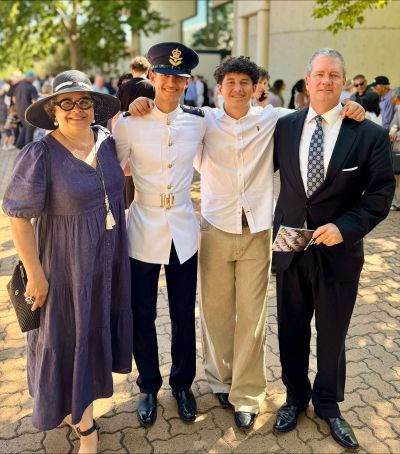 were introduced in Vienna by a fellow classmate and very close friend who had moved to Austria to work with Mars, Inc. By 2008, we were living in between Paris and Amsterdam with our first child, and I had reached a glass ceiling as a non-born-and-bred naturalised Frenchman (i.e., I wasn’t going to be-come the head of our French practice as a French-Ameri-can!). So I asked Accenture’s senior leadership whether I could serve in Asia as I had in Europe, and the answer was: come straight away. So we made our home in Melbourne while I worked across Asia. We had spent plenty of time in Melbourne before and knew it to be an incredible city. It was one of the best decisions that we ever made together.
Q: You did graduate work in French and hold U.S., French and Australian citizenship. What drew you to France?
The honest answer is that France found me. I took French in high school because a language was required; at William & Mary I took it again for the same unromantic reason — and encountered Professor Ronald St. Onge, and requirement became interest. Years later, after my Accenture col-leagues and I had helped manage the successful merger of Chase Manhattan and Chemical Bank and I then lost a bit of thrill as I went to work on much smaller projects, I asked to be sent where I could be challenged again - to do what I was previously doing but in a new country - and ended up pushing myself into Accenture’s French practice. Middlebury’s graduate level summer French immersion program and my subsequent move to Paris swiftly cured me of the illusion that I was fluent in French and able to work at the same level, speed and effectiveness in French as in English. So I studied in every spare hour, had a tutor most days, used Post-it notes on every surface of the apartment — until after a few years I was finally ‘working-at-speed level’ fluent. In time I helped manage the merger that created the largest insurance company in France, led many other projects with French clients and eventually served on our leadership team across France Benelux. But what France really gave me was a second home and a lasting lesson: fluency in an-other culture is earned the same way trust is — daily, humbly, over years. It is difficult to be arrogant in your life when your garbage-man – and rightfully so - feels the need to correct your French grammar.
Q: Your volunteer and board consulting activities seem as substantial and “intense” as your job. Has that been a goal of yours, or has your ability to analyze and assess and problem-solve just led to organizations’ seeking your advice and wise counsel?
I’ve been lucky enough to have teachers, institutions and colleagues who generously invested in me long before I could repay them. So I see my board and volunteer work as a sort of repayment schedule. For example, our family unfortunately spent real time at the Royal Children’s Hospital in Melbourne, so serving six years on the translation and commercialization committee on the board of the Murdoch Children’s Research Institute — among the finest children’s research institutes in the world — was a debt I owed. The same is true of Randolph-Macon Academy, where I serve on the Board of Trustees, and of William & Mary, where I serve on the Reves Global Engagement Board and help as an advisor to the AUKUS Center of Excellence as an Affiliate of the Whole of Government Cen-ter of Excellence. All these great institutions helped shape me into the person I am today. I try to serve only where I can genuinely add value and with people, causes and institutions about whom I genuinely care.
Q: One of the threads through your professional life has been a commitment to “education, global best-practice research, and international collaboration.” You also are special, I think, in your understanding of the role public policy plays in research and partnerships with industry and academia. I’m thinking of Funding Australia’s Future IV, which you co-authored. Why did you participate in that project, and what do you think is its importance?
Because the question it asked was real, and the people asking it were serious. The Australian Centre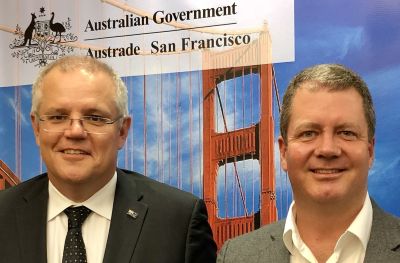 for Financial Studies is a rare institution — a university-anchored body where government, industry and academia can think together rather than past one another. Its founder, Kevin Davis of the University of Melbourne, who has taught a remarkable share of Australia’s central bankers, asked me to chair the fourth Funding Australia’s Future study, and I considered it a deep honour. My whole professional life has been about the discipline of execution — making sure change actually happens effectively rather than simply being written about in Powerpoint. Research earns its importance the same way: when it clarifies a hard question, in language every party can act on. That is what the first study did superbly, and what we tried to live up to in the fourth iteration.
Q: There’s a stereotype that business and especially finance is in opposition to government. You see opportunities. Is that an accurate assessment, and how did you come to that understanding?
I don’t accept the opposition at all. Finance, left entirely to itself, behaves like water: it flows downhill, maximizing every profit available, and in doing so it can quietly raise the level of risk for everyone. That is not a moral failing of the people in it; it is the nature of the current. Government’s role is to build the banks and the dams of the river — and good regulation is not the enemy of finance but the foundation of trust in it. Australia taught me this by example: they have a firmly regulated financial system that grew more slowly than America’s and came through the Global Financial Crisis with its people largely unharmed. Some of the best opportunities of our time sit precisely at that meeting point of business, government and the public good — but only for those willing to respect all three.
Q: You have skill in large-scale transformations and collaborations and in streamlining and increasing efficiency, but it seems you also see that as a means to a better end, rather than an end in itself. You work to put things in a larger context. Would you say that’s true?
Yes — and I would go further. Efficiency is a fine servant and a horrible master. It is one thing to climb the ladder faster; if the ladder leans against the wrong tree, speed only gets you to the wrong place sooner. The questions that matter come first: why is this being done, whom does it serve, and is it the thing that ought to be done at all? Only then is it worth doing well.
Q: You maintain ties to business schools — both at W&M and in Australia. What have you learned and gained from those continuing relationships? What is appealing to you?
I find that being around universities keep me honest and alive – I enjoy it. Leaders can easily grow stale without noticing and being around students and researchers is refreshing. Whether guest lecturing at HEC in Par-is, serving as an Honorary Fellow at the University of Melbourne, or guest teaching at William & Mary, I have always received more than I gave: the questioning, the newness, the refusal to accept that things must be as they are. Teaching makes you question what is most important in what you do – and why you do it. Plus -- the professors, researchers and doctoral students at the best global institutions are asking the questions the rest of us will be forced to answer in ten years. Being near that is an awesome privilege, and I treat it as one.
Q: Do you have a current project that excites you? Something you’d like to do?
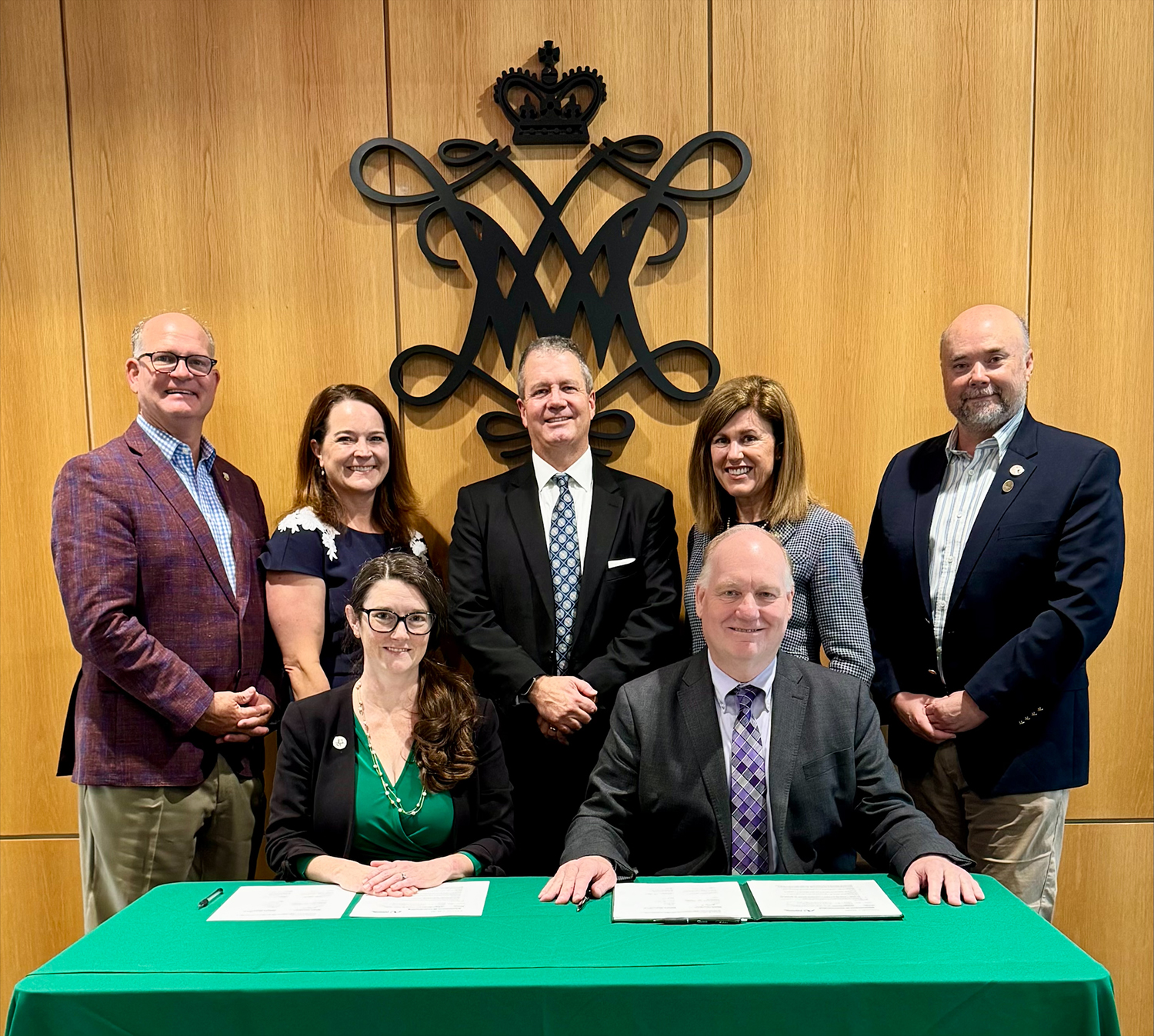
Very much so. The work I am doing now with William & Mary is very meaningful. With Teresa Longo and her team at the Reves Center, we are refreshing the strategy of a center whose contribution to the university is far larger than most people know. And with Dr. Kay Floyd and Captain Kathleen Jabs – two amazing leaders - I have been helping to connect William & Mary — as the U.S. Center of Excellence for AUKUS — with its Australian counterparts, including brokering a partnership with Adelaide Universi-ty that we hope will open research collaborations, study-abroad pathways and student linkages across the Pacific. AUKUS is sometimes described as a submarine deal. It is actually much, much more: a trilateral framework supporting the security of the US, UK, and Australia for the twenty-first century, built as much on shared knowledge and shared people as on shared platforms. That a 333-year-old Virginia college stands as the US Center of Excellence for it — and that I can help — fills me with genuine excitement.
Q: Do you have a favorite memory or memories of your time at W&M?
I enjoyed attending W&M, loved being in Williamsburg, and especially appreciated the incredible friends that I made. I stayed in Williamsburg after graduation racing motorcycles before beginning my career, in part because I was reluctant for my experience to end. In Washington,D.C. afterwards, a townhouseful of William & Mary friends became a circle of twenty or so close friends that has now lasted a lifetime — through weddings, continents and de-cades. I also loved that the college was hard. I remember Paul’s Deli and the College Delly with great affection. William & Mary’s real genius is the people it gathers and what it plants in them: ask any alumnus, anywhere in the world, and you will find the same love — for the college, for Williamsburg, and for the college’s singular place in the history of our country. And of course, love for the Cheese Shop and for house dressing with bread ends.
Q: How do you think your experience at W&M has affected your life and decisions you have made?
It changed my life, and I suspect most alumni would say the same. I arrived from a military prep school; William & Mary is where I grew up. It surrounded me with people of remarkable calibre, professors who demanded more than I thought I had, and a liberal-arts education that marched me — sometimes protesting — out of my comfort zone and opened my eyes. Everything since has drawn on it: the career it prepared me for and more deeply the habit of rig-or and the respect for learning.
Q: You worked many years at Accenture. Did you find that experience valuable? How?
Immensely. Accenture taught a generation of us that excellence and decency can be the same culture. The people were extraordinary — for years the firm was among the largest recruiters of graduates in America, and it chose well. I began in change management when it was a brand-new discipline: the craft of making change actually succeed rather than merely announcing it — and that craft has shaped everything I have done since. Two things marked me most. First, the firm’s refusal of vanity: leaders like George Shaheen, Joe Forehand and Pierre Nanterme — Pierre with whom I was privileged to work closely — kept changing the firm from the top, stripping away corner offices and trappings so that a partner’s worth could never hide behind furniture. Second, its standard: we were premium, so everything we delivered always had to be worth far more to our clients than it cost — and we often walked away from work that wasn’t. Serving the largest institutions in each country, in France-Benelux and then across Asia, alongside people I admired without exception, of-ten doing very large or very difficult things hand-in-hand with amazing clients — I look back on those years with nothing but gratitude.
Q: Do you have any advice for current students?
The world is changing radically — AI today, quantum computing tomorrow — but that said, the world has always been changing, and the counsel that served past generations still serves. Three things. First: while you are at university, seek out what is uncomfortable — courses, people, causes beyond your comfort zone. Everything worthwhile I’ve ever achieved came from constantly placing myself in difficult, uncomfortable, and challenging environments. Second: begin with the end in mind, and make the end large, bold and worthwhile. It costs the same effort to attempt something truly bold that delivers real value for others as to attempt something incremental — so be bold. Always. Third: keep good people close, try and always do good for others, and keep your word. Your word and your integrity are the only assets that appreciate every time you live up to them — and so when you fail, as you will if you are working towards bold and worthwhile goals, admit it plainly, act with integrity and keep carrying on in your mission and in doing good for others. That, in the end, to me, is the whole of it.
Q: Is there any advice you wish you had received?
The advice I just offered is precisely the advice I wish someone had given me: treasure your relationships and build them deliberately; be bold on purpose rather than by accident; decide where you are going and go; be good and do good where you can; and try to add extraordinary value to every person you touch or commitment you make. And have fun – wherever you are and in whatever you are doing – as life is short. And also remember, all that matters is what you do now – the past has already happened and you can’t change it. I stumbled into those truths through good fortune — through safe harbors and generous people who let a young man explore. Not everyone is so lucky. That is rather the point of passing advice on: so the next person needn’t rely on luck.
Q: Anything else you would like to add?
Only gratitude, and an invitation. Gratitude — to William & Mary, which gave me my education, my dearest friendships and my direction, and which now allows me to give something back through teaching, the Reves Center and the AUKUS Center of Excellence. And an invitation to my fellow alumni: the college does not need your money so much as it needs you. Give your time, your experience, your involvement — in whatever measure you can. A place that has given all of us so much deserves nothing less; and I have found that in giving back, we receive the best of it all over again.