Skip to main content
In the field: Q&A with Mika Taylor '23
Fulbright Teaching Assistant in South Korea
 At her graduation, Michaela-Katherine Gabrielle Taylor ’23 (also known as Mika) received the Sullivan Award "in recognition of influence for good, taking into consideration such characteristics of heart, mind, conduct and demonstrating a spirit of love and helpfulness to others. Here's how she was described at commencement when the award was announced:
Taylor graduated with a Bachelor of Arts degree in global studies with a concentration in Asian and Middle Eastern studies further focused on East Asian studies. Raised across England, Germany, Korea and Japan, she has a unique perspective on the world and a desire to share it with others, according to the award citation.
Taylor served in the Global Education Office as a peer advisor, guiding students through the study abroad process, conducting workshops and promoting study abroad opportunities on campus. She was selected as an International Student Advisory Board member and International Peer Leader, assisting international students as they transitioned to W&M.
Taylor worked as a resident advisor, peer advisor and served on advisory boards for the dean of students and the provost. She has also supported her department, volunteering to help with communications and social media and actively working to create feelings of comradery among students. During study abroad, Taylor sought ways to uplift others, including volunteering to help South Korean children learn English. She was recently awarded a Fulbright Scholarship.
One nominator described a phenomenon at the Reves Center as the “Mika Effect.” The simple mention of Taylor’s nickname elicits a smile, a tiny pause of shared recognition and appreciation and the conversation continues. Her colleagues appreciated her for her empathy, caring and dependability — qualities that “make her a superb writer and a wonderful human being,” according to a nominator.
“Her heart, mind and conduct have marked campus and the world-at-large for the better,” a mentor wrote.
Q: You received a Fulbright to South Korea after you graduated in 2023. What was your assignment? Where did you live?
My first assignment was in Mokpo in Jeollanam-do on the southern coast. This year I am in Asan (close to Pyeongtaek) which is in Chungcheongnam-do, about an hour and a half south of Seoul.
Q: I understand you were invited to continue for a second year. Is that true? Was it to continue in the same role or was it to be something different?
With the Fulbright program, (the Korea ETA one specifically), we have to apply annually to renew for a potential total of three years. Each year the application to extend a year has to be approved, and I am grateful to have been accepted for a second year.
Q: So, all told, how long have you been in South Korea for this/these fellowships – when did you arrive? Do you have an end date or is it open-ended?
I arrived in January last year for the nearly two-month orientation that had us become familiar with the program itself, Korean culture, and expectations for us as an ETA. This year, since I am a renewee, I joined for the later half of orientation in February. The Fulbright contract for us ends in December, but we aren’t required to leave for another month.
Some people use this opportunity to go traveling or to stay in their city, but once the contract is over we are expected to move out, so it's financially on the ETA as to what they decide to do post-grant until the visa expires (around end of January). I went home a few days after since I wanted to spend Christmas with my family and intend to do so again this year!
Q: What ages are your students?
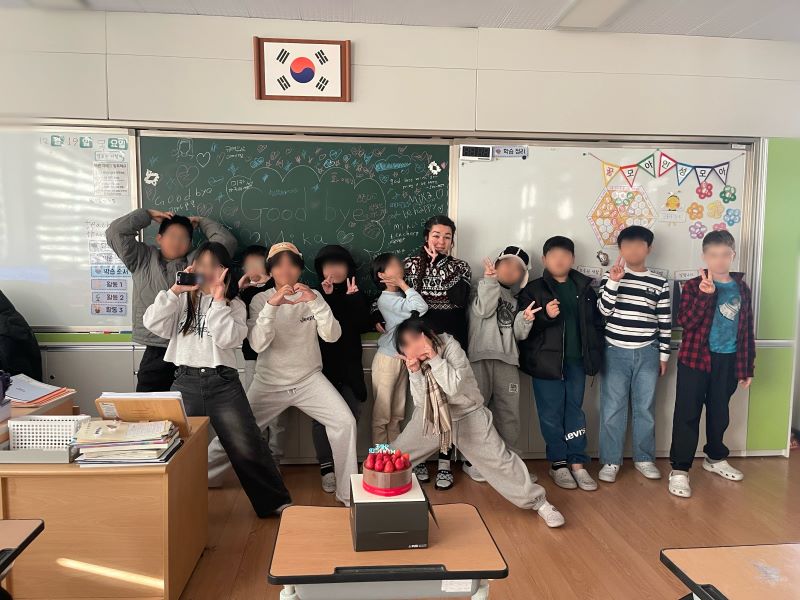
I am an English teaching assistant, so I work on my own classes and lesson plans as well as leading extracurriculars and getting involved in the local community. Last year I was assigned to an elementary school but this year I am at a middle school. Middle schools in Korea are the U.S. equivalent of 7th to 9th grade.
Q: Have there been any surprises?
It was very interesting getting to learn about Korean workplace culture with this opportunity. I learned about events such as 회식 (hweshik) which are regular teacher get-togethers, I get to lead talking classes with some of the administrative staff, and despite having no prior teaching experience I was able to adapt and learn a lot in this field. My staff is patient and kind and my students are simply delightful; I feel very lucky.
Q: You studied abroad in South Korea. Was it different this time, living as a working professional?
I studied in 2021 at Korea University so my studies were relatively intensive. With teaching my focus is on creating lesson plans that students can understand and connect with as well as forming relations with them and my staff, so my central focus is both work and interpersonal relations. I am also in a different area that is more rural, so I get to have a more intensive language learning/practice experience without English as a crutch.
Q: I understand you have tutored a North Korean defector. What were your impressions?
I spent a year tutoring four North Korean Defectors (NKD), and was able to learn a lot about what that community looks like in Seoul. Of course, my main job was teaching and I never wished to pry about their life experiences, I got to learn why learning English was so important to them. From wanting to attend college to wanting to become a journalist to write on the NKD experience, I was grateful for my time with my students and think we both learned a lot from each other and grew together.
Q: Would you recommend applying for a Fulbright?
I would 1000% recommend applying. As someone who is a third culture kid who has lived in multiple countries throughout my life, I can't express how enlightening the Fulbright experience is. Getting to become part of a community, practice cultural ambassadorship and learning about other cultures and languages is such an incredibly valuable experience that is life changing. No matter your background it is a transformative experience that everyone can learn and grow from.
Q: What have been the highlights of the experience for you?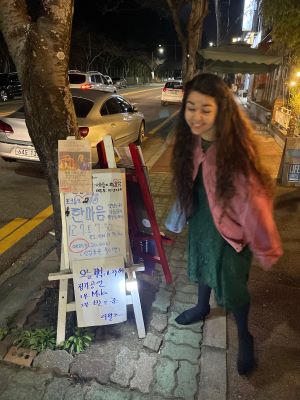
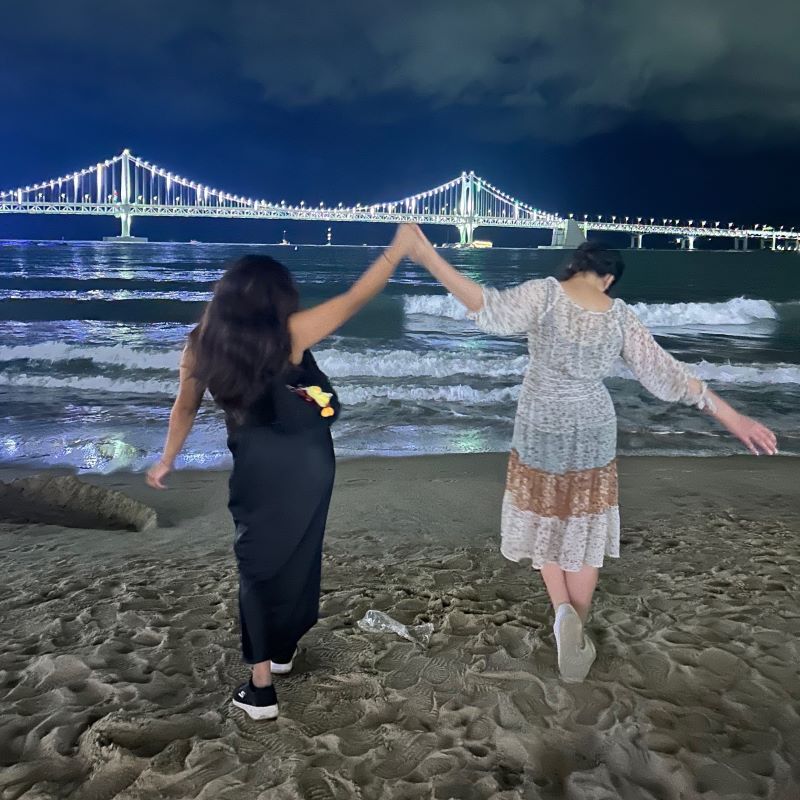
I am very grateful to be able to say I have had a multitude of highlights. Building connections within my community, from cafe owners to students has been a pleasure. Events like going on a field trip to Jeju, participating in students’ Sports Day and touring a folk village. Trips such as doing cultural tours in places like Gyeongju, going to concerts in Seoul and planning my first solo trip to Japan. Moments I share with people such as my birthday picnic with my Fulbrighter friends, a temple stay with my counselor, and road trips across the country with friends. I have been incredibly lucky to experience such amazing events and create such profound memories.
Q: What have been the challenges?
The initial part of my first year was a bit difficult. After the month-long intensive orientation we were brought to our new city and I started work the next day. Adjustment periods are difficult in general, but having it be my first time on my own overseas with many expectations outside of college, I was overwhelmed. Most, if not all, ETAs had this experience, and I was very drained at the beginning. But I gave myself time and space to adjust as I needed. I made sure to make time for myself and to slowly make efforts to connect with my local community. A few months later I was fully comfortable and had a routine, and even figured out how to travel cross-country. Thanks to my local community’s support, as well as connecting with other ETAs that I befriended during orientation, I was able to make a slow but healthy transition.
Q: Have you given any thought to your next step?
This fall I will be applying to master’s programs and grants. I have always wanted to work in the realm of cultural diplomacy, with intercultural programs that are transformative and impactful, so I intend to continue my studies to do just that! I am casting a wide net and will choose my path from whatever opportunities I am offered.
Q: Is there anything you’d like to share that I haven’t addressed in these questions?
I would love to highlight Fulbright extracurriculars. Outside of the Fulbright ETA experience, there are some clubs that provide ETAs to be active and to connect to their local community and South Korea at large.
There are organizations such as KBI (Korea Bridge Initiative) that provides classes with volunteer teachers to students who can’t typically afford 학원 (hagwons, Korean cram schools/academies). KAMP (Korean Adolescents Mentoring Program) is a program where ETAs become mentors to students who require extra support. Infusion is a literary magazine run by ETAs, KKOOM is an organization supporting orphaned Korean youth, and there is the NKD tutoring program.
I am grateful to be a part of all of them this year, Directing KAMP and director of KBI, and think it’s wonderful that ETAs are provided with these experiences to learn about Korean issues and be able to make positive contributions to their community and Korea as a whole.
Additionally, If anyone would like to ask about my Fulbright experience or the South Korea ETA Fulbright program, they can reach out to michaelakat.taylor@gmail.com. I would be more than happy to help.