 Skip to main content
History of the Office
Established in 1979, the provost is the chief academic and budget officer of the university. Reporting to the president, the provost is responsible for all academic and research programs, academic budgets, institutional planning, space allocation and faculty development.
Peggy Agouris (2019-present)
Originally from Athens, Greece, Agouris received her engineering degree from the National Technical University of Athens, and her master’s and doctoral degrees from The Ohio State University. As an undergraduate, she also received a degree in classical music and piano from the Greek Conservatory. Before joining William & Mary she served at George Mason as dean of the College of Science, chair of the Department of Geography and Geoinformation Science and as a professor of remote sensing and spatial informatics. Before joining the faculty of George Mason, Agouris worked for the University of Maine as an assistant professor and then associate professor in the now named School of Computing and Information Science, and as a postdoctoral research associate for the Department of Civil, Environmental and Geomatic Engineering with the Swiss Federal Institute of Technology in Zurich, Switzerland. She has also worked with the private sector, serving as principal investigator on technology transfer projects. As a scholar, Agouris has published more than 100 papers in numerous academic outlets, with more than 2,600 citations to date. At George Mason, Agouris oversaw one of the university’s most active research units. In 2018 alone, the College of Science accounted for almost a third of George Mason’s total research expenditures and nearly half of its indirect revenue. The college includes 13 departments and programs, 20 research centers and nearly 80 degree programs. In 2017, the College of Science led George Mason’s largest research proposal to date, which was funded by the federal government with an initial budget of $40 million. During her tenure as dean, Agouris was also credited with creating new cross-cutting academic programs, increasing the diversity of the faculty body by almost 40 percent and assembling a diverse leadership team for her college comprising more than 60 percent women and under-represented populations. |
Michael R. Halleran (2009-2019)
As provost, he played a leading role in implementing the William & Mary Promise, which increased access, affordability and predictability for in-state students, while providing more resources for university priorities. He established the Creative Adaptation Fund for curricular innovation, expanded elearning across the campus and, with the support of the Andrew W. Mellon Foundation, created the W. Taylor Reveley, III Interdisciplinary Fellows Program. Halleran helped establish a Confucius Institute in partnership with Beijing Normal University, and has overseen a major increase in international students on campus and the success of the joint degree programme with the University of St Andrews, Scotland. Halleran attended Kenyon College (A.B., 1975), where he graduated summa cum laude with high honors in Classics and was elected to Phi Beta Kappa, and received his M.A. (1978) and Ph.D. (1981) from Harvard University focusing his studies on the Greek and Roman classics. He served on the faculty at Connecticut College, the University of Washington and the University of Miami before coming to William & Mary. At the University of Washington he was chair of the classics department (1991-97) and then Divisional Dean for the Arts and Humanities (1997-2005) and served as Dean of the College of Arts and Sciences at the University of Miami (2005-09). His teaching and scholarship have focused on ancient Greek language, literature, intellectual history and mythology, and his publications (articles, books and translations) are primarily on Greek tragedy. |
P. Geoffrey Feiss (2003-2009)
His research interests are hydrothermal geochemistry and economic mineral resources. He co-authored a book with John J.W. Rogers of the University of North Carolina at Chapel Hill, titled People and the Earth: Geological Perspectives on Global Sustainability, Cambridge University Press, 1997. He continues to be active on the national scene in matters related to post-secondary geoscience education. A fellow of the Geological Society of America, he has served as chair of its Geology and Public Policy and Congressional Science Fellow Selection committees and as vice-chair of the Geological Society of American Foundation. He has been a member of the National Academy of Science/National Research Council Committee on Earth Resources and is chair of the Board of Trustees of the Southern Universities Research Association (SURA). He is also a past president of the Council of Colleges of Arts and Science and the National Association of Geoscience Teachers. |
Gillian T. Cell (1993-2003)
Provost Cell did serious good for our university in many spheres but especially, perhaps, in strategic planning, the redirection of resources in the face of declining state support and advances in information technology on campus. Those who heard her read from the College's Royal Charter during the annual Charter Day rites will never forget the melodious English tones and crystalline clarity with which she always celebrated the words of our creation. In 2003, Provost Cell was awarded the Thomas Jefferson Award, William & Mary's highest honor for members of our academic community. When announcing her retirement, President Sullivan captured the essence, saying Gill had "deep respect for the academic endeavor, a rigorous commitment to excellence, and a fierce, yet graceful, determination to succeed." |
Melvyn D. Schiavelli (1986-1993)
He was on leave in the second semester of the 1972-1973 school year, and a full year of leave from 1976-1977. He received the Thomas Jefferson Award in 1993. Schiavelli grew up in Cicero, Illinois and attended DePaul University in Chicago, earning a BS in Chemistry in 1964. He went on to earn a Ph.D. in Chemistry from the University of California at Berkeley. Schiavelli published many articles in his field. |
George R. Healy (1979-1986)
Healy assumed the role of acting president after Thomas Ashley Graves, Jr. resigned to assume leadership of Winterthur Museum and Garden in Wilmington, Delaware on January 9, 1985, and before Paul Verkuil assumed the presidency on June 30, 1985. Healy graduated from Oberlin College in 1948, later attending the University of Minnesota for his MA (1951) and Ph.D. (1955). As a historian, Healy specialized in the intellectual history of 18th-century France and translated Montesquieu's Persian Letters. Prior to his career at William & Mary, Healy taught at the Massachusetts Institute of Technology and Bates College, where he also served as dean of faculty and provost. Healy was the university's first provost, replacing retiring Academic Vice President Melville Jones in 1971. As provost, Healy was noted for strong fiscal stewardship during a time of notable budget constraints as well as for his unusually eloquent memoranda. In the fall of 1985, Healy oversaw the brief cancellation of classes and postponement of Parents' Weekend in preparation for Hurricane Gloria. |
 Peggy Agouris became William & Mary's sixth provost on July 1, 2019.
 Michael Halleran became William & Mary's fifth provost on July 1, 2009. He continues to serve as a professor of
 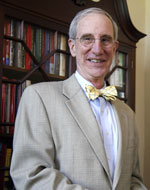 Dr. P. Geoffrey Feiss became the fourth provost of the university in July of 2003. Prior to that he was Dean of the Faculty of Arts and Sciences and Professor of Geology. He received the AB in Geology from Princeton University and the MA and Ph.D. in Geology from Harvard. From 1975 to 1997, he was on the faculty at the University of North Carolina at Chapel Hill, also serving as chair of the Department of Geology and subsequently as Senior Associate Dean of Arts and Sciences. He taught at Albion College from 1970-1975.
 Gillian T. Cell was Dean of the College of Arts and Sciences at UNC Chapel Hill before joining William & Mary as its third provost. She came to love William & Mary and was, herself, beloved and respected while among us. Born near Liverpool, England, Gill graduated from the University of Liverpool with a BA in 1959 and a Ph.D. in History in 1964. She was expert in early British colonial expansion, publishing two books on the subject. She received an honorary doctorate from St. John's University in Newfoundland.
 Melvyn D. Schiavelli was Provost of the university from 1986 - 1993. He was Assistant Professor of Chemistry from 1968-1971, Associate Professor of Chemistry from 1971-1980 and Dean of the Faculty of Arts and Sciences from 1984-1986.
 George R. Healy was a faculty member at the university serving as: Professor of History, 1971-1986; Vice President for Academic Affairs, 1971-1983; Provost, 1979-1986; Acting President, 1985; Professor of History, Emeritus, 1986-; and Acting Director of the Institute of Early American History and Culture, 1990-1992. Healy received the Thomas Jefferson Award in 1987.