 Skip to main content

Building Resilient Food Systems: Permaculture Solutions to African Snail Impacts in Trinidad
Research Location:
Trinidad
Conservation Partners:
Wa Samaki
Faculty Mentors
Dr. Troy WiipongwiiProject Description
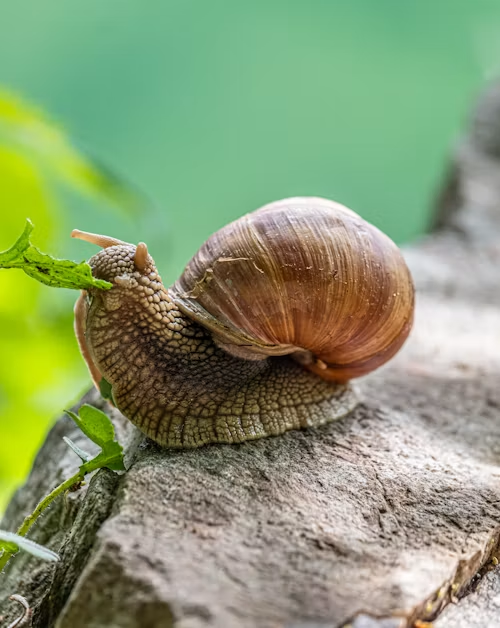
This interdisciplinary student project, conducted in partnership with Wa Samaki Ecosystems, will explore the impacts of the African snail on Trinidad’s agricultural systems and farmer livelihoods, with a particular focus on how permaculture and regenerative agriculture can be used to mitigate its impacts and build more resilient food systems. Students will work closely with Wa Samaki’s partner farmers to understand how the snail affects crops, yields, labor, and livelihoods; interview farmers about their experiences and management strategies; and use GIS and spatial analysis to map impacts and identify environmental and agricultural factors that may influence its spread. At Wa Samaki, Trinidad’s premier permaculture demonstration site with more than 30 years of experience teaching and designing biodiverse agricultural systems, students will investigate how permaculture principles—including biodiversity, crop diversity, ecological farm design, soil health, and integrated production systems—might reduce vulnerability to pest pressures while maintaining food production and supporting farmer livelihoods. Students will collect field data on regenerative systems, including yield-versus-labor measurements, and connect these findings with farmer knowledge and spatial analysis to explore practical strategies for adapting Trinidad’s food systems to the African snail challenge. Wa Samaki will provide on-the-ground knowledge of Trinidad and Tobago ecosystems, facilitate engagement with partner farmers, co-design the curriculum, provide a living field site for research and experimentation, and serve as a training site for agricultural agents, youth, and farmers.Skills and Prereqs
Students should preferably bring complementary skills/backgriound or interests in:
- GIS and spatial analysis, including mapping environmental or agricultural data.
- Agriculture, ecology, biology, food systems, or regenerative approaches.
- Qualitative research and community engagement, including interviewing and working with farmers.
- Field data collection, organization, and analysis.
Travel
Students will travel to Trinidad during the summer research period and undertake local ground travel to Wa Samaki and partner farms. Students should be prepared for long-distance international travel, travel between agricultural field sites, outdoor work in tropical conditions, and potentially long or variable field days involving farm visits, farmer interviews, mapping, and field data collection.
Notes for Applicants
This project is a good fit for students interested in sustainable agriculture, food systems, GIS, community-based research, and conservation. Students should be comfortable with hands-on outdoor work and engaging directly with farmers and community partners, and should bring curiosity, flexibility, cultural humility, and a willingness to learn from local knowledge and agricultural practices.Number of students
TwoProject ID - Format
27-005-27- CRP YearInterested in this project?
Review the CRP application requirements and submit your application by October 25, 2026.