 Skip to main content
Extending Predictive Microbiome Frameworks for Climate-Resilient Eelgrass Restoration
Research Location:
Portsmouth, New Hampshire and Chesapeake Bay, Virginia
Conservation Partners:
W&M Applied Science and Piscataqua Region Estuaries Partnership
Faculty Mentors
Dr. Geoffrey Zahn and Dr. Robert RoseProject Description
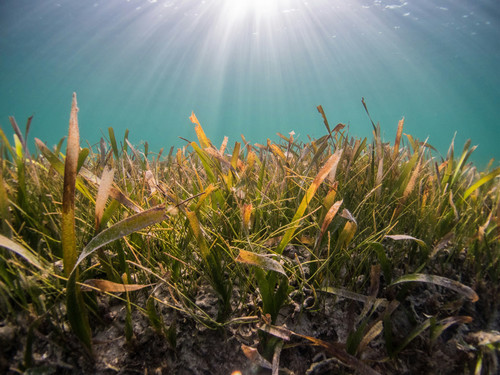
Eelgrass restoration is a key nature-based strategy for strengthening coastal resilience and recovering blue carbon, yet restoration success remains difficult to predict under changing environmental conditions. This project builds on an ongoing Revive & Restore-funded effort to develop a predictive AI framework for determining when microbial inoculations can enhance eelgrass establishment.The current project is generating a high-replication dataset from controlled greenhouse experiments in New Hampshire and Virginia, where donor and resident sediment microbiomes are combined to test how microbial community compatibility influences plant performance. These data will be available in January 2027 and will provide the foundation for training models that predict restoration outcomes based on microbiome interactions.
Two William & Mary students in the IIC’s Conservation Research Team will join this interdisciplinary effort alongside faculty, students, and external conservation partners, including the Piscataqua Region Estuaries Partnership (PREP). Students will investigate how landscape-level climate and biophysical factors—including salinity, sedimentation, and other environmental conditions—are associated with eelgrass establishment, persistence, and restoration success. They will use these insights to develop analyses and design an extension experiment, conducted either in the field or greenhouse, to test whether predictions from the existing AI framework remain robust under environmental conditions relevant to climate change.
Students will then integrate environmental and landscape-level data with results from controlled microbiome experiments to evaluate how different microbial communities perform across varying environmental conditions. This work will help identify the microbiome conditions most likely to support eelgrass establishment under field-relevant conditions and provide an opportunity to test and refine the predictive model beyond the controlled conditions of the initial experiments.
The IIC project will give students hands-on experience connecting microbiome science, ecological experimentation, environmental data, and predictive AI to a real-world conservation challenge. By integrating lessons from laboratory experiments with landscape-level environmental variation and field conditions, students will contribute new data and analyses that can improve model training and decision-support tools for identifying where and under what conditions microbiome-based eelgrass restoration is most likely to succeed. Ultimately, this work will help advance more targeted and effective approaches to eelgrass restoration in coastal systems facing climate change.
Skills and Prereqs
We are looking for one student with Data science background (AI and machine learning) and one student with GIS and Remote sensing skills.
Number of Students
Two
Travel
Students will do both lab work and also fieldwork in New Hampshire and Virginia. This will involve snorkeling or scuba diving to collect samples, so students should be able to swim and should be hearty to handle cold waters (with a wetsuit) in New Hampshire.
Notes for Applicants
This project is a good fit for students interested in marine ecology, microbiology, climate resilience, and hands-on environmental research who enjoy combining fieldwork with detailed laboratory experiments. Students should be comfortable swimming and working in cold water (with a wetsuit), be willing to snorkel or scuba dive for sample collection, and have the patience and attention to detail needed for rigorous laboratory work.
Project ID - Format
27-001-27
Interested in this project?
Review the CRP application requirements and submit your application by October 25, 2026.