 Skip to main content

Exploring Community-led Mitigation Strategies to Prevent Human-Carnivore Conflict in the Western US and Humla, Nepal
Research Location:
Humla, Nepal and the Western USA
Conservation Partner:
Ukali
Faculty Mentors
Dr. Sapana Lohani and Erica Garroutte
2026 Student Researchers
Sarah Bigley '27, Majors: Biology and Environmental Science; 2026 CRPElijah Clark '28, Majors: Environmental Science and Philosophy; 2026 CRP
Past Student Researchers
Ava Fischer '26, Major: Biology; Minor: AnthropologySrija Upadhyay '27, Majors: Biology and French/Francophone Studies
Project Description
W&M students are supporting herder communities in Humla, Nepal to implement human-carnivore conflict mitigation strategies by documenting lessons learned and evaluating the effectiveness of similar strategies used in the western United States.
Human-wildlife conflict poses significant challenges to both the environment and the livelihoods of pastoralist communities worldwide. In Humla, a remote region in northwest Nepal, the coexistence of herding practices and carnivores is increasingly threatened by climate change, degradation of high-elevation rangelands and pasture resources, and evolving herder livelihoods.Local herder communities In Humla have identified the black bear, wolves, and snow leopards as problematic species, responsible for livestock and, occasionally, human fatalities. These conflicts are exacerbated by climate change, ecological shifts, agricultural changes, deforestation, andwildlife habitat disruption. There is an urgent need to understand the drivers of these conflicts and to identify effective mitigation strategies that can ensure both the persistence of carnivore populations and the sustainability of herder livelihoods.
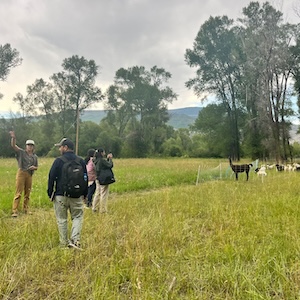
Human-carnivore conflicts are also prevalent in the Western United States, where ranching, farming, and conservation communities have tested a variety of mitigation strategies. These strategies offer valuable lessons that could inform conflict management efforts in Humla. As part of a long-term, community-led research and conservation initiative spearheaded by Ukali, a team of students from W&M and Nepal traveled across Colorado, Wyoming and Montana to interview ranchers, hunters, federal and state agencies, and conservation NGOs to learn about lessons learned and best practices for mitigating human-carnivore conflict. The lessons learned from western communities will be shared with herder communities in Humla, Nepal to support their mitigation efforts. And the connections made between herders and ranchers in the US and Nepal will enable a cosharing of strategies and support. In 2026, Elijah Clark and Sarah Bigley will work with Ukali to continue to interview ranching communities in Colorado, Wyoming and Montana about how to specifically implement and evaluate mitigation efforts to support the real-time piloting of mitigation efforts in Humla, Nepal.
Project ID - Format
25-011-25-26 - CRP Year