 Skip to main content


Exploring Community-led Mitigation Strategies to Prevent Human-Carnivore Conflict in the Western US and Humla, Nepal
Research Location:
Humla, Nepal and the Western USA
Conservation Partner:
Ukali
Faculty Mentors
Dr. Sapana Lohani and Erica Garroutte
2025 Student Researchers
Ava Fischer '26, Major: Biology; Minor: AnthropologySrija Upadhyay '27, Majors: Biology and French/Francophone Studies
Project Description
W&M students are supporting herder communities in Humla, Nepal to implement human-carnivore conflict mitigation strategies by documenting lessons learned and evaluating the effectiveness of similar strategies used in the western United States.
Local herder communities in Humla have identified black bears, wolves, and snow leopards as the primary species responsible for livestock losses and, in some cases, human fatalities. These conflicts are intensified by ecological changes, deforestation, agricultural transitions, and the disruption of wildlife habitats. There is an urgent need to better understand the drivers of these conflicts and to identify effective, community-driven strategies that can protect carnivore populations, keep human communities safe, and sustain the livelihoods of herders.
Similar human-carnivore conflicts exist in the western United States, where ranchers, farmers, and conservationists have developed and tested a variety of mitigation strategies. These efforts offer valuable lessons that could inform conflict management in Humla.
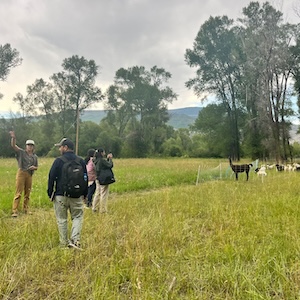
As part of a long-term, community-led research and conservation initiative led by Ukali, a team of students from William & Mary traveled across Colorado, Wyoming, and Montana to interview ranchers, hunters, government agencies, and conservation organizations. They documented lessons learned and best practices for managing human-carnivore conflict in the Western United States to inform direct implementation of mitigation strategies in Humla, Nepal that balance ecological and economic needs. The insights gathered from these communities in the American West are being shared with herders in Humla to inform locally relevant mitigation efforts, and the connections formed between herding communities in Nepal and ranching communities in the U.S. will help facilitate the co-sharing of strategies, tools, and mutual support.
In 2026, two William & Mary students will be invited to continue this work with Ukali by conducting further interviews in the western U.S., focusing on how mitigation strategies can be effectively implemented and evaluated to support real-time piloting of efforts in Humla. This will include identifying a few key mitigation strategies, like flaggery, electric fencing or early warning detection devices, that could potentially be used in the Humla context. Students will apply lessons learned from interviews in the American West and will work with Ukali to design an experiment to test mitigation strategies and will help evaluate the success of the mitigation using camera traps. Further, students will have an opportunity to work directly with ranching communities in the Western US to identifying the factors that need to be considered when implementing mitigation strategies, which will provide useful exchange of expertise between herder and rancher communities in the US and in Humla, Nepal.
2026 Prerequisites and Required Skills
We are looking for one student with computer programming and engineering skills, preferably a student who has experience in the W&M Makerspace developing low-cost tools. This student will help with designing mitigation tools that are low cost and effective for herders in Humla, Nepal.
We are hoping the second student will have sociological research experience.
None of these skills are required, but would just be beneficial. We are mainly looking for students who are willing to take on complex challenges and who like to work with people.
2026 Travel Required
Travel to Colorado, Wyoming and Montana over the summer. This will involve camping and working on ranches learning mitigation techniques as well as conducting interviews with ranchers, hunters, and conservation organizations across the region.Notes for 2026 Applicants
This is a good project for students who enjoy working with people.Project ID - Format
25-011-25-26 - CRP Year