Skip to main content
Revolutionary Transformations
A new tour telling stories of William & Mary in the era of American independence
Under the direction of Dr. Robyn Schroeder, students in HIST 413 (Fall '25, Fall '26) and HIST 312 (Spring '26) have written a new campus tour in commemoration of the semiquincentennial of the United States.
There are more revolutionary stories among us than are usually told. William & Mary College—as it was often called at the time—stayed open even as some of its faculty fled Williamsburg with the last royal governor of Virginia, even as students formed volunteer militias in service of the Patriot cause, and while rising tides of republicanism and financial straits caused a raft of unforeseen changes.
Still in operation as a school, the Wren Building hosted the fourth Virginia revolutionary convention from December 1, 1775 to January 20, 1776, coinciding with the Battle of Great Bridge and the burning of Norfolk. The era saw students form new societies for debate and conviviality, even as the college closed its divinity school, grammar school, and the Brafferton Indian School, and sold its plantation, the Nottoway Quarter, and many enslaved people. The college buildings withstood gunfire as continental soldiers fired on British troops at Confusion Corner during the 1781 invasion of Virginia. At war’s end, the college closed as the whole city, campus inclusive, transformed into a site of preparation for the siege of Yorktown, after which the Wren Building become a French military hospital while the interior of the president’s house was destroyed by fire.
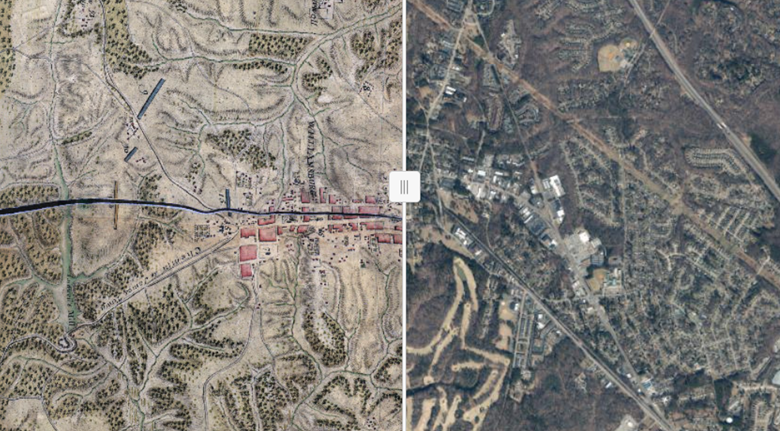
NIAHD students have reviewed old and done new research to help us tell these fascinating stories in human terms—of undauntable student soldiers, nervously Loyalist professors, and unruly children at the grammar school; of enslaved people working among former Burgesses making a new Virginia government; of Native people like the Pamunkey Patriot Robert Mursh and the maverick John Montour; of French soldiers, surgeons and engineers, some of them casualties of the American war for independence; and of everyday soldiers who served under icons like Baron von Steuben and the Marquis de Lafayette, who drilled troops on campus before marching them to Yorktown. Student research into the specific location of the College Camp, a military training site a short distance from the colonial college, done in collaboration with the Center for Geospatial Analysis, was featured in January 2026 on C-SPAN.
The public tour, Revolutionary Transformations at William & Mary, which debuted in March 2026, sees the history of this place as being for everyone: stories of everyone who was here then, for everyone who arrives here now. The tour also offers a chance to meet members of the next generation of museum professionals and public historians, as undergraduates at William & Mary learn to research, write and tell these stories in the present and preserve them for the future. We can't wait to share this history with you!
Full tour information, and tour sign-ups, can be found through the tour website:
Revolutionary transformations - TOUR INFORMATION & SIGN UP