 Skip to main content

On paying attention: a conversation with 24th U.S. Poet Laureate, Ada Limón
“Everything about poetry begins with paying attention,” said Ada Limón, the 24th U.S. poet laureate, in an interview with the College of Arts & Sciences. For Limón, poetry is not only an art form but also a mode of conversation, one that invites readers to slow down, listen closely, and engage more deliberately with the world around them.
Limón will bring this intentionality when she visits the William & Mary campus for a poetry reading on Feb. 10 as part of the College of Arts & Sciences Open Inquiry Speaker series, a biennial program that brings transformative speakers and organizations to campus to engage with diverse perspectives and enhance community dialogue. Her visit comes as W&M concludes the Year of the Environment. 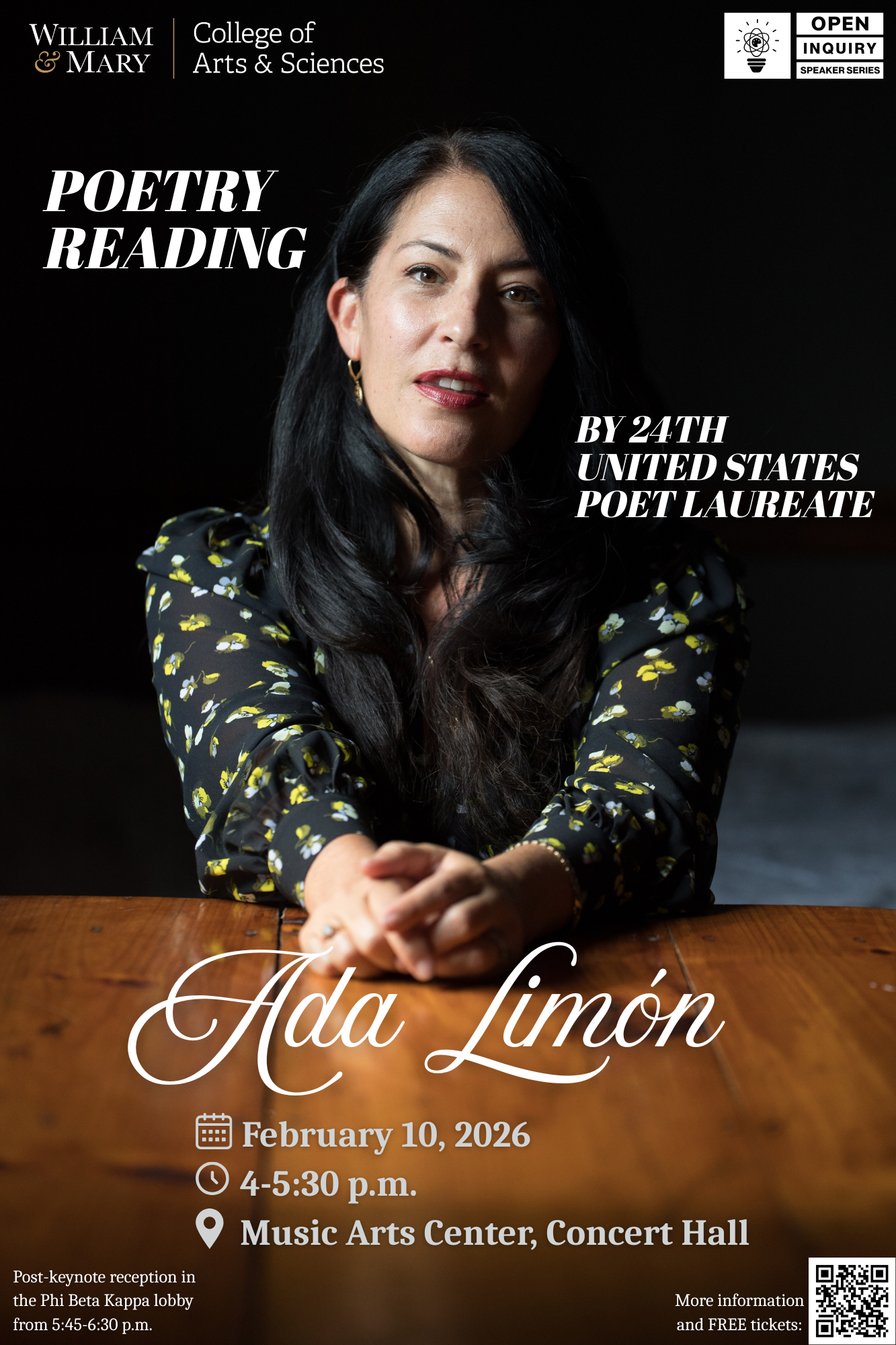
Named a Woman of the Year in 2024 by Time Magazine and the recipient of a MacArthur “Genius” Fellowship, a Guggenheim Fellowship, and a National Book Critics Circle Award, Limón is the author of seven poetry books, most recently “Startlement: New and Selected Poems.” She served as the 24th U.S. poet laureate from 2022 to 2025.
Before the poetry reading at 4 p.m. in the Concert Hall of the Music Arts Center, Limón will lead a poetry workshop open to the W&M community from 10-11:15 a.m.
Limón recently spoke with the College of Arts & Sciences before her visit to campus, sharing thoughts on poetry and its importance to the world and to college students.
Q: The Open Inquiry Speaker Series brings transformational organizations and speakers to the William & Mary community to explore shared values, engage with diverse perspectives, and enhance the success of our teaching and research practices through community dialogue and collaboration. What part of the series resonates with you the most? How do you see poetry as a form of inquiry or tool for conversation?
A: I’ve always said that poetry really exists in the questions. It’s not about answers. It’s not about certainty. It’s about leaning into the mystery, leaning into the unknowns—making space for many different possibilities of being. I think poetry is the perfect venue for this speaker series because it is really an art form that is about interrogation, and what you’re doing is asking yourself and the world the big-ticket questions about how does one exist on this planet in this moment, at this time.
Q: The idea of the “ampersand” at William & Mary encourages students to explore not only their intended field, but to explore broadly across science and the arts. How do you think poetry as a form of art is significant to the overall development of a college student and perspective on the world in general?
A: I think that creative writing, and in particular poetry, is really essential to the development of young minds. I think that we’ve always done a huge disservice when we’ve split the arts and the sciences because they were always meant to be connected. In fact, I think it’s very dangerous when we have science without the arts, because in many ways, the arts are the soul; the arts are the heart, and they’re where we develop our skills for empathy, our skills for living in someone else’s life, and seeing a world through a broader lens. Science is also a part of interrogation; it’s a part of questions. So they really begin in the same place.
I think poetry is especially important, partly because it is not just an art form, but it’s also a way of looking at the self and figuring out what it is that is running through the self all day long. That sort of inner chatter—that thing that’s never quiet, the voice underneath the voice. Poetry allows us to find that, to slow down enough, to listen. You really begin to embody your own self in the world in a different way when you experience both the reading and the writing of poetry.
Q: Before the poetry reading on Feb. 10, you will lead a poetry workshop open to the W&M community. What can attendees expect?
A: I think there’s such an essential part of gathering right now. I will primarily work with people on making new poems, and I’m really hoping that people come away with seeds of poems and some little spring starts that might flourish into adult poems. But it’s really about gathering, about being in the same place, and starting to understand the rhythm and breath and the noticing of the natural world that we sometimes ignore and need to lean into when we are writing poems.
Q: William & Mary’s campus, steeped in history, is very grounded in its strong sense of place. How does place, whether physical, emotional, or historical, shape the way you approach a poem?
A: I think place is essential to not just how we approach a poem, but how we approach our lives. Everything about poetry begins with paying attention. Sometimes, all it takes is looking out the window and noticing what is going on in your inner life around you. I think it’s important if we just take a moment to recognize where we are in space and time. It’s important to situate ourselves and recognize that not only are we in a place, but that we are connected to others and that everything is connected.
One of my main projects while serving as poet laureate was a book called You Are Here, and also a project called You Are Here, Poetry in the Parks, and a lot of it was just to remind us that we are here on this planet in a place we are living. I think so much of our lives are spent in this sort of ethereal, virtual world, and it’s incredibly important to ground ourselves in our bodies and on the physical ground on the planet. Place is essential to not just my way of writing, but my way of being.
Q: Your work has covered a range of themes, including place, the environment, poetry as refuge, kindness, etc. Are there specific topics that are most salient for you as you prepare to visit W&M?
A: I think that the big topics that run through my work are really the big topics of most people’s lives, which is this “how do we live in a world where we lose, eventually, ourselves and everything we love” and the recognition of our mortality. I think that is essential to my art, because in that recognition of our own eventual demise is the recognition of the incredible importance of this moment. I think that we can lose sight of that when we think of ourselves as invincible. I think that a lot of what I deal with in my work is how to remain present, how to pay attention, and how not to miss this living moment that we are all in together experiencing on the planet. 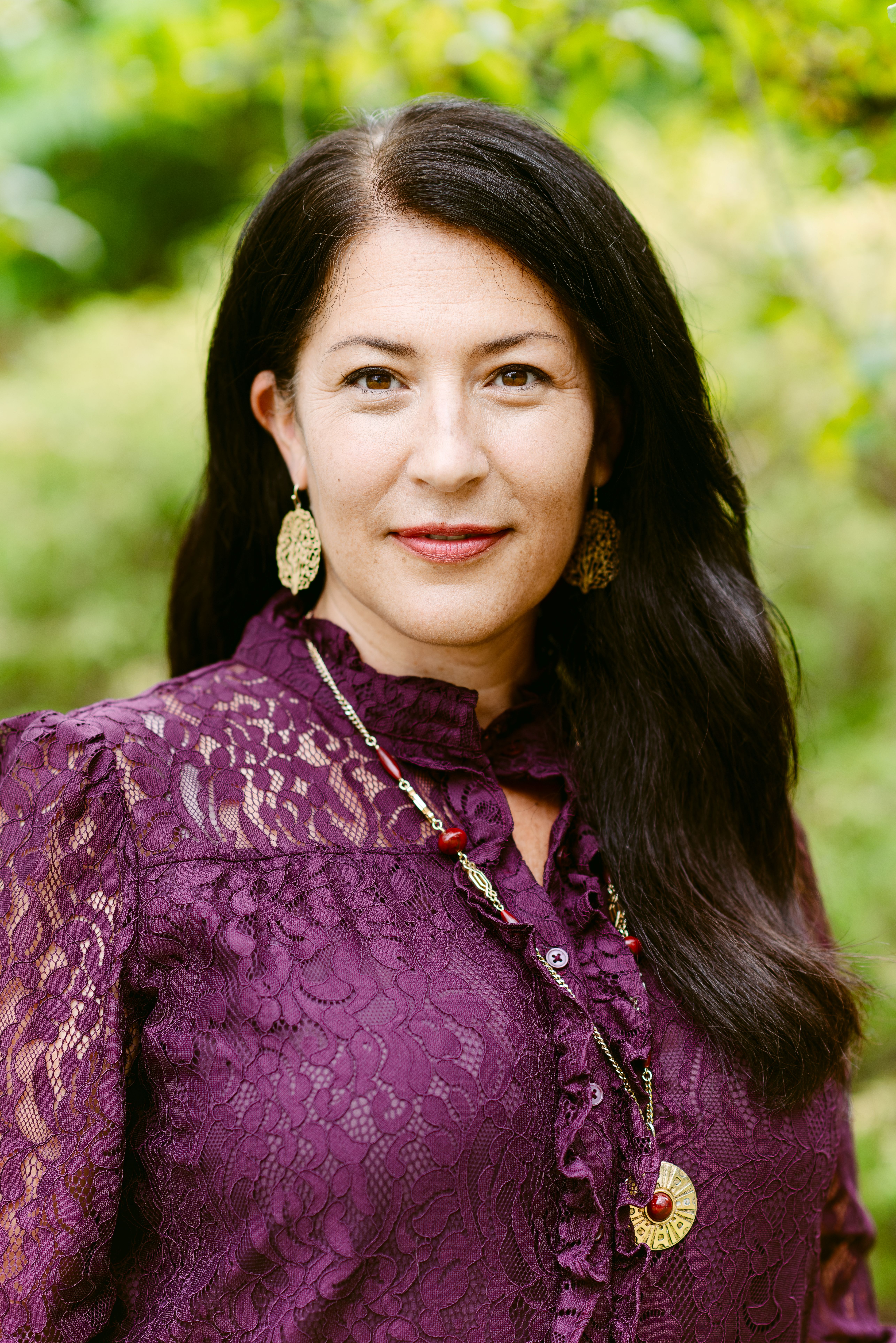
Q: College is a coming-of-age time for young adults. How has poetry helped you discover parts of yourself as both a writer and as a person in ways similar to how university life pushes students to grow?
A: I think that poetry is so essential to who I am in many ways and I think that there’s a moment when you find poems that you realize that you’re not alone in the world. I don’t think it’s necessarily a mirror looking back at you, but it does seem like a place to stand in, a place to live in where you can be your most free self. When you’re writing, you’re creating this sacred space which you can’t really create in our physical world… but we can make a safe space for us in our imagination on the page. I did that and began quite young, writing poems, and I think that what it has done is foster my imagination, my curiosity about human condition and the big “whys” of our lives.
I think that what it’s fed me has always been a grounding in bravery and courage. Even when I feel the most vulnerable and I’m writing, what comes from it is a braver self and a freer self. For me, poetry is someplace where I go to interrogate, but also sometimes where I go to lay something down—where I think, you know what? I’m going to lay this down for a little bit so that I don’t have to hold it all, the page can hold it all. I think it’s shifted me similar to an education; it’s shifted me to regain and recenter my power as a woman, as a Latina, and I feel that is really essential to all of our lives is to find ways that we can recenter and reclaim our power.
Q: What do you hope the audience will take from the poetry reading?
A: My biggest hope for all of us—not just the audience—is to remember that we are powerful, that we are kind, that there is good in humanity. I think so often we are just witness to a barrage of cruelty and chaos, and I hope that this is a moment we can gather and celebrate what is good in us and not lose sight of that, and to go away from it feeling bravery, stronger, and clinging on to not just hope, but to action.
Q: What pushed you to take your voice seriously as a poet, and what might help students give themselves that same push and certainty?
A: I think it’s really hard to find permission in the world to be an artist. There’s a lot of fear about how you make a living and also make art and stay true to that free self that wants to play, experiment, and spend time with the imagination. I was lucky enough to have a mother who was a painter, so she gave me a great deal of permission. My stepfather was an author who also took my voice very seriously and would always talk about the importance of what I was doing. My father is also a very artistic soul and writer, so I feel like even though they all had different ways of looking at the world, I was encouraged to see the importance of making something.
I hope that more and more, we can inspire young people to give themselves permission to write poems, make art, and to play because I think we need to foster the imagination more than we ever have. I think we’re living in this sort of strange time where everything feels inevitable, and we need to open ourselves up to the possibility of “we don’t know the ending to this story.”
I feel really lucky that I had people in my life that gave me the permission to take myself seriously, to take my art seriously, even when I failed and wrote terrible poems. I think a really important thing to do is to encourage all of us to foster that sense of imagination and that sense of making because it’s not only remaking the self and writing ourselves into the world, but it’s [also] remaking the world.
For more information about the Open Inquiry Speaker Series and to reserve tickets, visit here.