 Skip to main content

Environmental Factors Affecting Stream Salamander Distribution in the Lake Matoaka Watershed
Kara SantaLucia ’23
In the Southeastern United States, small, low-order streams are commonly home to a number of stream-dwelling salamanders. Salamanders of the Plethodontidae family make use of aquatic stream habitat during both stages of their biphasic life cycle, but especially during their larval stage when they are fully aquatic. In this study, I sought to examine the relationship between salamander abundance and various physical, biological, and chemical factors. I sampled 72 sites within nine streams located in the Lake Matoaka watershed of Williamsburg, Virginia and evaluated environmental factors at each site, including temperature, conductivity, dissolved oxygen, stream morphology, bottom characteristics, nutrient content, and the presence of other organisms. I also completed length measurements for each of the captured salamanders using digital image analysis.
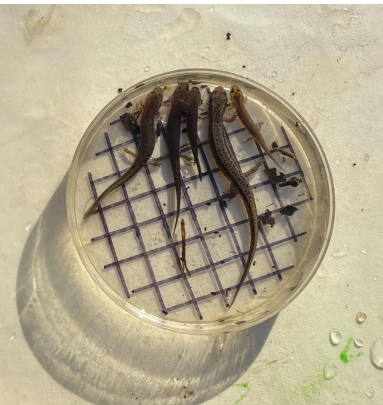
Salamander larvae, likely belonging to the species Eurycea bislineata, were present in all nine streams, but their abundance and individual sizes varied. Using logistic regression and AIC model selection, I found that leaves, roots, channel volume, nitrate and the normalized difference vegetation index (NDVI) are the best predictors of salamander abundance out of the factors evaluated, while volume, nitrate, and amphipods are the best predictors of salamander size. These results indicate that salamander distribution patterns are influenced by multiple interacting factors, which are important to consider in the face of land use changes and increasing urban development.

Kara's work is available as an honors thesis in biology here.