 Skip to main content

Ecology Facilities
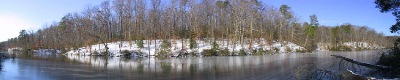
Lake Matoaka and Keck Environmental Field Lab
The William & Mary campus is home to a remarkable mix of aquatic and terrestrial habitats, supporting a rich variety of plants and animals typical of the southeastern coastal plain. Lake Matoaka, nestled within the Chesapeake Bay watershed, serves as both a living laboratory for aquatic ecology courses and a hub for outdoor recreation—canoeing from the boathouse is a favorite pastime.
Right next to the lake, the Keck Environmental Field Lab gives students and faculty everything they need for hands-on fieldwork and in-depth research. The facility comes equipped with canoes, a wet lab with aquatic tanks, a fully outfitted analytic lab (complete with elemental analyzers and a fume hood), a walk-in cold room for storing samples, a GIS computer suite, and a conference room set up for videoconferencing.
The College Woods and Wildflower Refuge
Beyond the lab, the College Woods stretch out as the largest unbroken tract of second-growth forest still standing in Williamsburg. Researchers here aren’t limited—they can investigate everything from untouched forests and streams to freshwater lakes and tidal wetlands.
Back on the main campus, the Wildflower Refuge forms a living bridge between Crim Dell and the College Woods. This protected area shelters native plants rescued from development sites across the region, a mission formally backed by the College’s Board of Visitors.
For more details about the Keck Lab, College Woods, or Lake Matoaka, reach out to Randy Chambers.