


Washington Hall
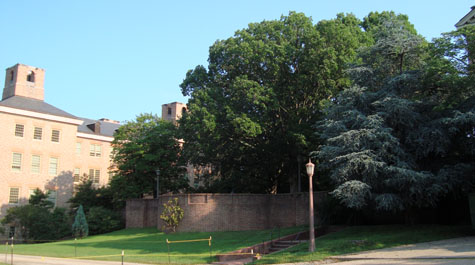 Cedrus atlantica glauca The Blue Atlas Cedar (right), at the southwest corner of Washington Hall.
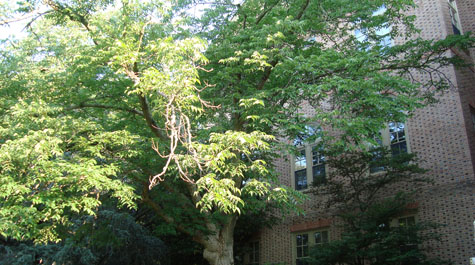 Phellodendron amurense Amur Corktree.
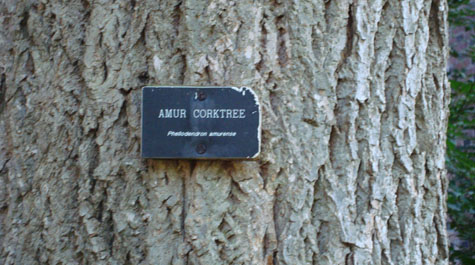 Phellodendron amurense Closeup of the Corktree, showing its distinctive bark.
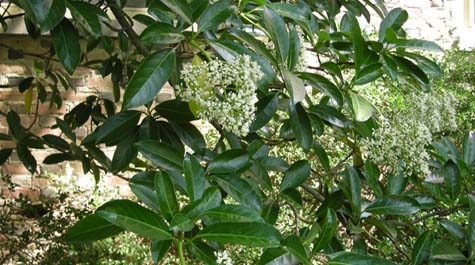 Camellia sp. Delicate white blossoms appear on this Camellia in early June.
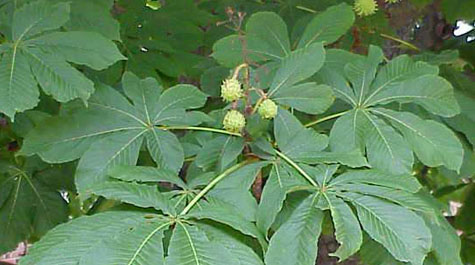 Aesculus hippocastanum The leaves and immature fruit of the Horse Chestnut.
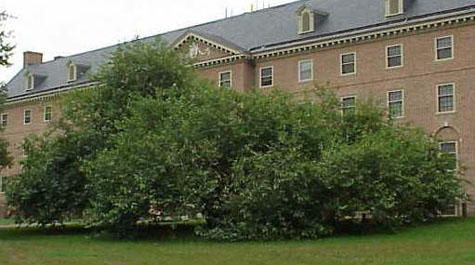 Morus alba A low, spreading White Mulberry, framed by Jefferson Hall.
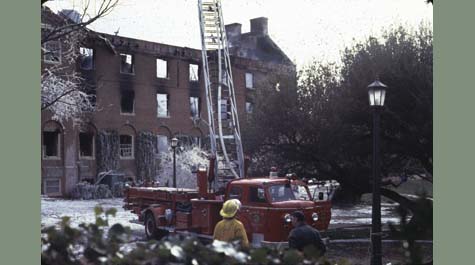 1983 The Mulberry tree largely escaped damage in the 1983 fire at Jefferson Hall.
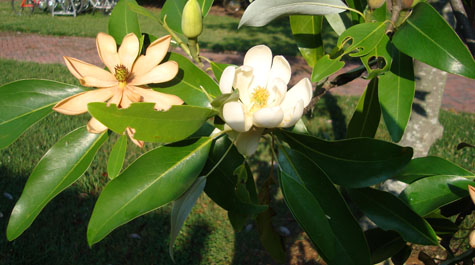 Magnolia virginiana Sweetbay Magnolia.
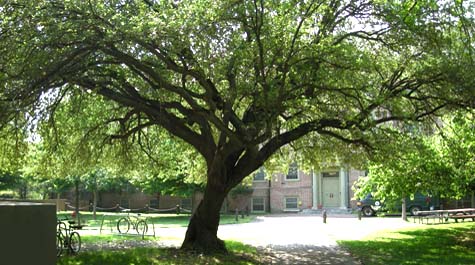 Quercus virginiana The Live Oak is prized for its graceful, spreading habit.
Note the cluster of trees at the southwest corner of Washington Hall, which include a magnificent blue atlas cedar (Cedrus atlantica glauca), amur corktree (Phellodendron amurense), and camellia (Camellia sp.). The corktree is native to China. Close by is a horse chestnut (Aesculus hippocastanum).
The area to the south of Washington Hall features a number of interesting species. A most unusual and rarely seen oak is the loquat oak (Quercus rysophylla), introduced into cultivation from Mexico in the 1970s. This semi-evergreen oak has oval-shaped elongated leaves with sunken and pronounced veins that are quite striking, reminiscent of the true loquat tree that you will see later. You may not have known that this is an oak except when it produces the characteristic acorn fruit. It has been singled out by an International Horticultural Society publication as a tree of the year (2016).
Another spectacular specimen in this area is a mature white mulberry (Morus alba). White mulberries were introduced into this area in colonial times to feed silkworms as a possible industry. The silkworms did not find the climatic conditions hospitable, but the white mulberry is now a common tree that is invasive. This specimen, however, may be one of the largest and oldest specimens of its kind in the United States. It is also widely spreading which is more typical of the black mulberry which makes this tree even more unusual. Luckily, it survived the Jefferson Hall fire in 1983. Another spreading tree is the live oak (Quercus virginiana) planted here and other places on campus. It is also an evergreen oak but native to the southeastern United States. This species was among one of the first cultivated species planted on the campus.