 Skip to main content

Crim Dell
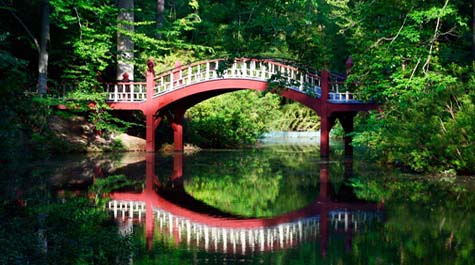
Crim Dell Bridge
The most photographed (and romantic) spot on campus.
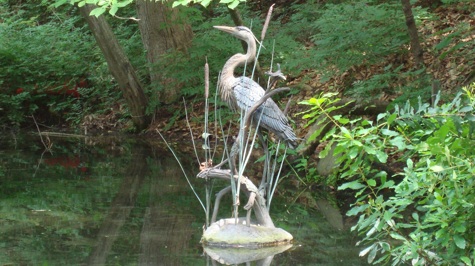
Great Blue Heron with Marsh Wren and Turtle
By {{https://nationalsculpture.org/news-events/turner-honored/,David H. Turner '83}}, donated by Ben Field '57.
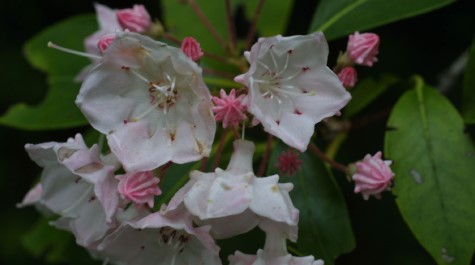
Kalmia latifolia
The mountain laurels show off spectacular open flowers and buds in May.
Steven J. Baskauf http://bioimages.vanderbilt.edu/
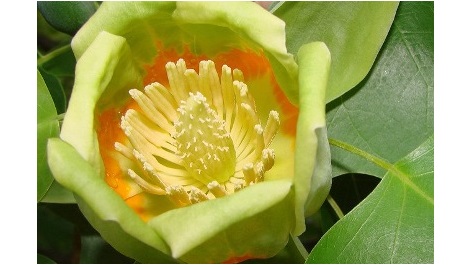
Tulip tree flower
by {{https://www.flickr.com/photos/martinlabar/,Martin LaBar}}, {{https://creativecommons.org/licenses/by-nc/2.0/,(CC BY-NC 2.0)}}
Steven J. Baskauf http://bioimages.vanderbilt.edu/
History and Tradition
Dedicated in May 1966, Crim Dell was preserved by President Paschall to fulfill the vision of a natural campus heart. The area is named for John W.H. Crim (Class of 1901), and the famous bridge was a gift from the Class of 1964.
Campus Lore: It is said that two people crossing the bridge while holding hands will be lifelong friends—and if they share a kiss, they will be lifelong lovers.
The Path to the Bridge
The approach to the bridge features a blend of native and cultivated species:
- Mountain Laurels (Kalmia latifolia): Known for their spectacular May blooms.
- American Beech (Fagus grandifolia): Large trees with distinctive smooth gray bark.
- Tulip Poplar (Liriodendron tulipifera): A stately tree near the bridge that produces nectar-rich flowers and a unique natural antibiotic.
Native Vegetation and Wildlife Support
Across the bridge, the landscape transitions into hardy native species:
- White Oak (Quercus alba): A regional staple with pale, shredding bark and durable wood.
- Yaupon Holly (Ilex vomitoria): A moisture-tolerant shrub that provides critical food for local wildlife through its bright berries.
- Restoration: The eastern end is currently undergoing restoration to remove invasive bamboo and return the area to its native state.
Art in the Meadow
At the western end of the water, look for the bronze sculpture:
- Featured Artwork: Great Blue Heron with Marsh Wren and Turtle by David H. Turner ’83.
- Fun Fact: After Hurricane Ernesto in 2006, the sculpture was lost and later found at the bottom of Crim Dell. It was reinstalled in the water based on the recommendation of Biology Professor Martin Mathes.